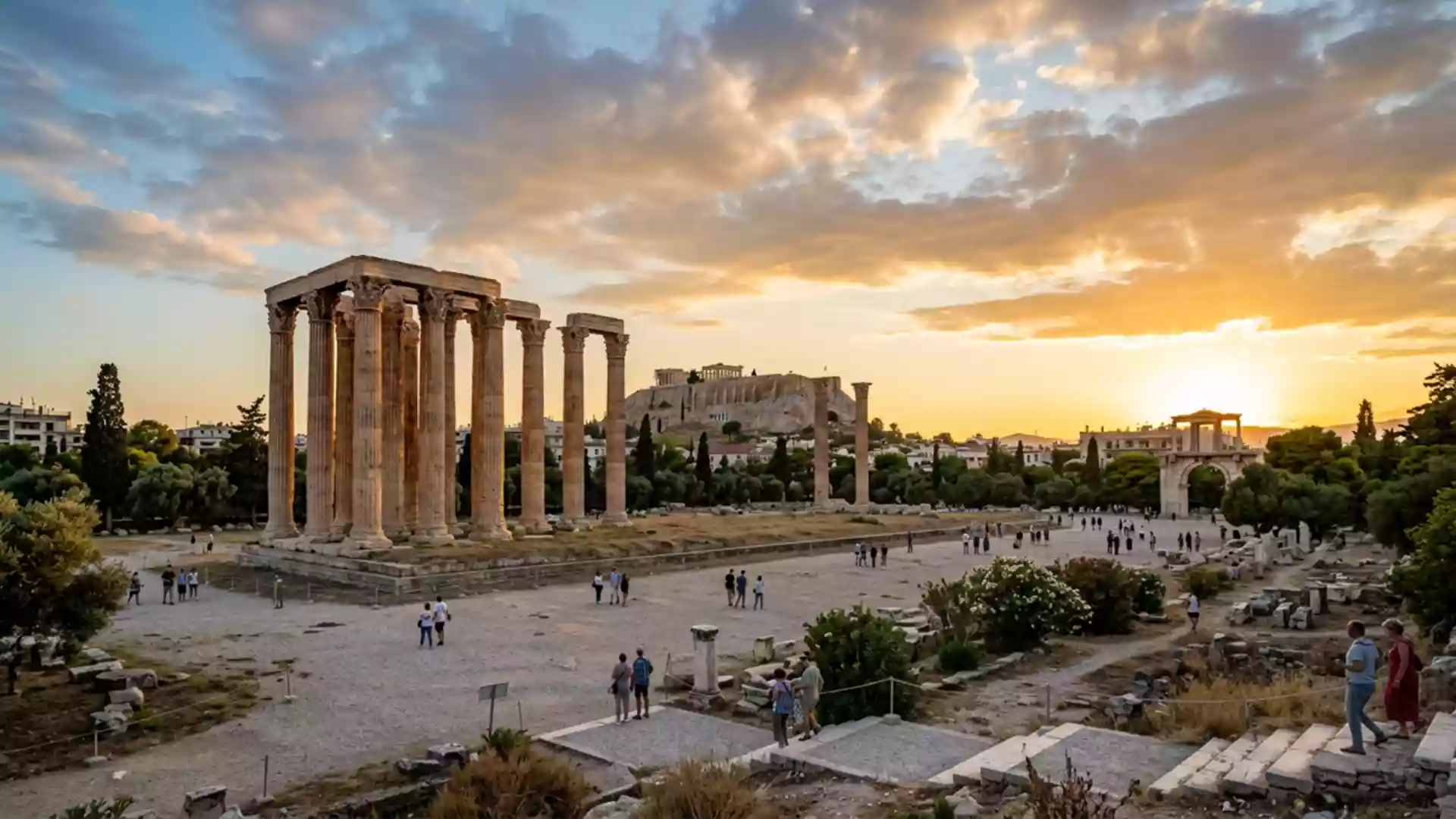
Naos tou Olympiou Dios and its marble columns in Athens
Published on 09/03/2026 at 17:02 | Editorial responsibility: Rafael Müller, Editor-in-Chief AD HOC NEWS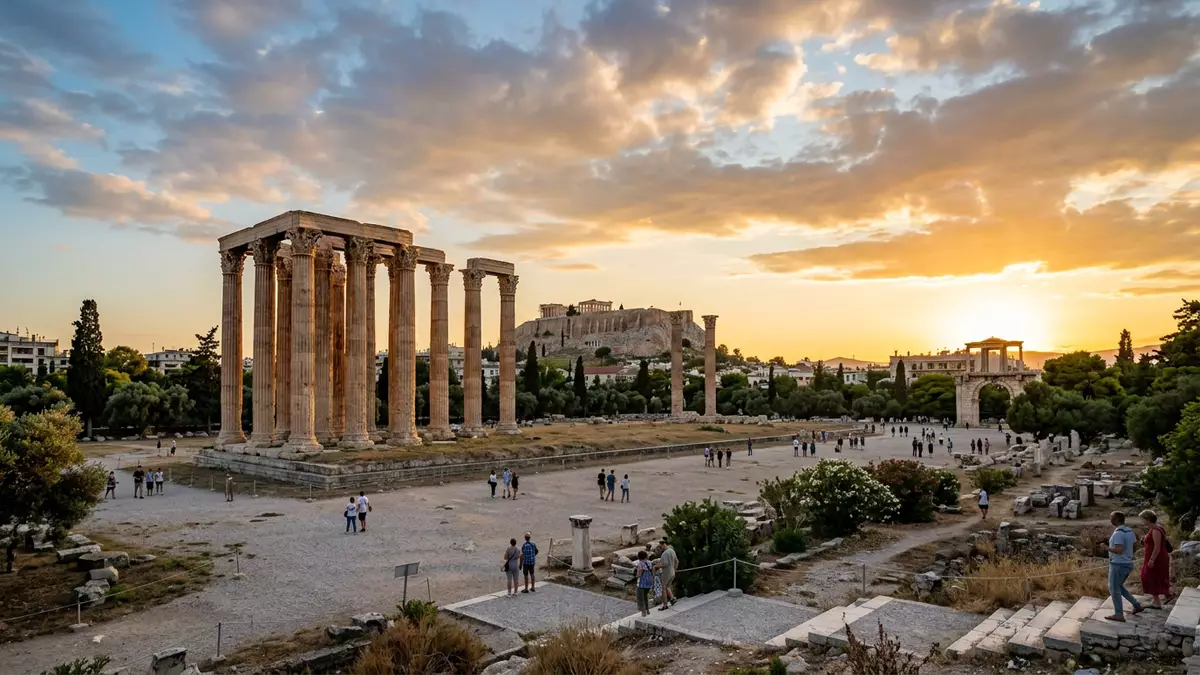
Naos tou Olympiou Dios in Athen is the ruined Temple of Olympian Zeus, a vast classical precinct dominated by surviving Corinthian columns. Its long building history runs from the sixth century BC to completion under Hadrian in the second century AD.
Corinthian columns in a Roman finish
The temple’s best-known feature is its scale in fragments: a row of tall marble shafts, open sky above, and a plan that once enclosed a much larger sacred space. The Roman finish under Hadrian gives the ruin its present character, even though the project began in an earlier Greek ageRoman finish under Hadrian.
Antiochus IV Epiphanes and the Roman architect Decimus Cossutius belong to the temple’s Hellenistic phase, when the design moved towards Corinthian splendour. The same long sequence of building, delay and completion gives Naos tou Olympiou Dios its unusual historical depthAntiochus IV Epiphanes.
From sanctuary to ruin
Naos tou Olympiou Dios stands as a temple to Zeus, and the dedication remains central to its identity. The monument is also tied to Hadrian, whose final completion of the work belongs to the second century AD and marked the temple’s Roman chapterfinal completion of the work.
What survives is enough to show the difference between the planned monument and the ruined site that visitors meet today. The standing columns and the surrounding archaeological precinct keep the temple legible as an ancient public monument in central Athen.
What survives on the site
The remains consist chiefly of columns, foundations and open ground, with the Arch of Hadrian nearby at the north-west corner of the precinct. The temple’s marble fabric and ruined state make the site read as architecture rather than reconstruction.
The sanctuary formed part of the ancient city’s sacred landscape south-east of the Acropolis. That position gives it a direct relationship with the larger topography of ancient Athen, even when viewed as a ruin rather than a functioning templesouth-east of the Acropolis.
Visiting Naos tou Olympiou Dios: what travellers from Western Europe should know
- The site lies in central Athen, south-east of the Acropolis and close to the Arch of Hadrian. It is reached on foot from the surrounding historic district.
- The ground is level, but the remains are spread across an open archaeological area. Marble columns and scattered fragments set the main rhythm of the visit.
- English is not an official language in Greece, and the currency is the euro.
- Entry requirements depend on your nationality; UK travellers can check the FCDO travel advice at gov.uk/foreign-travel-advice, Irish travellers the Department of Foreign Affairs at ireland.ie.
- The temple belongs to the unified archaeological sites of Athen. Its setting links it with other ancient monuments in the same urban landscape.
Searching for Naos tou Olympiou Dios on social platforms
These links open searches for Naos tou Olympiou Dios on each platform.
Frequently asked questions about Naos tou Olympiou Dios
Where is Naos tou Olympiou Dios?
It stands in central Athen, south-east of the Acropolis. The Arch of Hadrian sits close by.
What does a visit involve?
The site is an open archaeological area with standing columns and ruined masonry. It reads as a temple precinct rather than an intact building.
What makes it distinctive?
Its mixture of sixth-century BC origins, Hellenistic intervention and Hadrianic completion gives it an unusually layered history. The surviving Corinthian columns still dominate the place.