
Naos tou Olympiou Dios and Athens’ marble colonnade
Published on 09/16/2026 at 20:29 | Editorial responsibility: Rafael Müller, Editor-in-Chief AD HOC NEWS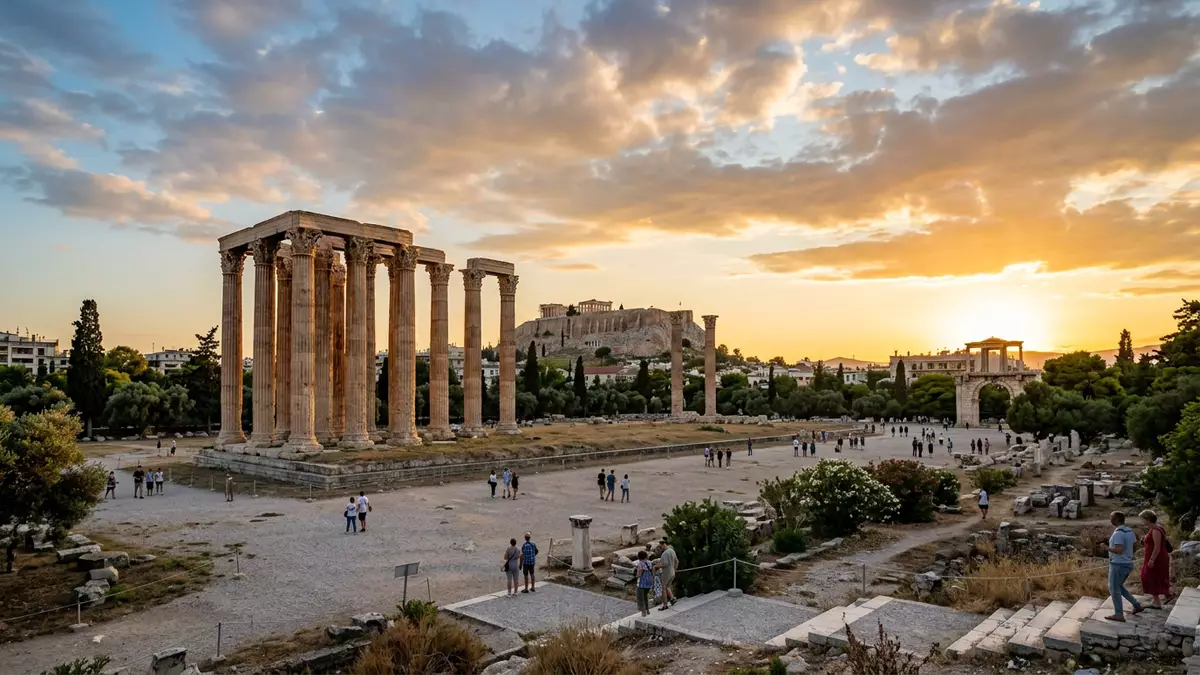
Naos tou Olympiou Dios is one of central Athens’ most recognisable ruins, a field of marble columns standing in the open beside the city’s main routes. Its story reaches from the sixth century BC to the reign of Hadrian, and that span is visible in the monument’s layered form.
Naos tou Olympiou Dios and the scale of a ruined temple
The temple is also known as the Temple of Olympian Zeus, and its ancient Greek name is preserved in the modern form Naos tou Olympiou Dios. It stands in Athens, south-east of the Acropolis, as a surviving fragment of a once vast sanctuary.
The most immediate feature is its row of tall Corinthian columns, now isolated against sky and traffic. The ruin keeps the temple’s scale legible even without a roof or cella, and the marble shafts still define the ground plan.
From the sixth century BC to the Roman period
The sanctuary began in the sixth century BC under the Athenian tyrants, then passed through a long sequence of interruption and renewal. Antiochus IV Epiphanes resumed the project in 174 BC, and Roman influence gave the temple its final monumental form.
The completed building belonged to the Corinthian order, with Pentelic marble replacing the earlier planned material. Completed under Hadrian in 131 AD, it linked an archaic Athenian foundation with Roman imperial finish.
The columns and the precinct today
Sixteen columns remain associated with the monument, and one lies fallen on the ground. The ruin sits within an open archaeological precinct, where the surrounding space is part of what the visitor reads as the site.
The nearby Arch of Hadrian belongs to the same historical landscape, placing the temple within a wider Roman frame in central Athens. The contrast between the surviving marble and the urban setting gives the place its force without needing any reconstruction of the original whole.
Visiting Naos tou Olympiou Dios: what travellers from Western Europe should know
- Naos tou Olympiou Dios lies in central Athens, south-east of the Acropolis and close to major city streets and public transport corridors.
- The site is open ground with gravel and uneven stone underfoot, and the ruined columns are spread across a broad enclosure.
- The Acropolis and the Arch of Hadrian are nearby, so the temple sits within a dense historic district rather than an isolated monument.
- The official language is Greek and the currency is the euro.
Searching for Naos tou Olympiou Dios on social platforms
These links open searches for Naos tou Olympiou Dios on each platform.
Frequently asked questions about Naos tou Olympiou Dios
Where is Naos tou Olympiou Dios in Athen?
It stands in central Athens, south-east of the Acropolis, in a district of major monuments and main roads.
What does a visit to Naos tou Olympiou Dios involve?
It means walking through an open ruin with standing columns, fallen marble and long views across the archaeological precinct.
What makes Naos tou Olympiou Dios distinctive?
The temple combines a sixth-century BC beginning, a Roman completion under Hadrian and a surviving colonnade of Pentelic marble.


