
Namib Desert at Sossusvlei and its towering rust?red dunes
Published on 09/19/2026 at 16:26 | Editorial responsibility: Rafael Müller, Editor-in-Chief AD HOC NEWS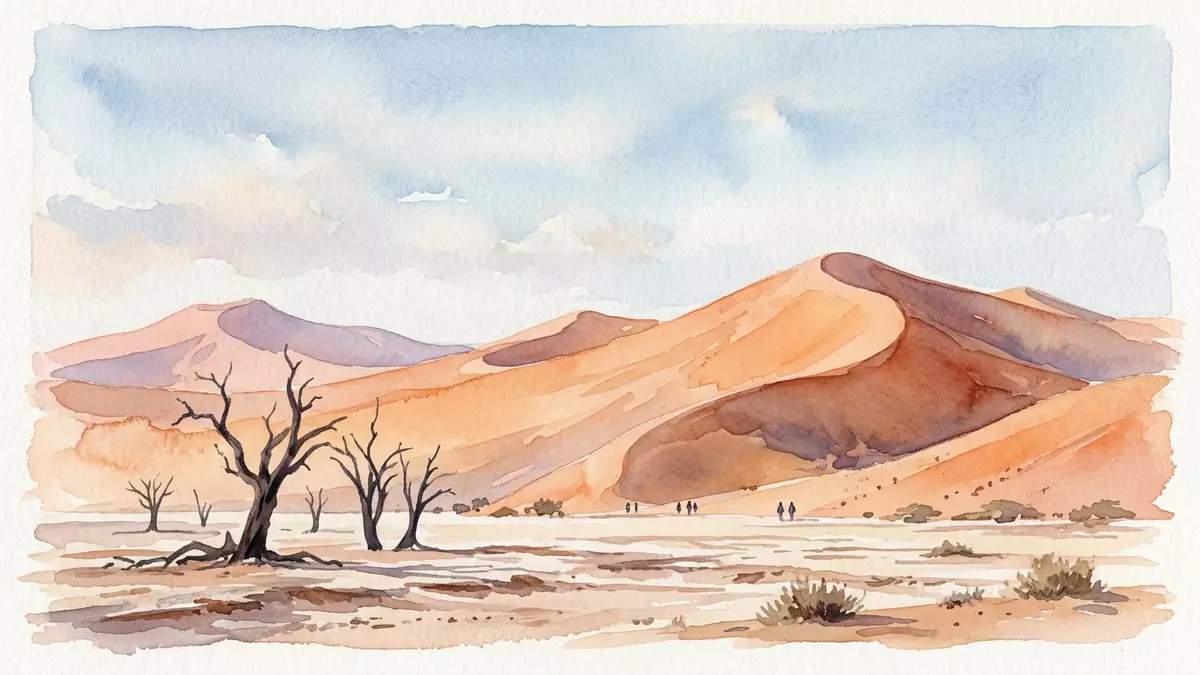
The Namib Desert around Sossusvlei presents one of the starkest desert landscapes on Earth, where rust?coloured dunes rise above pale clay pans inside Namibia’s vast Namib?Naukluft National Park. This section of the desert forms part of the Namib Sand Sea, a dune field traditionally dated to tens of millions of years of arid history.
Dunes, clay pans and the Namib Sand Sea
Sossusvlei is a salt and clay pan surrounded by high sand dunes in the southern Namib Desert, lying within the Namib Sand Sea inside the Namib?Naukluft National Park.salt and clay pan surrounded by massive dunes The contrasting surfaces are immediate: a bright, almost white basin ringed by slopes of deep orange sand. The pan marks the end of the Tsauchab River’s course during rare flood events, but for long periods it lies dry.
The surrounding dune field, part of the Namib Sand Sea, covers tens of thousands of square kilometres along Namibia’s Atlantic coast.section of the desert that spans 34,000 square kilometres Geologists identify the Namib Desert as among the oldest deserts on Earth, with arid or semi?arid conditions estimated in the tens of millions of years.among the oldest deserts on Earth The dunes here are composed of sand derived in part from older river systems and reworked by long?standing coastal winds.
Rust?red star dunes: Big Daddy and Dune 45
The dunes around Sossusvlei are known as star dunes, shaped by winds from several directions so that ridges radiate from a central point.star dunes shaped by the wind Their colour ranges from apricot to deep rust, a visible sign of iron?rich sands that have undergone oxidation over long periods.ochre sand dunes surrounding Sossusvlei Many dunes in the Sossusvlei area reach heights above 200 m (656 ft), with slopes that rise sharply from the clay pans below.many of them higher than 200 metres
One of the best?known features is Big Daddy, a dune standing between Sossusvlei and the neighbouring pan of Deadvlei and measured at about 325 m (1,066 ft) from base to crest.Big Daddy is the tallest dune in the Sossusvlei area Another named height is Dune 45, a star dune near the access road at roughly the forty?fifth kilometre marker, formed from ancient sands that have been dated to several million years in age.Dune 45 is a star dune at the 45th kilometre Together, these dunes form a sequence of ridges and valleys that define how visitors move through the landscape.
Namib?Naukluft National Park and the wider desert
The Namib Desert section around Sossusvlei lies inside Namibia’s Namib?Naukluft National Park, which was formally proclaimed in 1979 by combining earlier protected areas and state land.Namib-Naukluft Park proclaimed in 1979 The park extends from the Atlantic shore to inland escarpments and includes sand dunes, gravel plains, the Sesriem Canyon and the Naukluft Mountains.national park in western Namibia Within this area the Namib Sand Sea presents a continuous belt of dunes that has been recognised as a World Heritage Site, emphasising its scale and natural character.Namib Sand Sea, a UNESCO World Heritage Site
The desert along this coast is classed among the world’s oldest, with estimates of its age reaching around 55 million years.at 55 million years old, the Namib Desert Within the park, vegetation types range from desert grasses and shrubs on dune fringes to more varied plant communities on inselbergs and escarpment slopes.Namib Desert, Succulent Karoo and Nama Karoo biomes Animal life includes species adapted to arid conditions, using the sparse moisture and shelter offered by the dunes and plains.
Visiting Namib Desert: what travellers from Western Europe should know
- Namib Desert around Sossusvlei lies in south?western Namibia, reached from the settlement of Sesriem by a road leading into the Namib?Naukluft National Park.
- The terrain in the dune area is sandy, with steep slopes and soft surfaces; approaches to the clay pans involve walking on loose sand and, in places, climbing narrow ridges.
- Nearby features include the Sesriem Canyon carved into sedimentary rock, the Deadvlei clay pan with standing tree trunks, and views towards the Naukluft Mountains to the east.
- The official language is English and the currency is the Namibian dollar.
- Entry requirements depend on your nationality; UK travellers can check the FCDO travel advice at gov.uk/foreign-travel-advice, Irish travellers the Department of Foreign Affairs at ireland.ie.
Searching for Namib Desert on social platforms
These links open searches for Namib Desert on each platform.
Frequently asked questions about Namib Desert
Where is the Namib Desert around Sossusvlei located?
It lies in south?western Namibia within the Namib?Naukluft National Park, in a section of the Namib Sand Sea close to the Sesriem area.
What should visitors expect when exploring Sossusvlei?
Visitors encounter a bright clay pan ringed by high rust?red dunes, sandy approaches, and named features such as Big Daddy and Dune 45 rising above the desert floor.
What makes this part of the Namib Desert distinctive?
The combination of an ancient desert age, star?shaped dunes exceeding 200 m (656 ft), and the contrast between white pans and orange?red sand makes the Sossusvlei area distinctive.


