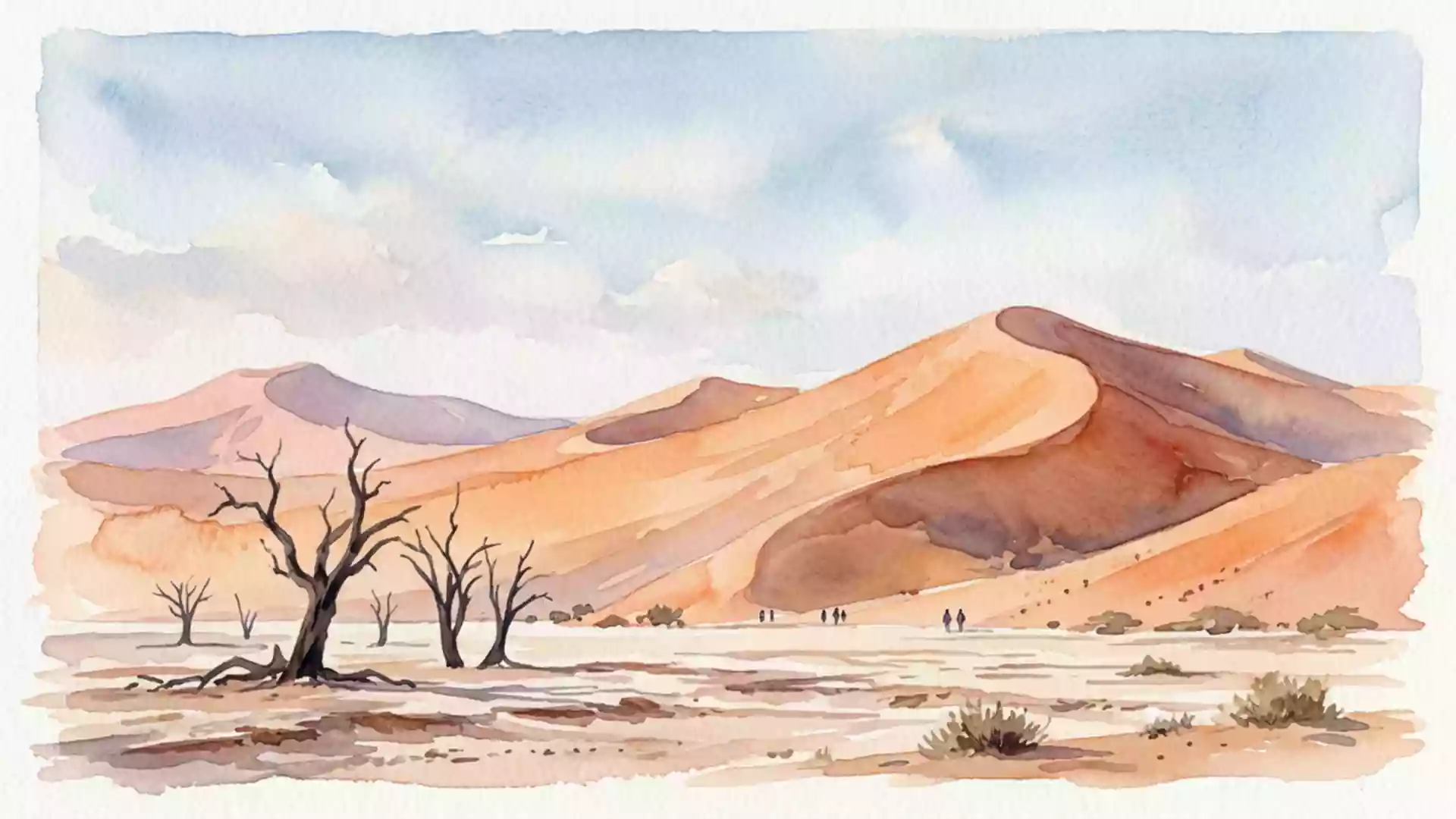
Namib Desert at Sossusvlei and its towering red dunes
Published on 09/11/2026 at 19:47 | Editorial responsibility: Rafael Müller, Editor-in-Chief AD HOC NEWS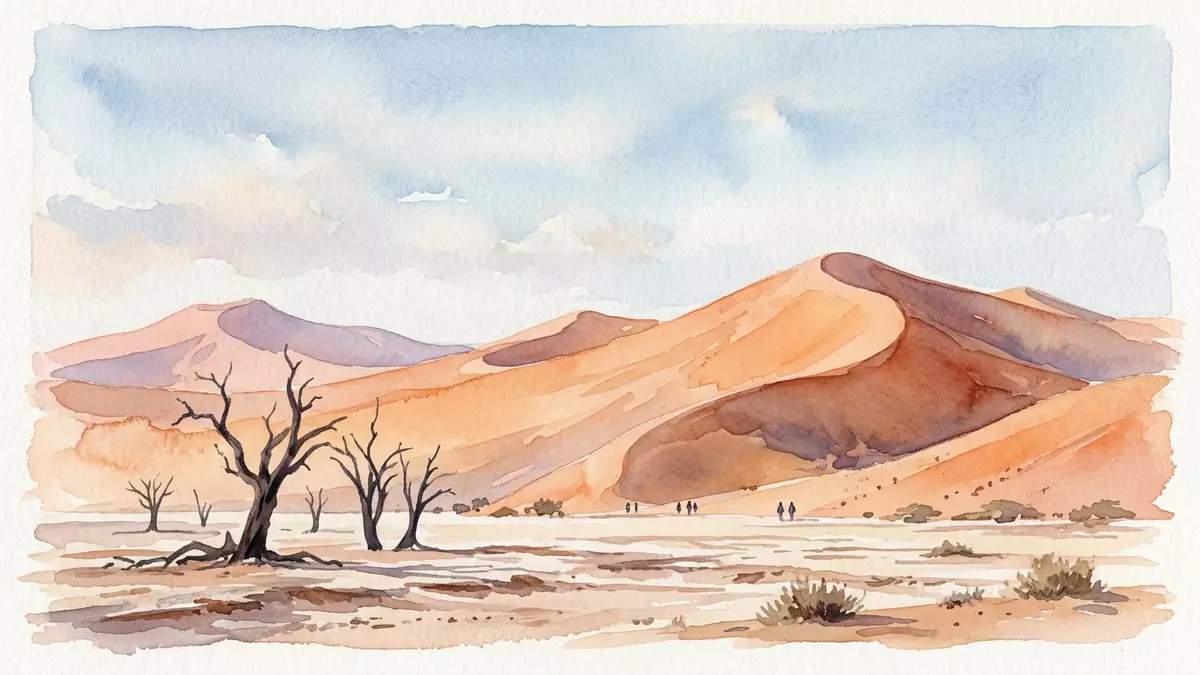
In the southern part of the Namib Desert, the Sossusvlei basin sits within the Namib Sand Sea, where towering red dunes frame a pale salt and clay pan in Namibia’s interior. This desert landscape forms part of Namib-Naukluft National Park and the Namib Sand Sea, which was inscribed on the UNESCO World Heritage List in 2013 as a coastal fog desert with extensive dune fields.
Red dunes and a salt and clay pan
Namib Desert around Sossusvlei is shaped by sand and drought, with Sossusvlei itself forming an endorheic salt and clay pan at the end of the Tsauchab River’s course.Sossusvlei is described as a salt and clay pan The pan lies in the Namib Sand Sea, a dune field that covers tens of thousands of square kilometres and is entirely enclosed within Namib-Naukluft National Park.Namib Sand Sea within Namib-Naukluft Park Around the pan, dunes rise in shades of red and orange, their colour linked to iron oxide coating the sand grains.
The pan stands out as a pale, flat depression set against the steep dune faces, a contrast that gives Sossusvlei its distinctive appearance in the wider Namib Desert.Salt and clay pan surrounded by red dunes The Tsauchab River is ephemeral, and the clay ground in the basin allows water to linger when the river flows, though for much of the time the pan’s surface dries and cracks into patterned plates.Tsauchab River and clay pan behaviour The broader Namib Desert is recognised as one of the oldest and driest deserts on Earth, giving the dunes and pans an ancient, weathered character.
Star dunes of the Namib Sand Sea
The Namib Sand Sea is described as a coastal fog desert where dune fields extend inland from the Atlantic coast across more than three million hectares.Namib Sand Sea area and description Within this expanse, the Sossusvlei region is characterised by large dunes, many exceeding 300 m (980 ft) in height, among the tallest sand dunes recorded in desert environments.Dunes exceeding 300 metres near Sossusvlei These dunes are formed primarily from quartz sand that has accumulated over millions of years, shaped continuously by wind.
In the Sossusvlei area the dunes are known as star dunes, a term linked to the way desert winds shape their ridges from several directions, giving multi-crested forms above the sand sea.Star dunes shaped by desert winds Individual dunes such as Big Daddy rise to heights of about 325 m (1,066 ft), while Dune 7 elsewhere in the Namib reaches around 383 m (1,257 ft).Heights of Big Daddy and Dune 7 The sand itself is estimated to be several million years old, contributing to the deep red hues where iron oxide has oxidised over long periods.Age and colour of Sossusvlei sand
Geological setting and protected status
Sossusvlei lies within the Namib Desert, whose underlying bedrock belongs to ancient metamorphic rocks of the African craton, with parts dating back over a billion years.Ancient bedrock beneath the Namib Desert Overlying this bedrock, the dune sea at Sossusvlei formed from sand transported by rivers such as the Orange River to the Atlantic and then moved northwards by the Benguela Current before being blown inland by prevailing winds.Sand transport via Orange River and Benguela Current The resulting landscape combines ancient rock, long-lived aridity and relatively young dune fields on the surface.
The Namib Sand Sea, including Sossusvlei, was granted World Heritage status by UNESCO in 2013 as the only coastal desert recognised for extensive dune fields influenced by ocean fog.World Heritage status for Namib Sand Sea Within Namibia, Namib-Naukluft National Park is described as the country’s largest protected area, with the Sossusvlei basin forming one of its best-known dune landscapes.Namib-Naukluft National Park extent The combination of extreme aridity, star dune forms and the salt and clay pans has made this part of the Namib Desert a reference point for studies of desert geomorphology and long-term climate stability.
Visiting Namib Desert: what travellers from Western Europe should know
- Namib Desert at Sossusvlei lies in the south-west of Namibia, reached by road from towns such as Sesriem, with access points leading into Namib-Naukluft National Park.
- The terrain around the Sossusvlei pan consists of loose sand and steep dune slopes, and approaches to viewpoints involve walking on soft dune surfaces and ascending sandy ridges.
- Nearby features include Deadvlei and Hiddenvlei clay pans, as well as named dunes such as Big Daddy and Dune 45, which rise above the surrounding sand sea.
- The official language is English and the currency is the Namibian dollar.
- Entry requirements depend on your nationality; UK travellers can check the FCDO travel advice at gov.uk/foreign-travel-advice, Irish travellers the Department of Foreign Affairs at ireland.ie.
Searching for Namib Desert on social platforms
These links open searches for Namib Desert on each platform.Frequently asked questions about Namib Desert
Where is the Namib Desert at Sossusvlei located?
Sossusvlei lies in the southern part of the Namib Desert within Namib-Naukluft National Park in south-western Namibia, in the Namib Sand Sea dune field.
What kind of landscape can visitors expect at Sossusvlei?
Visitors encounter a pale salt and clay pan surrounded by very high red sand dunes formed as star dunes, with loose sand surfaces and steep dune faces.
What distinguishes Namib Desert at Sossusvlei from other desert regions?
The area combines one of the world’s oldest deserts, multi-crested star dunes exceeding 300 m (980 ft), and the UNESCO-listed Namib Sand Sea with its fog-influenced dune fields.