
Namaqualand’s rock, dunes and wide open country
Published on 09/12/2026 at 08:59 | Editorial responsibility: Rafael Müller, Editor-in-Chief AD HOC NEWS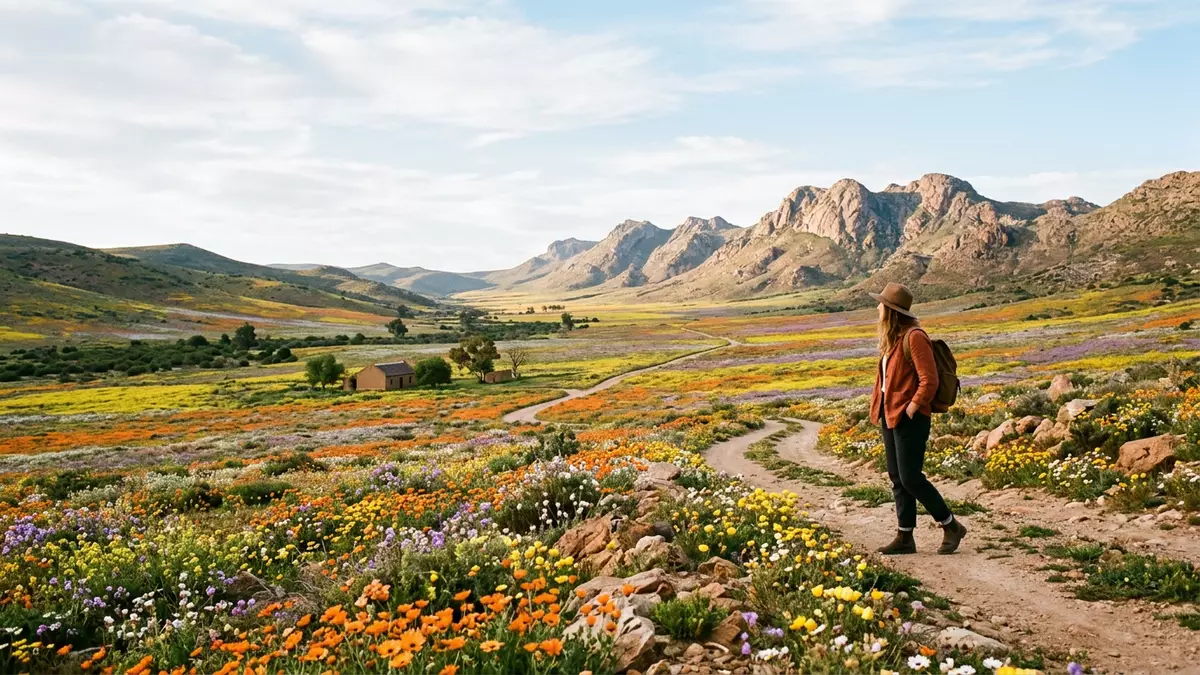
Namaqualand is a broad region in South Africa’s Northern Cape, with Springbok as its chief town. Its landscape moves between rocky hills, sandy plains and a coastal edge shaped by the Atlantic.
Namaqualand’s rocky hills and open plains
The region’s ground is the first thing that defines it: granite hills, outcrops and long stretches of bare, sandy country. In the Namaqua National Park, the bedrock includes quartzo-feldspathic gneiss from the Kookfontein subgroup within the Namaqualand Metamorphic Complex, a geological name that links the place to deep timeNamaqualand Metamorphic Complex.
That hard surface appears in the park as smooth rock faces, rounded boulders and low ridges, with a valley and an escarpment shaping the view in different directions. The highest point in the park, Wolfhoek se Berg, rises to 948 m (3,110 ft)Wolfhoek se Berg.
Springbok and the southern Namaqualand region
Springbok gives the South African side of Namaqualand its main town, and it sits within a landscape that extends across the dry western side of the country. Britannica places the region in Northern Cape province and notes Springbok as its chief townchief town.
The wider region reaches from the Atlantic coast towards inland desert country, and its south-western corner includes the Namaqualand coast and the Hardeveld. SANParks describes the coastal plain and the escarpment as part of the area, with sandy material of aeolian origin between the Groen and Spoeg riverscoastal plain.
Namaqualand in geological and ecological layers
The region belongs to a landscape that is older than its roads and towns. In the Richtersveld, the earliest identifiable rock layers are described as dating to about 2 billion years ago, and the Namaqualand Metamorphic Complex records later change under heat and pressureabout 2 billion years ago.
Namaqualand also sits inside the Succulent Karoo, a dry biome with a rich plant life. The area is linked to winter rainfall, and its plant communities include sandy plains, rocky slopes and coastal stretches that look different but belong to the same regional fabricSucculent Karoo.
Visiting Namaqualand: what travellers from Western Europe should know
- Springbok is reached by road in the Northern Cape, and the N7 connects the town with the route north towards Namibia. The region is large enough that settlement becomes sparse outside the main road corridor.
- The terrain includes rocky hills, sandy ground and, in places, low ridges and escarpment country. In the park sections, the ground rises from sea level to higher uplands.
- The coast and inland plains belong to different parts of the same region. The western edge faces the Atlantic, while inland country extends towards the Kalahari.
- In the Namaqua National Park, the Skilpad section and the coastal plain belong to the same wider landscape. The park’s geology and relief are part of the Namaqualand experience.
Searching for Namaqualand on social platforms
These links open searches for Namaqualand on each platform.
Frequently asked questions about Namaqualand
Where is Namaqualand?
Namaqualand lies in south-western Africa, mainly in South Africa’s Northern Cape and across the border into Namibia. Springbok is the chief town on the South African side.
What should a visit include?
A visit can focus on Springbok, the rocky inland hills and the coastal plain around the Namaqua National Park. The region’s terrain is broad, dry and varied.
What makes Namaqualand distinctive?
Its mixture of ancient rock, sandy ground and winter-rainfall ecology gives it a strong regional character. The Namaqualand Metamorphic Complex and the Succulent Karoo are part of that identity.


