
Mystras, a Byzantine hill city above Sparta
Published on 09/10/2026 at 13:40 | Editorial responsibility: Rafael Müller, Editor-in-Chief AD HOC NEWS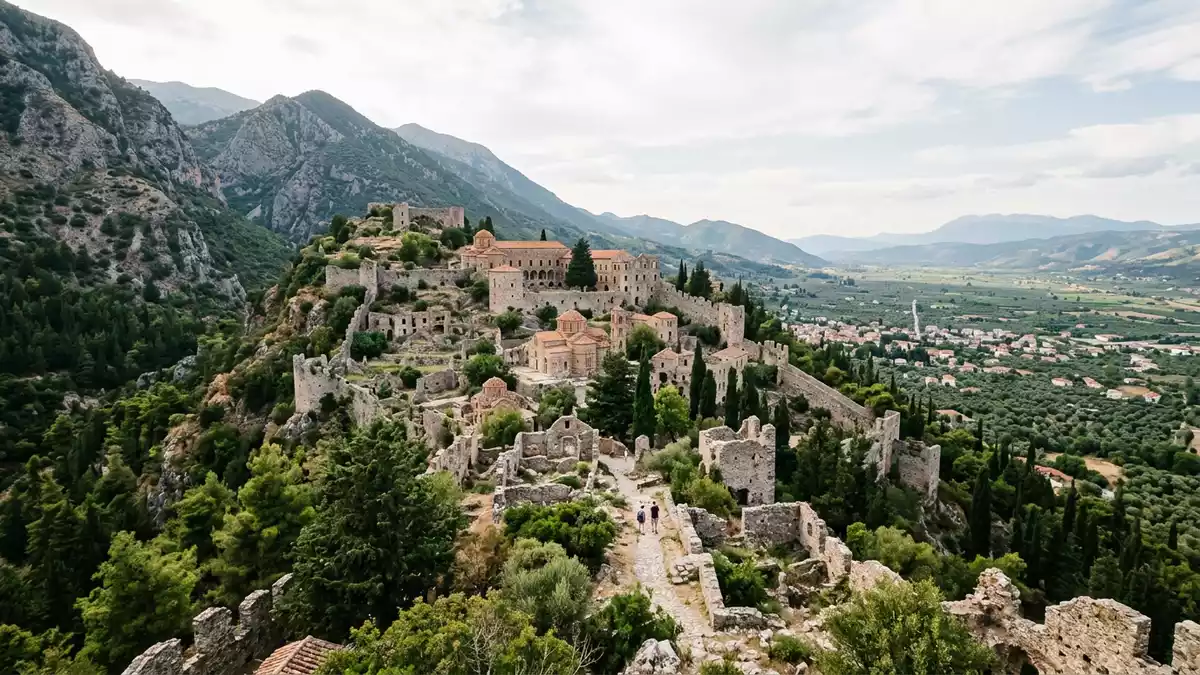
Mystras is a fortified medieval hill town above Sparta in southern Greece, where terraces of ruined houses, churches and palaces climb a steep spur of Mount Taygetos to a Frankish-built castle at the summit. Founded in 1249 by William II of Villehardouin and later capital of the Byzantine Despotate of the Morea, it survives today as an abandoned archaeological site whose late Byzantine streets and churches earned inscription on the UNESCO World Heritage List in 1989.
Mystras as a complete medieval hill town
The defining feature of Mystras is its layered townscape, a whole medieval city preserved on a rocky hillside above the plain of Sparta. The settlement spreads across a spur of Mount Taygetos, with the fortress crowning a hill that rises to around 620 m (2,034 ft), and the ruins descending towards the modern road and village below.a 620 m high hill overlooking Sparta Streets and stairways link clusters of houses, cisterns and chapels, so that walking through the site follows the lines of a once-inhabited town rather than an isolated castle.
Mystras developed from the fortress built in 1249 by William II of Villehardouin, prince of Achaia, on the summit above Sparta, and the town grew down the slope under Frankish and later Byzantine rule.founded in 1249 CE by William II of Villehardouin In the later thirteenth and fourteenth centuries it became the provincial capital of the Despotate of the Morea, a semi-autonomous Byzantine principality, and the urban fabric reflects that status: a palace complex on the upper terraces, metropolitan churches with rich fresco decoration, monastic enclosures and substantial town houses stepping down the slope.provincial capital of the Byzantine Despotate of the Morea
Palaces and churches of the Despotate of the Morea
The upper town of Mystras centres on the Palace of the Despots, a large secular complex that once housed the rulers of the Despotate of the Morea. The palace occupies a terrace below the summit castle, with ranges of halls and residential buildings arranged along the slope and looking out over the Lakonian plain. Its masonry reflects several phases between the fourteenth and fifteenth centuries, as successive despots extended and altered the complex during the city’s period as a political and intellectual centre of the late Byzantine world.a centre of intellectualism in the late Byzantine world
Across the middle and lower town stand churches and monasteries whose frescoes are among the most important ensembles of late Byzantine painting in Greece. The Metropolis of Saint Demetrios, the former cathedral, retains wall paintings from the so-called Palaeologan Renaissance, a flowering of art under the last Byzantine dynasty in the fourteenth century.art of the Palaeologan Renaissance Other churches, including Peribleptos and Pantanassa, form part of monastic complexes against the rock face, their interiors painted with saints, feasts and donors in vivid colours that survived the town’s abandonment.late Byzantine churches and monasteries
From Byzantine capital to archaeological site
Mystras reached its height as a Byzantine urban centre between the thirteenth and fifteenth centuries, when it served as the seat of despots connected to the imperial family in Constantinople. Philosophers and scholars were active at the court, and the city played a role in intellectual life in the last centuries of the Byzantine Empire. After the fall of Constantinople and the conquest of the Peloponnese, Mystras passed to Ottoman control in 1460, later experiencing brief periods of Venetian rule before returning to Ottoman hands.surrendered to the Ottomans in 1460 CE
In the nineteenth century the population moved to nearby modern Sparta, leaving the hill town uninhabited so that its streets and buildings gradually became a relict townscape. The ruins, including the fortress, palace, churches and monasteries, were recognised for their exceptional preservation as a complete medieval Byzantine city and inscribed on the UNESCO World Heritage List in 1989.inscribed on the UNESCO World Heritage List in 1989 The designated archaeological site covers more than 50 ha (around 135 acres), with a buffer zone extending over surrounding slopes of Mount Taygetos.area of 54.43 ha
Visiting Mystras: what travellers from Western Europe should know
- Mystras stands west of the modern city of Sparta in the Peloponnese, on a spur of Mount Taygetos, reached by road from Sparta and regional routes across Laconia.
- The archaeological site climbs a steep hillside, with paths and stairways linking the lower and upper towns; visiting the summit castle and palace involves sustained uphill walking on uneven stone surfaces.
- The wider site is divided into areas around the lower gate and upper entrance, with monastic enclosures, churches and ruined dwellings spread across terraces above the plain.
- The official language is Greek and the currency is the euro.
Searching for Mystras on social platforms
These links open searches for Mystras on each platform.
Frequently asked questions about Mystras
Where is Mystras and what kind of place is it?
Mystras is a fortified medieval hill town west of Sparta in southern Greece, preserved as an archaeological site on the slopes of Mount Taygetos.
What should visitors expect when exploring Mystras?
Visitors walk through an abandoned Byzantine city, following steep paths past ruined houses, monasteries, churches with frescoes, a despot’s palace and a summit castle.
What makes Mystras distinctive among historic sites?
Mystras is distinctive as a largely intact medieval Byzantine hill city whose townscape, palatial complex and late Byzantine churches earned recognition as a UNESCO World Heritage Site.


