
Mysore Palace and the glow of Indo-Saracenic Mysuru nights
Published on 08/19/2026 at 15:47 | Editorial responsibility: Rafael Müller, Editor-in-Chief AD HOC NEWS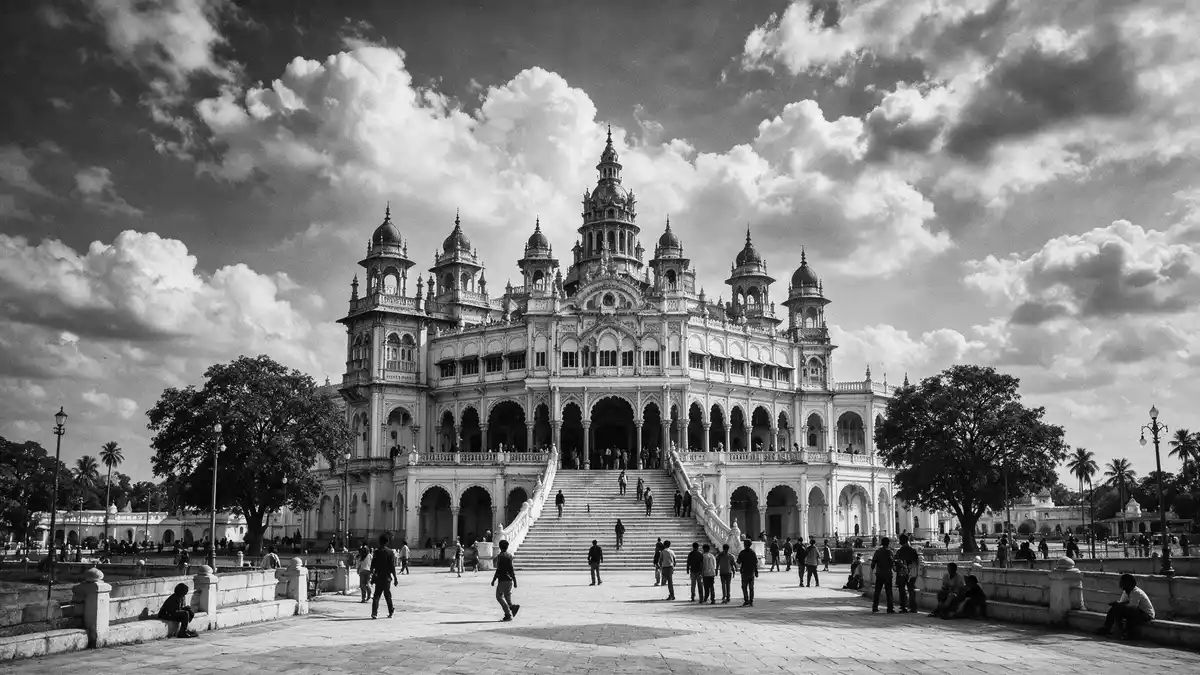
Mysore Palace in Mysuru, also known as Amba Vilas Palace, is a monumental reminder of the Wadiyar rulers and a textbook example of Indo-Saracenic architecture in southern India.Mysore Palace stands inside a historic fort at the centre of the city, where a royal residence evolved into a museum that frames Mysuru’s ceremonial life.
Granite, domes and a gilded profile
The present Mysore Palace was completed in 1912 after an earlier structure on the site was destroyed by fire in 1897, creating the three-storey royal residence visitors see today.The original palace was gutted by fire in 1897; today's structure was completed in 1912 The building is constructed largely in grey granite and crowned by a higher tower that culminates in a gilded dome, giving the complex a distinctive silhouette against the skyline.a sprawling three-story, gray granite, Indo-Saracenic building capped by a five-story tower that culminates in a gilded dome
The architect Henry Irwin worked in the Indo-Saracenic style, combining elements associated with Hindu, Islamic, Rajput and Gothic traditions in one highly ornamented composition.The current structure, designed by Ar. Henry Irwin in 1912, is an example of Indo-Saracenic style Domed pavilions sit above arcaded facades, while projecting balconies, tall finials and decorative parapets give the palace a layered, almost theatrical appearance that contrasts with the heavier granite beneath.
Seat of the Wadiyar dynasty
Mysore Palace was the official residence of the Wadiyar, or Wodeyar, dynasty, a royal family that shaped Mysuru’s history over several centuries and left the city with its reputation as a “City of Palaces”.Mysore Palace is a historical palace in Mysore, Karnataka, India, and was the official residence of the Wadiyar dynasty The palace stands on Sayyaji Rao Road within what was once a fortified enclosure, anchoring a wider complex of gateways, courtyards and subsidiary halls.The Palace of Mysore (also known as the Amba Vilas Palace) is a historical palace in the city of Mysore in Karnataka
Inside, the state rooms include a large Durbar Hall for public gatherings, more intimate audience chambers and a network of corridors where stained glass, painted ceilings and carved columns frame ceremonial routes. The palace now functions as a museum displaying objects associated with the Wadiyar household, from portraits and textiles to weapons and palanquins, placing visitors along the former paths of courtly processions.The palace has now been converted into a museum that is a repository of the art and architecture of the Wodeyar dynasty
Light, colour and the rhythm of festivals
Mysore Palace is closely tied to Mysuru’s festival calendar, particularly the city’s Dasara celebrations, when the complex becomes the setting for processions and public rituals anchored in the palace courtyards. The palace exterior carries multiple entrances aligned with these ceremonial routes, each backed by its own set of pavilions and verandas that frame views towards the city streets.
After dusk on select evenings the palace is illuminated by a dense grid of small light bulbs that trace its domes, arches and parapets, outlining the Indo-Saracenic profile in electric light against the night sky.the palace is illuminated by nearly 100,000 light bulbs that accentuate its majestic profile against the night The contrast between the lit facades and the darker interior courtyards highlights the complexity of the roofline, drawing attention to the layered domes and tower that distinguish Mysore Palace from the lower, flatter buildings around Mysuru’s historic core.
Visiting Mysore Palace: what travellers from Western Europe should know
- Mysore Palace stands in central Mysuru in Karnataka, India, with its main entrances on and around Sayyaji Rao Road in the old fort area of the city.
- The palace complex is spread across a level urban site, but visiting the interior involves staircases and long corridors within the multi-storey building.
- Mysuru is served by Mysore Junction railway station, and the palace lies within the urban area that also contains other palaces and civic buildings.
- The official language in Mysuru is Kannada and the currency is the Indian rupee. Entry requirements depend on your nationality; UK travellers can check the FCDO travel advice at gov.uk/foreign-travel-advice, Irish travellers the Department of Foreign Affairs at ireland.ie.
Searching for Mysore Palace on social platforms
These links open searches for Mysore Palace on each platform.Frequently asked questions about Mysore Palace
Where is Mysore Palace located?
Mysore Palace stands in Mysuru in the state of Karnataka in southern India, within the historic fort area near Sayyaji Rao Road.
What can visitors expect inside Mysore Palace?
Visitors walk through richly decorated halls, audience chambers and museum galleries that display objects associated with the Wadiyar dynasty and the former royal household.
What makes Mysore Palace distinctive among Indian palaces?
The palace combines grey granite structure, domes, balconies and a gilded central tower in an Indo-Saracenic composition that becomes especially striking when illuminated at night.


