
Myeongdong, Seoul’s dense maze of shopping streets
Published on 08/31/2026 at 22:48 | Editorial responsibility: Rafael Müller, Editor-in-Chief AD HOC NEWS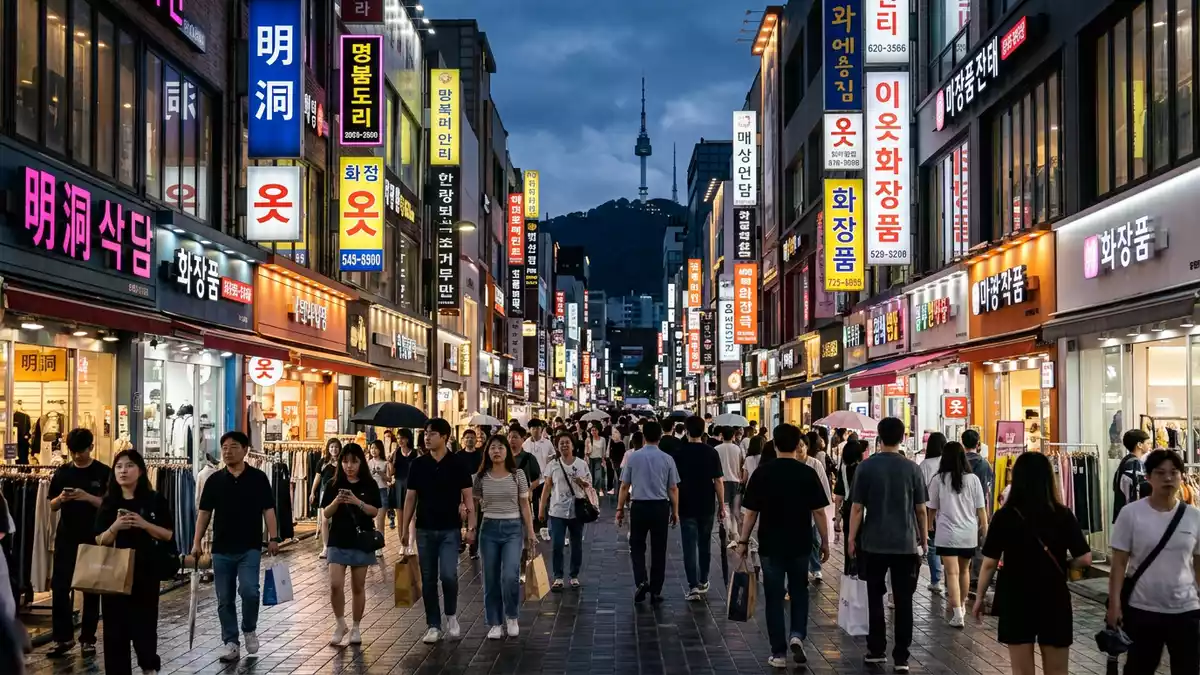
Myeongdong in central Seoul is a dense web of streets where shops, banks and a major Catholic cathedral share a compact urban block. The district in Jung-gu carries layers of history from the Joseon Dynasty through Japanese colonial rule into the modern city, while remaining one of Seoul’s core areas for shopping and street life.
From aristocratic quarter to commercial streets
During the Joseon Dynasty, the area now known as Myeongdong formed part of the southern district of Hanseong, the earlier name for Seoul. Sources describe it under names such as Myeongryebang or Chonghyeon, a hillside quarter where aristocrats and officials lived along narrow lanes.Myeongdong's journey from aristocratic quarter These earlier names and the residential character tie the district to the wider story of Joseon-era Seoul.
In 1914, under Japanese colonial administration, the district was renamed Meiji-cho, reflecting the influence of Emperor Meiji and linking the area more closely to Japanese-style commercial streets.It officially became the district of Myeongdong in 1946 Department stores such as Mitsukoshi followed in the early twentieth century, introducing modern retail infrastructure and helping to shift the district from a quiet hillside to an urban shopping landscape.department stores such as Mitsukoshi began operating near the district
Myeongdong Cathedral and the birth of Korean Catholicism
At the upper edge of the district stands Myeongdong Cathedral, a landmark of Korean Catholicism and one of the most recognisable buildings in central Seoul. Ground was broken for the present brick church in 1892, and construction was completed in 1898, giving the city a large Western-style religious building at the turn of the nineteenth century.Groundbreaking 1892 and completed 1898 When it was finished, the cathedral became one of the tallest structures in the city, rising above the surrounding streets and marking the skyline.became largest building in Seoul when it was completed
The building stands on a site linked to early Catholic gatherings in Korea during the late eighteenth century, connecting the nineteenth-century architecture with earlier religious communities in the neighbourhood.Korea's first Catholic community gathering in 1784 Constructed in red and grey brick, the cathedral combines a Western ecclesiastical form with the compact grain of central Seoul, and has long served as a focal point for religious life and public gatherings in Myeongdong.construction was completed with Our Lady of the Immaculate Conception as the patron saint
Shopping streets, department stores and urban density
The modern streets of Myeongdong form a tight grid between larger roads in Jung-gu, lined with department stores, smaller shops, cafés and street stalls. A main pedestrian route of roughly 1 km runs through the area, flanked by large shopping centres such as Noon Square and branches of long-established department stores including Lotte and Shinsegae.along a street about 1km long are a cluster of various large shopping centers Above street level, office towers and bank buildings show the district’s role as part of Seoul’s financial core, continuing shifts that began in the decades after the Korean War.
Many of the smaller units house fashion shops and beauty brands, reflecting Myeongdong’s long-standing reputation as a centre for clothing and cosmetics trade in Seoul.Myeong-dong became a place that offered Koreans easy access to the fashion and beauty cultures of the West The grid of streets is compact, with signage above doorways and commercial interiors reaching deep into narrow plots. Between them, occasional views open towards Namsan and the N Seoul Tower, linking the dense shopping lanes to one of Seoul’s recognised hill landmarks.location Jung-gu, central Seoul, near Namdaemun Market, N Seoul Tower, and Myeongdong Cathedral
Visiting Myeongdong: what travellers from Western Europe should know
- Myeongdong lies in Jung-gu, central Seoul, close to Namdaemun Market and within walking distance of Namsan Park. The area is served by Myeongdong Station on Seoul Subway Line 4.
- The streets form a compact urban grid with a mixture of broad pedestrian routes and narrower side lanes. Surfaces are paved and level, but the approaches towards Namsan slope upwards.
- The official language is Korean and the currency is the South Korean won.
- Entry requirements depend on your nationality; UK travellers can check the FCDO travel advice at gov.uk/foreign-travel-advice, Irish travellers the Department of Foreign Affairs at ireland.ie.
Searching for Myeongdong on social platforms
These links open searches for Myeongdong on each platform.
Frequently asked questions about Myeongdong
Where in Seoul is Myeongdong located?
Myeongdong is in Jung-gu, the central district of Seoul, between major roads near Namdaemun Market and on the lower slopes leading towards Namsan.
What can visitors expect on a visit to Myeongdong?
Visitors encounter a compact grid of streets lined with department stores, fashion shops, beauty brands, cafés and stalls, with Myeongdong Cathedral overlooking the district.
What makes Myeongdong distinctive among Seoul’s districts?
Myeongdong combines dense shopping streets, major financial buildings and a historic nineteenth-century cathedral within a small central area, linking commerce, religion and everyday urban life.


