
Myeongdong’s cathedral streets in central Seoul
Published on 08/27/2026 at 08:18 | Editorial responsibility: Rafael Müller, Editor-in-Chief AD HOC NEWS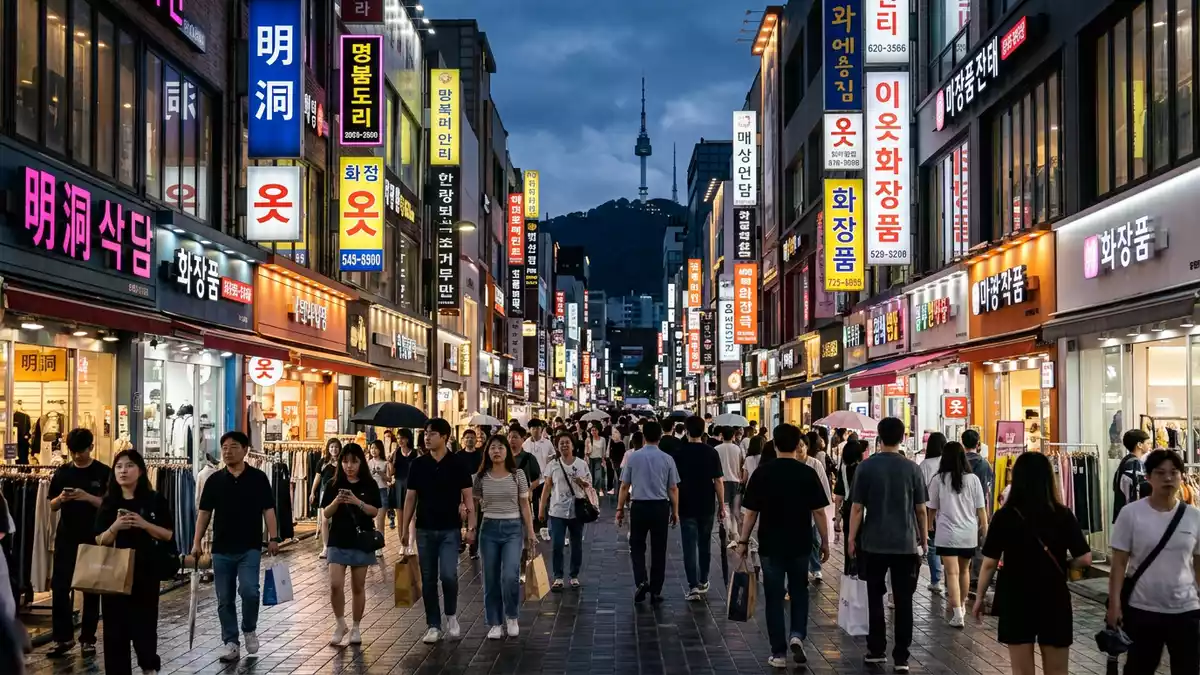
Myeongdong in central Seoul is a compact district where narrow shopping streets unfold around a late nineteenth-century brick cathedral and dense clusters of banks, theatres and offices. The neighbourhood forms part of Jung-gu, a central district of Seoul that already held an important position in the old Joseon Dynasty capital of Hanseong.
From Joseon lanes to a named district
Long before the neon shopfronts, the area now called Myeongdong formed part of the southern section of Hanseong, the walled capital of the Joseon Dynasty. In that period it carried names such as Myeongryebang and Chonghyeon, reflecting the administrative divisions of the pre-modern city.During the Joseon Dynasty era it was largely residential, with streets laid out between the city’s main palaces and the slopes of Namsan.
Under Japanese colonial rule the neighbourhood entered a different phase. In 1914 its name was changed to Meiji-cho, echoing Emperor Meiji and linking the district to the colonial administration’s urban plans.The modern name Myeong-dong dates from 1946, when independence brought a new toponymy to central Seoul. As Seoul rebuilt after the Korean War, banks and financial institutions along Namdaemun-ro and Euljiro extended their presence into these streets, and Myeongdong took on a marked commercial and financial character.By the 1970s the district was strongly associated with department stores, shopping centres and fashion boutiques.
Gothic brick above the retail maze
Rising above the surrounding low and mid-rise blocks, Myeongdong Cathedral anchors the district both visually and historically. The church’s formal name is the Cathedral Church of Our Lady of the Immaculate Conception, and it serves as the national cathedral of the Archdiocese of Seoul.The seat of the Archbishop of Seoul stands on a slight rise within the neighbourhood, its brick towers visible along many of the approach streets.
Construction of Myeongdong Cathedral took place in the 1890s, when French Catholic missionaries commissioned a Gothic Revival church in red and grey brick.Work began in 1892 and the building was completed in 1898, giving the cathedral a clear late nineteenth-century date within Seoul’s architectural history. The structure has been recognised as Historic Site No. 258 under South Korean heritage designation, reflecting its importance as one of the earliest major Gothic Revival churches in the country.At the time of completion it ranked among the most prominent buildings in Seoul’s skyline.
Shopping streets, theatres and civic memory
At street level, Myeongdong reads as a retail and entertainment district threaded by lanes and mid-block passages. Brand-name fashion shops, cosmetics stores and department stores stand along the main routes linking Myeongdong Station on Seoul Subway Line 4 with Euljiro and the Lotte Department Store.The two principal shopping streets meet near the middle of the block, with large department stores such as Lotte and Shinsegae lining the edges. Between them, smaller alleys are lined with shops selling clothes, shoes and accessories, as well as cafés and restaurants.
Alongside the retail frontage, the area carries layers of cultural and civic life. Myeongdong Theatre stands as a performing arts venue within walking distance of the cathedral, its present building tracing its origins to early twentieth-century theatre culture in the district.Nearby streets include a comics-themed route known as Jae-mi-ro, linking the contemporary cultural scene to Seoul’s graphic arts. From the late twentieth century, the plaza and steps around the cathedral became known as gathering points for demonstrations linked to South Korea’s democratisation movements, tying the religious landmark to the country’s political history.Protest marches and vigils have periodically centred on the church and surrounding streets.
Visiting Myeongdong: what travellers from Western Europe should know
- Myeongdong lies in Jung-gu in central Seoul, between Namdaemun-ro and Euljiro. The district is served by Myeongdong Station on Seoul Subway Line 4 and nearby Euljiro 1-ga Station.
- The streets form a dense grid of pedestrian alleys with frequent kerbs and short flights of steps between levels. Surfaces range from broad pavements along main roads to narrower paved passages.
- Myeongdong Cathedral stands on a modest rise above the commercial streets. The approach from surrounding roads involves an uphill walk and further steps within the church grounds.
- The official language is Korean and the currency is the South Korean won. Entry requirements depend on your nationality; UK travellers can check the FCDO travel advice at gov.uk/foreign-travel-advice, Irish travellers the Department of Foreign Affairs at ireland.ie.
Searching for Myeongdong on social platforms
These links open searches for Myeongdong on each platform.
Frequently asked questions about Myeongdong
Where in Seoul is Myeongdong located?
Myeongdong forms part of Jung-gu, a central district of Seoul, lying between Namdaemun-ro, Euljiro and the lower slopes of Namsan.
What should visitors expect in Myeongdong?
Visitors encounter dense shopping streets, department stores, cafés and theatres threaded around Myeongdong Cathedral and other civic buildings in a compact urban grid.
What makes Myeongdong distinctive among Seoul’s districts?
The combination of a late nineteenth-century Gothic brick cathedral, layered political history and intensely commercial streets gives Myeongdong a particular character within central Seoul.


