
Muttrah Souq in Maskat, Oman’s harbour-side market maze
Published on 09/17/2026 at 22:16 | Editorial responsibility: Rafael Müller, Editor-in-Chief AD HOC NEWS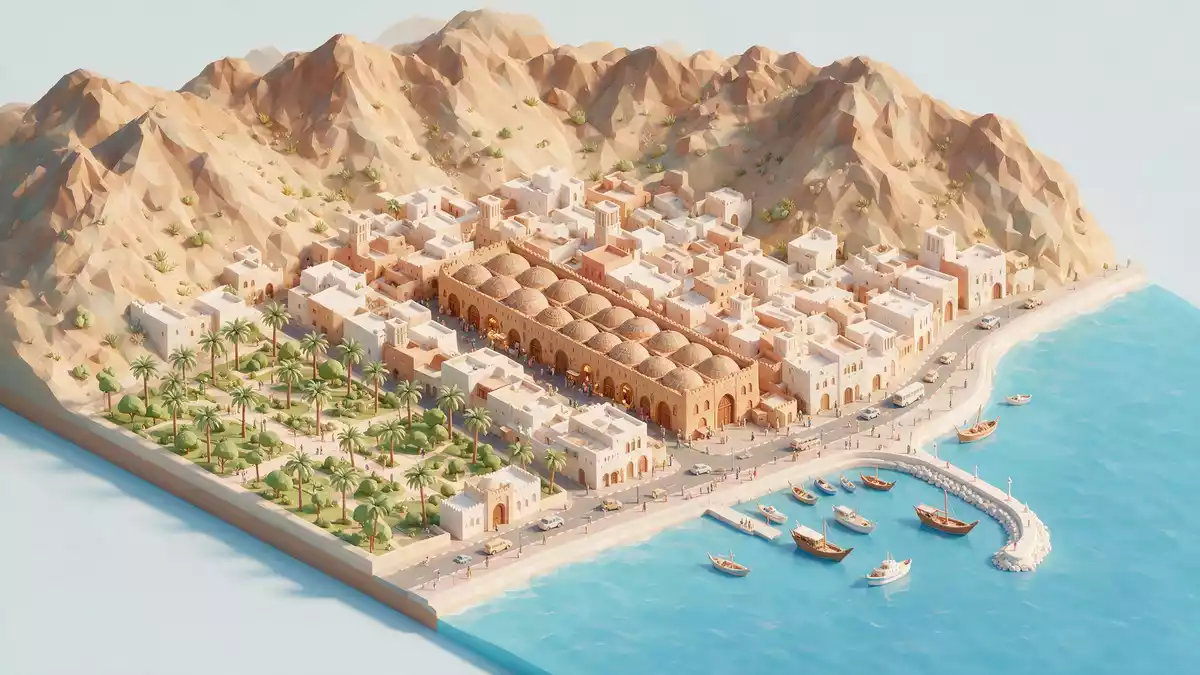
Muttrah Souq in Maskat, Oman, is a historic covered market that grew beside the city’s natural harbour, forming a dense maze of alleys lined with trading stalls. It is locally known as Al Dhalam Souq, a name linked to the way its tightly packed passages once kept out much of the bright Gulf sunlight, and is widely described as one of the oldest marketplaces in Oman, with roots stretching back around two centuries.
A harbour market shaped by Indian Ocean trade
Muttrah Souq sits in the Muttrah district on the waterfront corniche of Maskat, directly beside the deep natural harbour that made the city a key stop on sea routes between India, China, East Africa and the Arabian Peninsula. The area developed as the commercial heart of Maskat, while the neighbouring old town around the Portuguese forts held political and administrative functions, so the souq’s stalls grew in tandem with maritime traffic arriving in the bay.Muttrah was always the commercial heart Traders travelling by dhow landed here with dates, fish, spices and textiles, and the market acted as a point of exchange for goods coming from East Africa, India, Persia and further afield.goods arrived from East Africa, India and Persia
In its earlier form, the market fabric was built from mud walls and palm-leaf roofing, materials that suited the hot climate and could be assembled into narrow lanes that shielded traders and customers from direct sun.in the past the market was built from mud and palm leaves The local name Al Dhalam, meaning “darkness” in Arabic, refers particularly to the stretch between Al Lawatiya Mosque and Khour Bimba, where the combination of closely spaced shops and overhead coverings once blocked most daylight from the lanes.the name has been drawn from the part that extends from Al Lawatiya Mosque to Khour Bimba Over time, parts of the souq were rebuilt in sturdier materials, but the overall pattern of intimate passages clustered beside the harbour remained.
Inside the covered maze: alleys, goods and timber roofing
Walking into Muttrah Souq from the corniche side, the transition from open waterfront to covered alleys is marked by a distinct change in scale: the broad promenade funnels into a main entry leading straight into a timber-roofed interior of small shops and kiosks.the main entry is via the corniche opposite pedestrian traffic lights The present roofing uses modern timber construction, but the layout still follows the older pattern of interlocking lanes, side passages and small squares, with stalls often opening directly onto the walkway and overhead beams supporting the continuous cover.housed under modern timber roofing
Merchandise reflects Maskat’s trading history as much as its daily life. Textile shops display bolts of fabric and ready-made garments, alongside stalls selling sandals that form part of the smart national costume worn by Omani men.an alleyway of sandals that complete the men’s smart Omani costume Other alleys specialise in aluminium serving dishes used for dishes such as shuwa, marinated lamb cooked in an underground oven, while hardware, jewellery and incense shops are interspersed with stands selling fruit, vegetables, herbs and spices.local produce like fruits, vegetables, herbs and spices as well as traditional textiles, garments, jewellery, incense, pipes, pottery and craftwork Antique wedding chests known as mandoo and rope-twined muskets associated with conflicts such as the Dhofar wars appear in selected shops, echoing layers of Omani social and military history.
A market with centuries of continuity
Accounts of Muttrah Souq’s past converge on its age: it is regularly described as a marketplace dating back around 200 years, making it one of the oldest such trading sites in Oman and in the wider Arabian Peninsula.one of the oldest marketplaces in Oman dating back two hundred years For centuries it served as a focal point for goods passing through Maskat harbour from India, China, Europe and other parts of the Middle East, and the continuity of trading activity is a defining characteristic of the place.for centuries it served as a trading place for goods that passed through the Muscat harbour from India, China, Europe and other parts of the Middle East
Historical writing about Muttrah identifies phases of growth linked to wider shifts in Oman’s maritime and political fortunes, including contact with European powers such as the Portuguese and British and, later, the transformation of the country under Sultan Qaboos bin Said in the twentieth century.Muttrah went through different stages throughout history, influenced by foreign powers and by Sultan Qaboos bin Said’s reign from 1970 Through these changes, the souq retained its core role as a market where imported items and local produce met, and where Maskat’s coastal communities interacted with traders from Baluchi, Sindhi, East African and Indian backgrounds.Muttrah was home to Baluchi, Sindhi, East African and Indian merchant families
Visiting Muttrah Souq: what travellers from Western Europe should know
- Muttrah Souq is in the Muttrah district of Maskat, along the waterfront corniche by the city’s harbour, east of the old town and reached directly from the corniche road.
- Inside the market, the alleys are narrow and often busy, with some passages stepping up or down slightly between sections, so moving around involves frequent turns and short walks on foot.
- The surrounding Muttrah area forms part of Maskat, where Arabic is the official language and the national currency is the Omani rial.
- Entry requirements depend on your nationality; UK travellers can check the FCDO travel advice at gov.uk/foreign-travel-advice, Irish travellers the Department of Foreign Affairs at ireland.ie.
Searching for Muttrah Souq on social platforms
These links open searches for Muttrah Souq on each platform.
Frequently asked questions about Muttrah Souq
Where is Muttrah Souq located in Maskat?
Muttrah Souq is in the Muttrah district of Maskat, along the waterfront corniche beside the city’s natural harbour and close to the older quarters of the capital.
What can visitors expect when walking through the souq?
Visitors encounter a covered maze of timber-roofed alleys filled with stalls selling textiles, jewellery, incense, spices, household goods and occasional antiques, set in a dense, traditional market layout.
What makes Muttrah Souq distinctive among markets in Oman?
Its combination of centuries of continuous trading, its harbour-side setting and its Al Dhalam souq section of particularly narrow, once dark lanes make Muttrah Souq a distinctive historic marketplace within Oman.


