
Muttrah Souq in Maskat, Oman’s harbour quarter of trade
Published on 08/28/2026 at 10:19 | Editorial responsibility: Rafael Müller, Editor-in-Chief AD HOC NEWS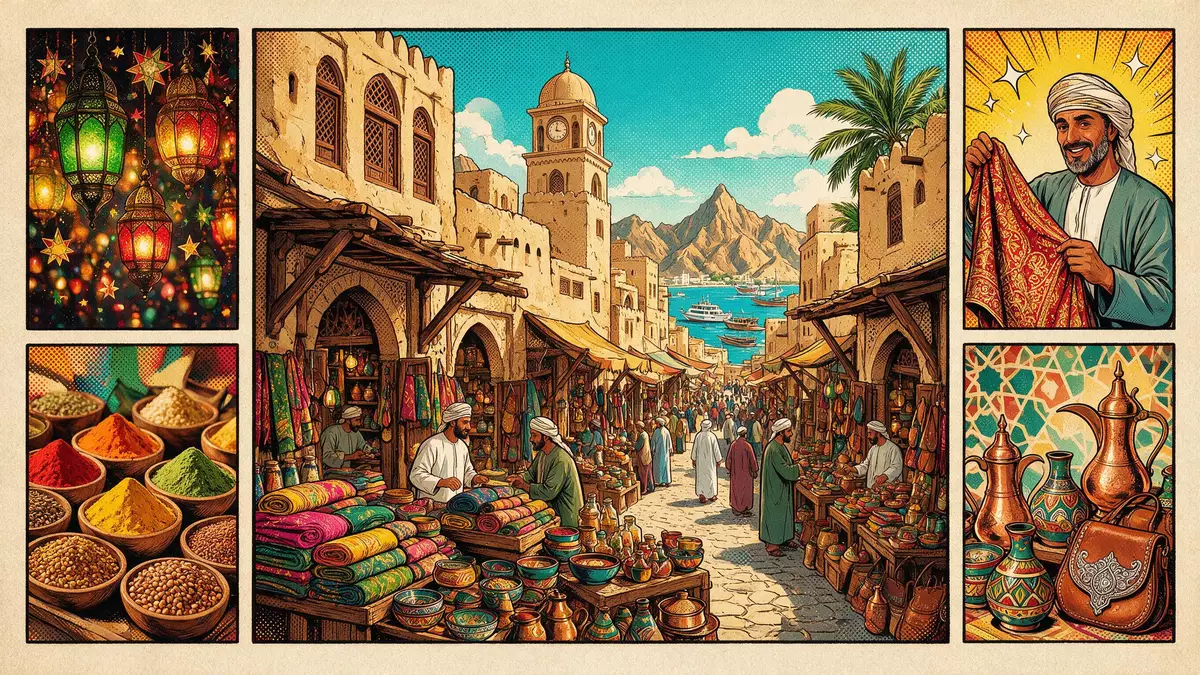
Muttrah Souq in Maskat, Oman, is an old covered market in the Muttrah district beside the city’s harbour, a compact maze of alleys lined with stalls and small shops. It is widely recognised as one of the country’s historic trading centres, linked for centuries to sea routes across the Indian Ocean that connected Oman with India, Persia and East Africa.
Harbour market shaped by Indian Ocean trade
The souq stands close to the waterfront in Muttrah, the historic port quarter of Maskat, with its entrance facing the Corniche promenade and the bay beyond.Muttrah Souq on the Corniche The name Muttrah refers to this coastal district, long associated with dhows and cargoes arriving from the wider Indian Ocean world. Inside the souq, the passageways form a dense network, turning and branching between closely packed units whose fronts open directly on to the alleys.
The market has functioned for generations as a trading hub for goods brought through Maskat harbour, including textiles, spices, jewellery and household items.Muttrah Souq as trading hub Historically, merchants used it to distribute cargoes arriving from regions such as India and China as well as neighbouring Arabian and Persian ports, making it part of a network that tied Oman to maritime routes across the Arabian Sea. The souq’s local name Al Dhalam, meaning “darkness”, reflects the deep canopy of roofing that once left its alleys dim even in bright daylight.Al Dhalam as the local name
Under timber roofs and along perfume-laden alleys
Muttrah Souq retains the feel of a traditional Arabian market, with narrow passages roofed in timber that lend the interior a continuous, sheltered character.Timber roofing over the alleys The roofing rests on structural supports between the shops, forming corridors where light filters through small gaps and decorative elements. Visitors walking inland from the Corniche gateway find the ground rising gently away from the sea as the alleys thread deeper into the district.
The shops themselves are varied, some devoted to textiles and clothing, others to household goods, incense burners and pottery. Several units display traditional Omani items such as silver khanjars, the curved ceremonial daggers associated with Omani dress, alongside Bedouin jewellery and brass coffee pots that recall the region’s coffee culture.Frankincense, khanjars and jewellery In other sections, tubs of frankincense and bukhoor, the aromatic wood chips burned for fragrance, line the passageways, contributing to the souq’s strong association with scent and smoke.
Muttrah Souq in the wider Muttrah district
The market lies within the Muttrah district of Maskat, a quarter that combines the old harbour, the Corniche and streets climbing towards Muttrah Fort on the hill behind.Muttrah Fort and district context From the Corniche, the souq’s main gateway forms part of a sequence of arches, mosques and waterfront buildings that frame views of the bay and of moored vessels in the harbour. The market’s proximity to the water underlines its long-standing role as a point where seaborne trade met local distribution.
The surrounding streets carry a mixture of older shopfronts and more recent commercial buildings, but the covered alleys of Muttrah Souq remain distinct in scale and atmosphere. The souq is set back slightly from the open seafront, so stepping through its gateway marks a clear transition from wide harbour views to enclosed corridors scented with incense. The Muttrah area forms part of the greater Maskat urban region, linking the port quarter with government and residential districts further east and west.
Visiting Muttrah Souq: what travellers from Western Europe should know
- Muttrah Souq stands in the Muttrah district of Maskat beside the Corniche along the harbour, reached most directly by road transport such as taxis and local buses.Location on Muttrah Corniche
- Inside the market, visitors walk along narrow alleys under continuous roofing, with occasional changes in level and junctions that demand attention when moving through the network of passages.Network of narrow passageways
- The official language in Oman is Arabic and the currency is the Omani rial.
- Entry requirements depend on your nationality; UK travellers can check the FCDO travel advice at gov.uk/foreign-travel-advice, Irish travellers the Department of Foreign Affairs at ireland.ie.
Searching for Muttrah Souq on social platforms
These links open searches for Muttrah Souq on each platform.
Frequently asked questions about Muttrah Souq
Where is Muttrah Souq in Maskat?
Muttrah Souq is in the Muttrah district of Maskat, beside the harbour and Corniche promenade, inland from the waterfront arches and mosques.
What can visitors expect inside the souq?
Visitors find narrow covered alleys lined with shops selling textiles, household goods, incense, silver khanjars, jewellery and other items associated with Omani and regional trade.
What makes Muttrah Souq distinctive among Oman’s markets?
Muttrah Souq is distinctive for its continuous timber roofing, dense network of alleys, long-standing role as a harbour-linked trading hub and its strong association with frankincense and other aromatic products.


