
Muttrah Souq in Maskat, Oman: a maze of light, timber and frankincense
Published on 09/12/2026 at 10:29 | Editorial responsibility: Rafael Müller, Editor-in-Chief AD HOC NEWS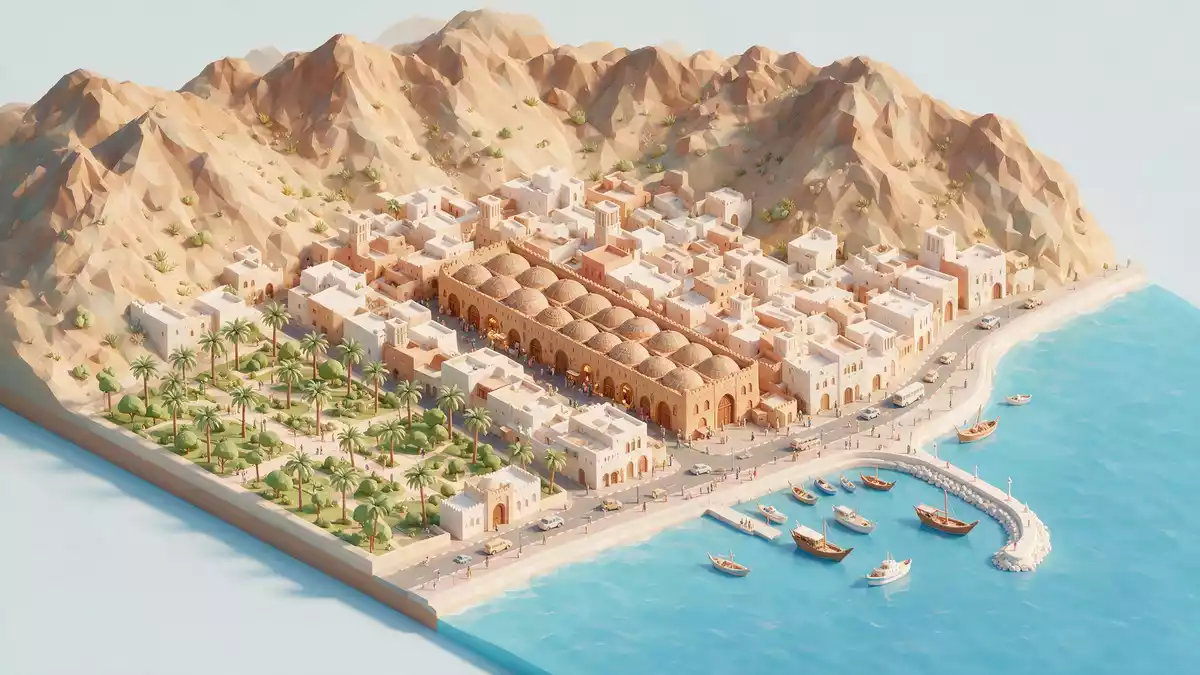
Muttrah Souq in Maskat, Oman, is a traditional market in the Muttrah district, pressed between the harbour and the waterfront Corniche. A timber-roofed maze of alleys carries a trading history that reaches back around two hundred years, reflecting Muttrah’s role as a key stop on routes between India, China and the Arabian Peninsula.one of the oldest marketplaces in Oman
A harbour market shaped by Indian Ocean trade
Muttrah Souq sits in the old port quarter of Maskat, just inland from the harbour where wooden dhows and modern ships share the bay.located by the harbour in the heart of Old Muscat For centuries this stretch of coast linked Oman with trading partners across the Indian Ocean, and goods arriving by sea passed through Muttrah’s warehouses into the lanes that became the souq.served as a trading hub for goods that came through the Muscat harbour from India, China, Europe and other Middle Eastern regions
The market is known locally as Al Dhalam Souq, a name linked to the shaded, enclosed character of its walkways under continuous roofing.Al Dhalam Souq is the local name Traders working here sell textiles, jewellery, incense and spices in a setting that deliberately preserves the feel of an Arabian bazaar while accommodating the city around it with timber structures and modern shopfronts.traditional Arab market housed under modern timber roofing
Inside the maze: alleys, arches and trading sections
Entry from the Corniche brings visitors through a two-storey gateway into the souq, where passages run slightly uphill away from the sea before branching into a network of side lanes.gateway on the Corniche by the traffic lights Overhead, timber beams and covered roofs filter daylight into the interior, creating alternating patches of brightness and shadow along the alleys. The routes curve and intersect, producing a layout that feels compact but layered, with small shops and stalls opening directly onto the main walkways.
Muttrah Souq contains distinct sections, including areas devoted to gold and silver jewellery, textiles, household goods and perfumes.divided into different sections including gold and silver Many stalls stack frankincense resin and bukhoor burners alongside traditional Omani khanjars, Bedouin-style jewellery and decorative coffee pots, while others display garments and colourful fabrics.tubs of frankincense, bukhoor, old silver khanjars, Bedu jewellery and other paraphernalia The combination of narrow alleys, timber structures and densely stocked shops gives the market a layered physical character that reflects its long life as a working commercial centre.
Muttrah district and Corniche: setting and nearby landmarks
Beyond the covered alleys, Muttrah Souq is framed by the Muttrah Corniche, a waterfront promenade that curves along the bay, and by the residential streets of the Muttrah district.Muttrah located in a cove east of Muscat along the Corniche The proximity of the sea remains visible at the main entrance, where the gateway stands opposite pedestrian crossing points on the coastal road.
Within walking distance of the market, visitors encounter Muttrah Fort on the hillside above and the mosques and residential quarters that make up this part of Maskat.Muttrah Fort in Muttrah, Muscat Governorate The souq forms part of a wider urban scene in which harbour activity, domestic life and religious buildings coexist at close quarters, with the market occupying the commercial core.
Visiting Muttrah Souq: what travellers from Western Europe should know
- Muttrah Souq lies in the Muttrah district of Maskat beside the Corniche, with the main entrance facing the coastal road close to pedestrian traffic lights.
- Inside the market, movement is along narrow alleys and passageways with steps and slight gradients, under continuous roofing that creates an enclosed environment.
- The waterfront Muttrah Corniche runs directly outside the souq, and Muttrah Fort stands on the hillside above, making it possible to combine the market with a walk along the bay and a visit to the fort.
- The official language is Arabic and the currency is the Omani rial.
- Entry requirements depend on your nationality; UK travellers can check the FCDO travel advice at gov.uk/foreign-travel-advice, Irish travellers the Department of Foreign Affairs at ireland.ie.
Searching for Muttrah Souq on social platforms
These links open searches for Muttrah Souq on each platform.Frequently asked questions about Muttrah Souq
Where is Muttrah Souq in Maskat?
Muttrah Souq is in the Muttrah district of Maskat, beside the Muttrah Corniche and close to the harbour in the historic core of the city.
What should visitors expect inside the souq?
Expect covered timber-roofed alleys lined with small shops selling textiles, jewellery, frankincense, bukhoor and other goods, arranged in sections such as gold and silver.
What makes Muttrah Souq distinctive among markets in Oman?
Muttrah Souq combines a two hundred-year trading history, a harbour-side setting and a dense network of timber-roofed alleys, giving it a long-established role as Maskat’s principal traditional marketplace.


