
Muttrah Souq and the old harbour streets of Maskat
Published on 08/31/2026 at 13:17 | Editorial responsibility: Rafael Müller, Editor-in-Chief AD HOC NEWS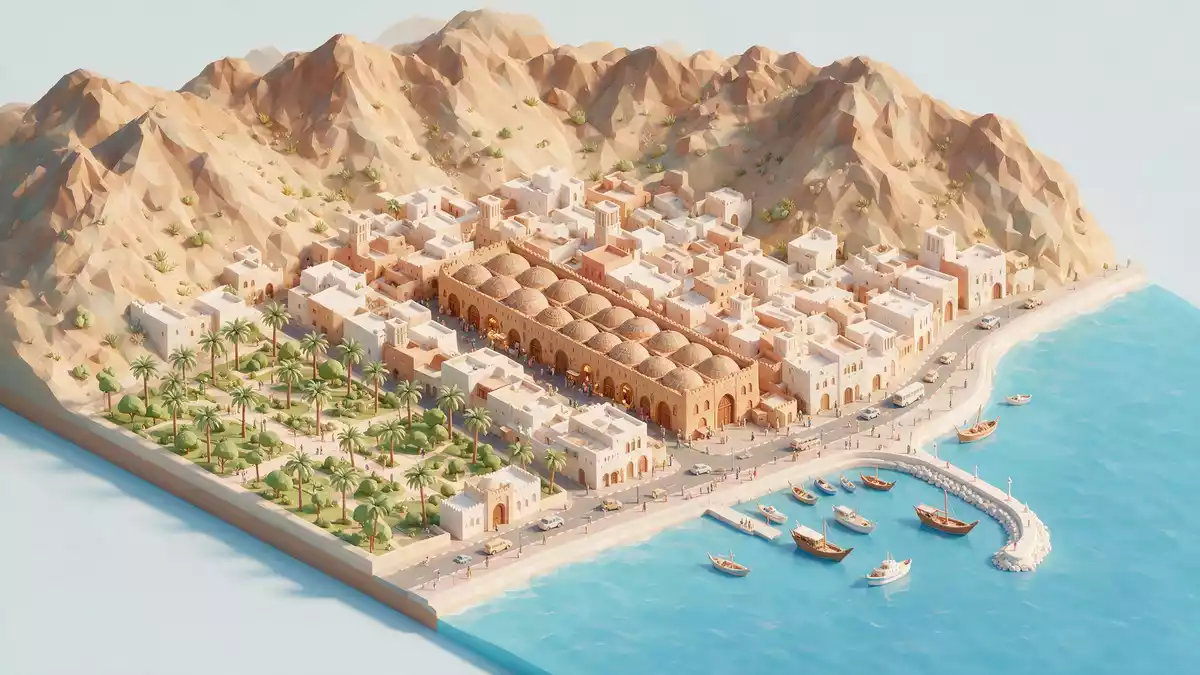
Muttrah Souq sits in Maskat’s harbour district as a covered market of narrow lanes, timber stalls and small shopfronts. Its character comes from the dense, older street pattern rather than a single grand façade.
The market belongs to the trading quarter of Muttrah, where port life and inland commerce met along the coast. The Arabic word souq names a traditional market, and Muttrah Souq remains closely tied to that everyday urban form.
Muttrah Souq in the port quarter
Muttrah lies on the coast of Maskat, and the market runs through the district’s older commercial streets. The setting links the souq to the waterfront, the corniche and the city’s historic harbour area.
One of the market’s strongest features is its enclosed rhythm: shaded passages, packed shops and bends in the lane replace the open geometry of a modern shopping mall. The result is a market that is read through movement, thresholds and layers of frontage.
Around the souq, traders have long dealt in goods that travelled by sea, including spices, textiles, perfume and household items. The merchandise changes from stall to stall, but the market keeps the same compact urban grain.
The souq’s built fabric is part of the attraction. Whitewashed surfaces, carved timber, metal fittings and painted signage sit within a network of smaller units, giving the place a lived-in texture rather than a monumental one.
Trade, materials and daily use
Muttrah Souq is associated with the longer maritime history of Oman, especially the commercial life of Maskat’s coast. The market reflects a port city where exchange, storage and retail have sat close together for generations.
Its identity is commercial before it is ceremonial. Shops line the passages in tight rows, and the merchandise includes everyday goods as well as objects that visitors often associate with Omani craft.
The market is known for spices, frankincense, textiles, silverwork and souvenirs, but these goods sit within a working retail district rather than a display hall. That mixture gives the souq its practical character.
The architecture remains modest in scale, with low roofs, narrow walkways and repeated shop openings. The effect is one of accumulation: many small spaces, each doing a limited task, joined into a larger market.
Historic accounts place the souq among the older markets in Oman, and its present form grows from long commercial use in the port district. older traditional markets in the country include Muttrah’s market, which remains part of Maskat’s coastal urban fabric.
What survives in the market lanes
What remains memorable is not a single building but the sequence of passages, stalls and openings. The market presents itself through its lanes, where the mix of wood, paint, fabric and metal keeps changing from one section to another.
The setting also preserves the scale of an older harbour town. Muttrah Souq still reads as a place where trading streets and market rooms sit close to the water, instead of being separated into large, isolated blocks.
Architectural details appear in fragments: arches, narrow fronts, corrugated coverings and decorative trim. These elements do not dominate the souq, but they give it a recognisable coastal-market identity.
The market’s appeal lies in that layered ordinaryness. It is a place of shops, passageways and goods, shaped by the commercial life of Maskat’s harbour quarter and by the persistence of the souq form itself. Mutrah Souk is the German-language name often used for the same place.
Visiting Muttrah Souq: what travellers from Western Europe should know
- The souq is in Muttrah, the harbour district of Maskat, near the Corniche and the waterfront. The market is reached on foot through the older commercial streets.
- Its lanes are narrow and covered in places. The layout is compact, with closely spaced shopfronts and frequent bends through the passageways.
- The market is in Oman. The official language is Arabic and the currency is the Omani rial.
- Entry requirements depend on your nationality; UK travellers can check the FCDO travel advice at gov.uk/foreign-travel-advice, Irish travellers the Department of Foreign Affairs at ireland.ie.
Searching for Muttrah Souq on social platforms
These links open searches for Muttrah Souq on each platform.
Frequently asked questions about Muttrah Souq
Where is Muttrah Souq?
Muttrah Souq is in Muttrah, the harbour district of Maskat, close to the waterfront and the Corniche. It sits within the older commercial part of the city.
What does a visit involve?
The market is a compact walk through narrow lanes lined with small shops. Visitors pass through a dense retail quarter rather than a single enclosed hall.
What makes Muttrah Souq distinctive?
Its strength lies in the combination of harbour setting, older market form and closely packed passages. The place reads as a working souq with a long commercial life in Maskat.


