
Muttrah Souq and the covered alleys of Maskat
Published on 09/24/2026 at 09:01 | Editorial responsibility: Rafael Müller, Editor-in-Chief AD HOC NEWS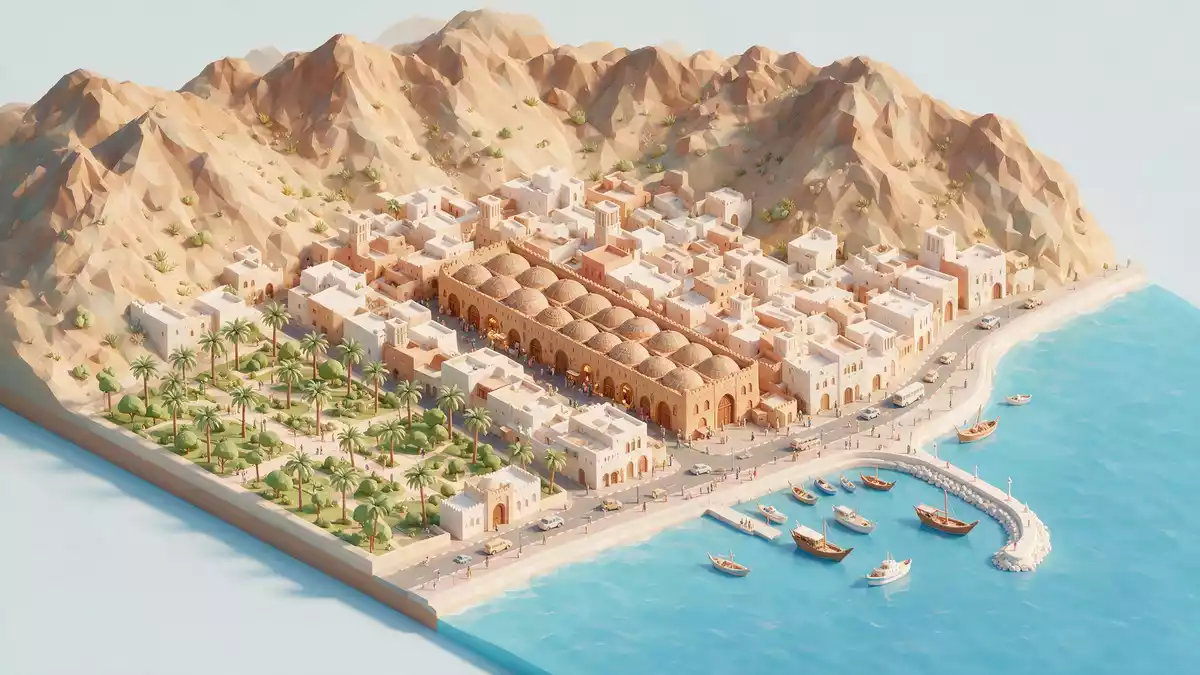
Muttrah Souq is a covered marketplace beside the waterfront in Maskat, Oman. Its narrow lanes, timber roofs and close-set shops form a compact passage between the city’s harbour district and its long trading history.
Muttrah Souq beside the harbour
The market lies in Muttrah, a historic port quarter of Maskat, close to Muttrah Corniche and the harbour. Its position places the souq within the maritime landscape of Oman, where routes across the Indian Ocean connected the Arabian Peninsula with India, East Africa and Persia.
Muttrah Souq is associated with the age of sail and with the movement of goods through Maskat’s port. Frankincense, spices, textiles and household objects belong to the market’s commercial vocabulary, while the surrounding waterfront preserves the relationship between trade, settlement and the sea. The harbour setting remains part of the place’s identity, even though the souq itself is a network of covered passages and small retail spaces.
Al Dhalam and the architecture of shade
Muttrah Souq is also known locally as Al Dhalam Souq, a name translated as “market of darkness”. The name refers to the dense arrangement of stalls and lanes, where roofs, awnings and shopfronts reduce the amount of daylight reaching the interior.
The market’s architecture combines plastered walls, timber beams, decorated doors and covered walkways. Arched entrances and ornamental details appear beside tiled corridors and more regular shopfronts. The result is not a single monumental building, but a connected market fabric made from passages, thresholds and small commercial rooms.
The souq’s form belongs to the traditional marketplace vocabulary of the Gulf. Roofs sit close above the lanes, wooden elements frame shopfronts, and side passages branch into smaller groups of stalls. These details make the market legible as an architectural environment as well as a place of commerce. Its nineteenth-century origins place it within the older built history of Muttrah.
Goods, crafts and the Indian Ocean world
Inside Muttrah Souq, merchandise occupies the narrow boundary between everyday shopping and cultural display. Shops offer frankincense, perfumes, silver jewellery, textiles, garments, spices and decorative objects associated with Oman and the wider region.
Frankincense has a particularly strong association with Oman. The aromatic resin links the market to ancient trade across southern Arabia, while silverwork and embroidered textiles connect the souq with Omani dress and craft traditions. Other goods point beyond Oman, reflecting the commercial geography of a port exposed to maritime exchange.
The market is not arranged as a museum collection. Objects sit within active shopfronts, among shelves, hanging fabrics, carved pieces, metalwork and containers of aromatic products. The mixture gives Muttrah Souq a commercial character that differs from a restored historic display. A passage may contain traditional goods, contemporary household items and souvenirs within the same sequence of stalls.
Muttrah Souq’s cultural importance comes from this overlap of place and practice. Its lanes preserve a spatial form associated with older markets, while its shops continue to present materials connected with Oman’s social and trading history. The market’s covered market architecture includes both traditional details and more recent interior finishes.
Visiting Muttrah Souq: what travellers from Western Europe should know
- Muttrah Souq is in the Muttrah district of Maskat, beside Muttrah Corniche and the harbour. It can be reached by road, taxi or bus through the waterfront district.
- The interior consists of narrow, covered passages with turns, shop thresholds and closely spaced stalls. Comfortable walking shoes suit the tiled and uneven sections of the market.
- The souq sits within a working harbour quarter. Muttrah Corniche, the waterfront and the old port landscape are close to the market lanes.
- The official language is Arabic and the currency is the Omani rial.
- Entry requirements depend on your nationality; UK travellers can check the FCDO travel advice at gov.uk/foreign-travel-advice, Irish travellers the Department of Foreign Affairs at ireland.ie.
Searching for Muttrah Souq on social platforms
These links open searches for Muttrah Souq on each platform.
Frequently asked questions about Muttrah Souq
Where is Muttrah Souq?
Muttrah Souq is in the Muttrah district of Maskat, beside Muttrah Corniche and the city’s harbour. The market belongs to the older waterfront quarter of Oman’s capital.
What can visitors expect inside?
Visitors encounter covered lanes, small shops, timber roofs, decorated doors and goods such as frankincense, perfumes, textiles, silver jewellery and spices.
What makes Muttrah Souq distinctive?
Its distinctive character comes from the combination of a harbour setting, narrow covered passages and the trading history of Oman’s Indian Ocean connections. The name Al Dhalam refers to the market’s dark, closely enclosed lanes.


