
Museum of the Future turns Arabic calligraphy into architecture
Published on 09/24/2026 at 00:05 | Editorial responsibility: Rafael Müller, Editor-in-Chief AD HOC NEWS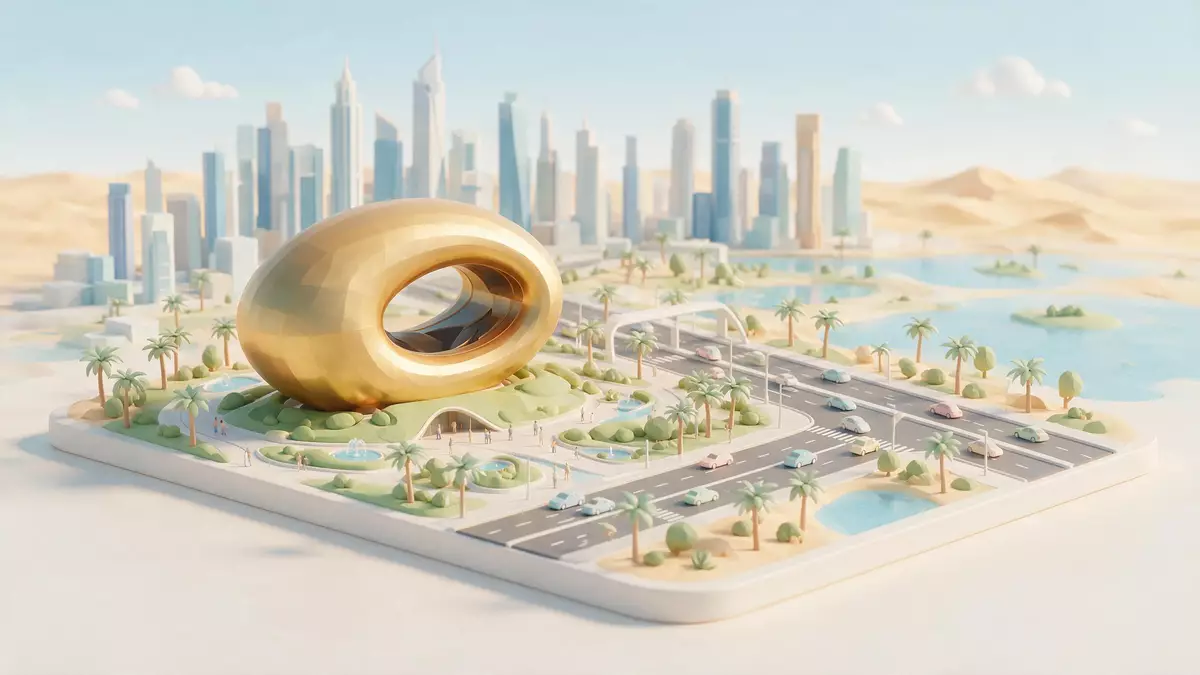
Dubai’s Museum of the Future is a building shaped as a stainless-steel torus, with an open centre and Arabic calligraphy forming its façade. Designed by Killa Design and opened on 22 February 2022, it combines a reflective exterior with exhibition spaces about science, technology and possible futures.
A stainless-steel ring beside Sheikh Zayed Road
Museum of the Future stands in Dubai’s Financial District beside Sheikh Zayed Road, close to Emirates Towers. Its main volume rises above a landscaped mound, giving the building a clear separation between the green base, the silver ring and the open space at its centre.
The structure measures about 77 metres in height and contains a column-free interior. Its torus form is visible from several parts of the surrounding district, while the broad opening cuts through the middle of the building and exposes the sky above the mound.
Arabic script across the façade
The exterior consists of 1,024 stainless-steel panels, each shaped for the building’s curved geometry. Large bands of Arabic calligraphy cross the surface, and the script also forms the glazed openings that bring daylight into the interior. the building’s architectural design is credited to Killa Design, with engineering by Buro Happold.
The calligraphy carries lines attributed to Sheikh Mohammed bin Rashid Al Maktoum, the ruler of Dubai. The words refer to imagination, innovation and the future, placing Arabic writing directly within the building’s structure instead of treating it as separate decoration.
Inside a museum about possible futures
Museum of the Future presents immersive environments rather than a conventional sequence of historical objects. Its galleries address subjects including space exploration, healthcare, urban mobility, sustainability and emerging technologies.
The interior includes exhibition floors, theatre spaces, a laboratory and a research centre. Physical sets, projections, sound and interactive installations present scenarios connected with life, work, cities and the wider environment. The institution’s focus is future-oriented, while the building itself remains a major part of the experience.
The project was developed by Killa Design and engineered by Buro Happold. Its built-up area is about 30,000 square metres, and its structural system supports the broad interior volume beneath the calligraphic shell. the engineering partnership brought together structural, façade, lighting, transport and building-services expertise.
Visiting Museum of the Future: what travellers from Western Europe should know
- Museum of the Future is on Sheikh Zayed Road in Dubai’s Financial District, beside Emirates Towers. The Emirates Towers metro station provides a public-transport reference point.
- The building sits above a landscaped mound, while the interior occupies a large torus-shaped volume. The central opening and curved galleries create a building with changing levels and extensive internal circulation.
- The official language is Arabic and the currency is the United Arab Emirates dirham.
- Entry requirements depend on your nationality; UK travellers can check the FCDO travel advice at gov.uk/foreign-travel-advice, Irish travellers the Department of Foreign Affairs at ireland.ie.
Searching for Museum of the Future on social platforms
These links open searches for Museum of the Future on each platform.Frequently asked questions about Museum of the Future
Where is Museum of the Future?
Museum of the Future is on Sheikh Zayed Road in Dubai’s Financial District, beside Emirates Towers and near the Emirates Towers metro station.
What can visitors expect inside?
The museum contains immersive galleries about space, healthcare, mobility, sustainability and technology. Installations combine physical environments with projections, sound and interactive elements.
What makes the building distinctive?
Its torus-shaped stainless-steel shell carries Arabic calligraphy across the façade. The script also forms the glazed openings around the building’s curved exterior.


