

Museum of Islamic Art in Doha and its ringed silhouette
Published on 08/29/2026 at 13:20 | Editorial responsibility: Rafael Müller, Editor-in-Chief AD HOC NEWS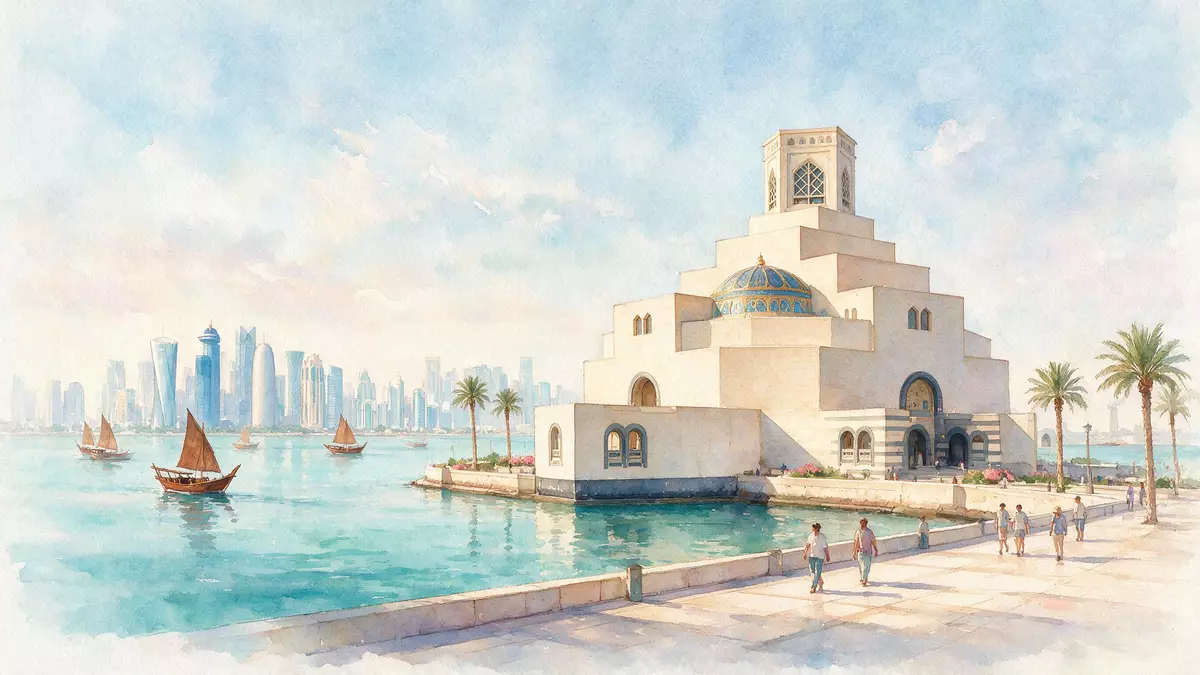
Museum of Islamic Art in Doha is one of I. M. Pei’s last major buildings, and its pale limestone mass reads as a severe geometric object on the Corniche. Opened in 2008, it stands on an artificial peninsula beside Doha Bay and presents Islamic art across a long historical span.I. M. Pei
Pei’s limestone form on Doha Bay
The building’s stacked volumes step back towards a central core, giving the museum a composed, almost fortress-like profile. Its walls are faced in cream-coloured limestone, a material that softens the mass and keeps the geometry legible from the waterfront.
The museum was designed by I. M. Pei, the Chinese-American architect associated with the Louvre Pyramid and the East Building of the National Gallery of Art in Washington. In Doha, he worked with a composition of cubes, arches and a central dome that gives the museum a disciplined skyline presence.
A collection that spans centuries
The museum presents Islamic art from the seventh to the twentieth centuries, drawing together manuscripts, ceramics, metalwork, textiles, jewellery, glass and woodwork. Its collection ranges across three continents and links courtly objects with works made for daily use.
That breadth gives the museum a different rhythm from many single-period collections. It moves between Ottoman metalwork, Iranian ceramics, Mughal textiles and manuscripts from different regions, so the galleries carry several artistic traditions in one building.seventh to the twentieth centuries
The museum and its waterfront setting
The museum sits on the Corniche, with the sea on one side and the city skyline on the other. A purpose-built park surrounds the building, and the approach keeps the museum separate from the denser fabric of central Doha.artificial peninsula
Inside, the plan centres on galleries arranged around a tall internal space. The arrangement gives the collections a clear sequence, while the exterior keeps the building’s profile compact and formally controlled.Wilmotte & Associés
Visiting Museum of Islamic Art: what travellers from Western Europe should know
- The museum is on Doha’s Corniche in Qatar, beside Doha Bay. It is reached by the city’s waterfront roads and sits close to the harbour edge.
- The building rises from an artificial peninsula, so the setting is open and exposed on several sides. The museum is approached across the park and waterfront edge rather than through a dense street frontage.
- English is widely used in museum settings in Doha. The official language is Arabic and the currency is the Qatari riyal.
- The museum shares its site with parkland and open water views. The surrounding spaces are part of the overall experience of the place, not just its setting.
Searching for Museum of Islamic Art on social platforms
These links open searches for Museum of Islamic Art on each platform.
Frequently asked questions about Museum of Islamic Art
Where is Museum of Islamic Art?
It stands on the Doha Corniche in Qatar, on an artificial peninsula overlooking Doha Bay. The museum is a waterfront landmark rather than a street corner building.
What does a visit involve?
The galleries present Islamic art in a sequence of objects, materials and periods. The building’s limestone exterior, central interior space and waterfront setting all form part of the visit.
What makes the museum distinctive?
The strongest feature is the combination of I. M. Pei’s geometric architecture with a collection that spans centuries and regions. The museum reads as both an architectural object and a major art collection.


