
Museum of Islamic Art in Doha and its geometric waterfront presence
Published on 08/30/2026 at 13:47 | Editorial responsibility: Rafael Müller, Editor-in-Chief AD HOC NEWS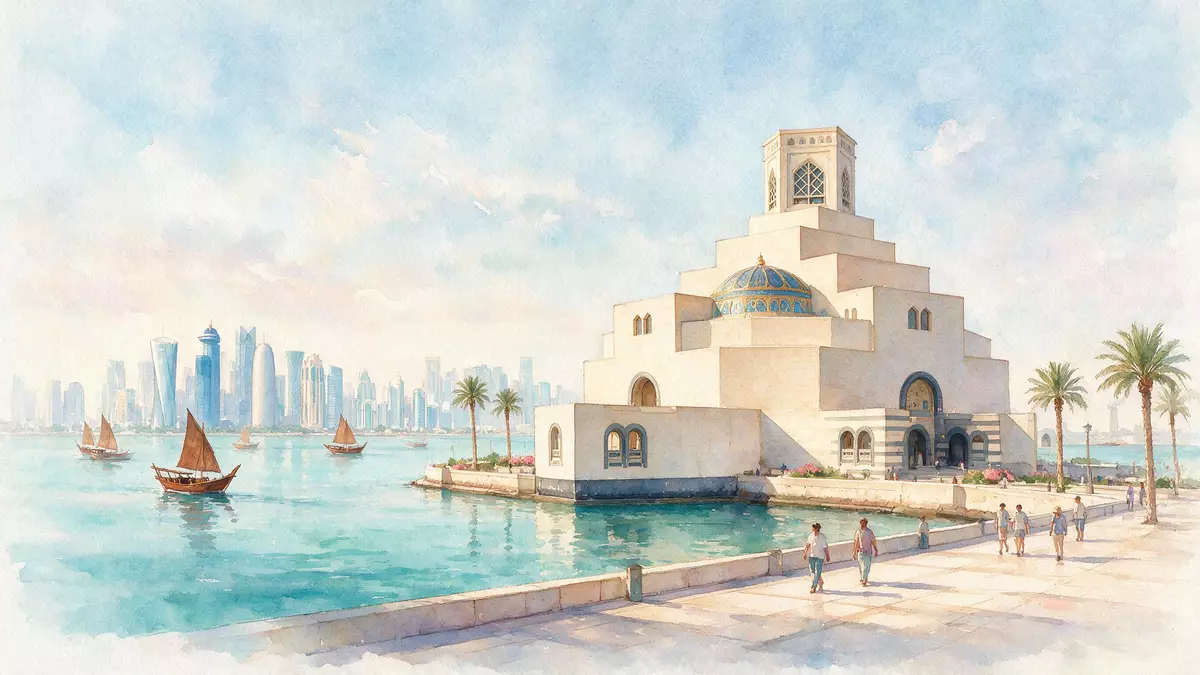
Rising from its own island off Doha’s Corniche, the Museum of Islamic Art combines I. M. Pei’s geometric architecture with galleries that trace more than a millennium of Islamic visual culture. Founded in 2008, it has become a focal point on Qatar’s waterfront, with the city skyline forming a constant backdrop to the museum’s pale stone volumes.
A geometric landmark by I. M. Pei
The Museum of Islamic Art was commissioned in the late 1990s and opened in 2008 as one of the first major projects under Qatar Museums, the body responsible for many of the country’s cultural institutions.Founded in 2008 and designed by the Chinese American architect I. M. Pei, it occupies a man-made island off an artificial peninsula near Doha’s traditional dhow harbour, at one end of the sweeping curve of the Corniche.built on an island
Pei, who had earlier designed the glass pyramid at the Louvre in Paris, worked with a vocabulary of clean lines and interlocking volumes for the Museum of Islamic Art.Pritzker Prize-winning architect I. M. Pei The building rises in stacked blocks of creamy limestone, culminating in a tower-like form that is set back from the water’s edge, with a lower base extending towards the city. The museum’s footprint incorporates a broad forecourt planted with rows of palms, framing the entrance and reinforcing the axial approach from the Corniche.
Interior space and the collection’s historical range
Inside, the Museum of Islamic Art is organised around a grand atrium that rises through several levels beneath a high dome, with galleries radiating from this central space.five-storey-high domed atrium The structural elements and finishes combine stone with metal and glass, forming bridges, staircases and balustrades that connect the different floors. The permanent collection is displayed on multiple levels, grouped conceptually and geographically rather than in a simple chronological sequence.
The museum’s holdings cover works of Islamic art from across Asia, North Africa and parts of Europe, with objects that span from the seventh to the nineteenth century. Metalwork, ceramics, glass, woodwork, textiles and manuscripts are all represented in depth, giving a sense of the diversity of materials and techniques within Islamic artistic traditions.four floors of exhibitions Since its opening in 2008, the museum has also hosted temporary exhibitions that highlight particular regions, themes or artists within Islamic cultures, extending its role beyond a static display of historical artefacts.dynamic programme of temporary exhibitions
Waterfront setting and MIA Park
The Museum of Islamic Art’s position along Doha Bay gives it a strong relationship with water and the broader cityscape. Set slightly apart from the mainland on its own platform, the building is approached by a causeway and framed by landscaped grounds known as MIA Park.purpose-built island abutting the Corniche From the park and the museum’s terraces, the view sweeps across the harbour, where traditional wooden dhows moor, and towards the modern towers of Doha’s business districts.
The park itself is laid out with lawns, pathways and seating areas, forming an open green space that extends the museum’s presence along the waterfront. The ensemble of building, park and bay situates the Museum of Islamic Art within a larger sequence of public spaces and cultural sites on the Corniche, alongside other institutions and landmarks that line this long coastal promenade.museum at one end of the Corniche
Visiting Museum of Islamic Art: what travellers from Western Europe should know
- The Museum of Islamic Art stands on an island off Doha’s Corniche, reached on foot or by road from the city’s waterfront and close to the traditional dhow harbour.
- The approach to the museum and its interior involve substantial walking distances, with broad external steps and internal staircases linking the different gallery levels.
- The museum sits within MIA Park, a landscaped waterfront area that offers open lawns and paved paths along Doha Bay.
- The official language is Arabic and the currency is the Qatari riyal.
- Entry requirements depend on your nationality; UK travellers can check the FCDO travel advice at gov.uk/foreign-travel-advice, Irish travellers the Department of Foreign Affairs at ireland.ie.
Searching for Museum of Islamic Art on social platforms
These links open searches for Museum of Islamic Art on each platform.Frequently asked questions about Museum of Islamic Art
Where is the Museum of Islamic Art located?
The Museum of Islamic Art is in Doha, Qatar, on an island off the city’s Corniche along Doha Bay, near the traditional dhow harbour.
What can visitors expect inside the museum?
Visitors encounter a multi-level atrium with galleries displaying Islamic art from the seventh to the nineteenth century, including ceramics, glass, metalwork, textiles and manuscripts.
What makes the Museum of Islamic Art distinctive?
Its combination of I. M. Pei’s geometric limestone architecture, island setting on the Corniche and wide-ranging collection of Islamic art gives the museum a distinct identity on Doha’s waterfront.


