Museum of Islamic Art and its geometric island silhouette in Doha
Published on 09/14/2026 at 19:13 | Editorial responsibility: Rafael Müller, Editor-in-Chief AD HOC NEWS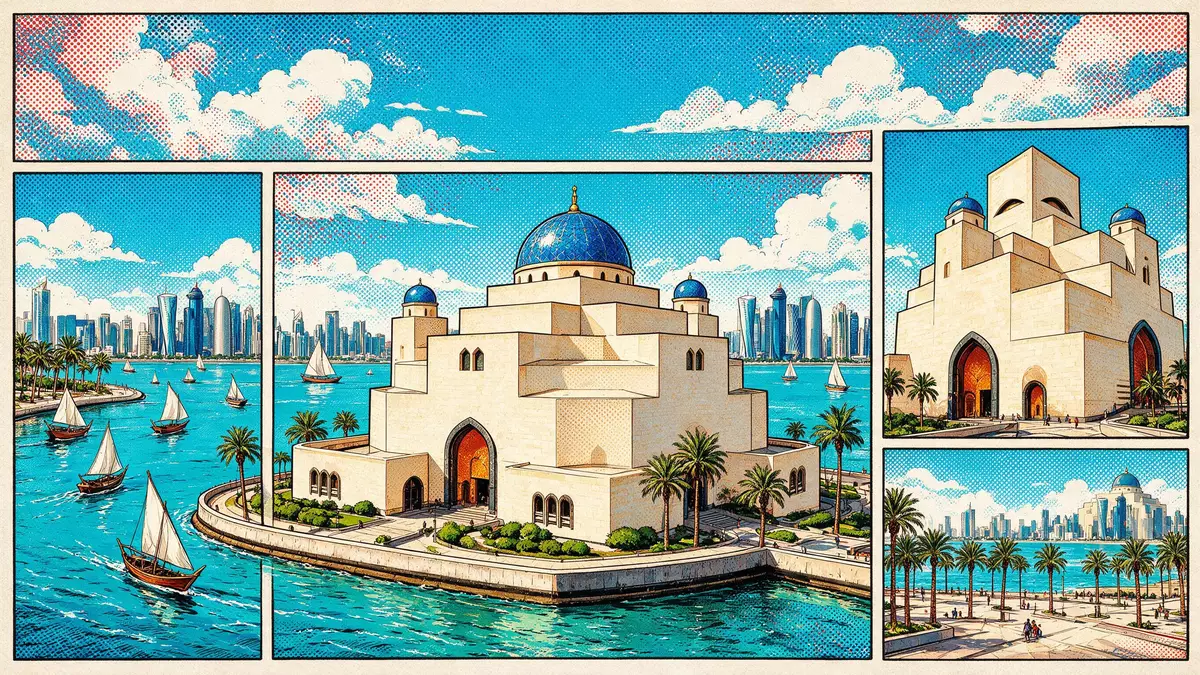
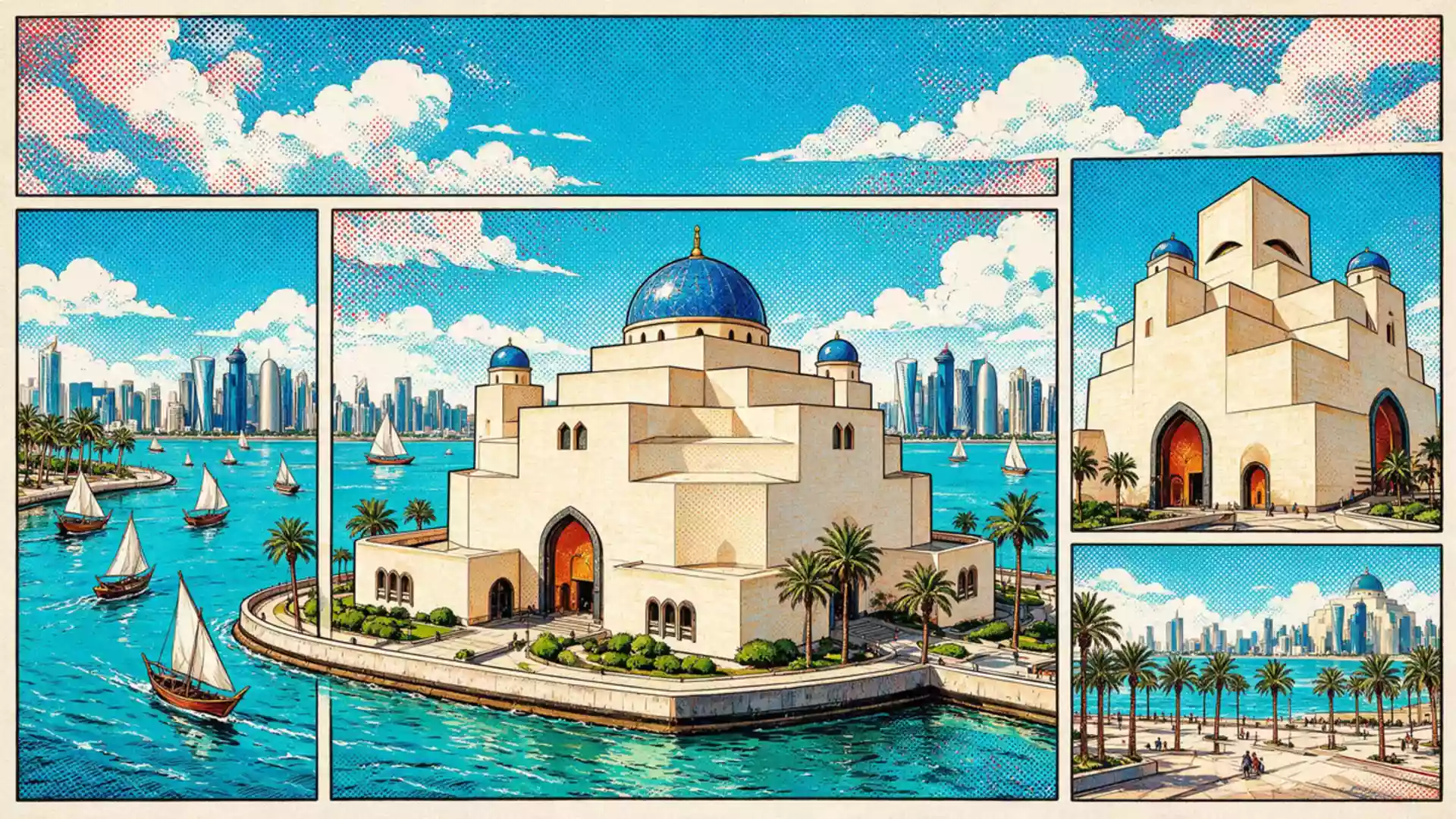
Museum of Islamic Art in Doha stands on its own island off the Corniche, a limestone mass of stacked geometry framed by the waters of the Arabian Gulf and the city skyline beyond. Designed by architect I. M. Pei and opened in 2008, it gathers Islamic artworks from across centuries into a building that is as much a sculptural object as a museum.
An island museum shaped by light and limestone
Museum of Islamic Art occupies an artificial island off Doha’s Corniche, with the Arabian Gulf surrounding the site on three sides and a causeway connecting it to the mainland.It is built on an artificial island located off the coast The approach by road curves away from the waterfront promenade, giving a clear view of the museum’s pale volumes against the water and the towers of West Bay in the distance.
The main building rises in a sequence of geometric forms, with a square base topped by receding layers that culminate in a central tower crowned by a dome. The structure is clad in cream-coloured limestone, chosen for the way it catches the desert light and throws soft shadows across the façades.The cream-coloured limestone exterior captures the changes in light and shade Seen from the Corniche, the museum reads as a composition of sharp edges and smooth planes, with the stone surfaces meeting large areas of glass that face the sea.
A five-storey atrium and galleries of Islamic art
The complex includes a five-storey main building with an adjacent education wing, both linked by a broad courtyard at ground level.MIA’s complex includes a five-storey main building with an adjacent education wing connected by a large central courtyard Inside the main building, visitors step into a high atrium where a grand staircase and suspended chandeliers frame views of the upper galleries and out to the Gulf through a glazed wall. Above, the dome sits over the atrium, its facets catching daylight that filters into the space.
The galleries display manuscripts, ceramics, metalwork, textiles and other objects from across the Islamic world, with works drawn from regions stretching from Spain to India.The museum collects, preserves, studies, and exhibits masterpieces of Islamic art that span three continents from the seventh to the nineteenth centuries Displays trace themes across time, with rooms devoted to calligraphy, scientific instruments, architectural fragments and objects of daily life, arranged so that historical periods and regions can be read through materials and craftsmanship.
I. M. Pei’s late monumental project on the Corniche
Museum of Islamic Art was one of the last major works by I. M. Pei, the Chinese American architect best known in Europe for the Louvre Pyramid in Paris.The Museum of Islamic Art in Doha was designed by the internationally acclaimed Pritzker Prize-winning architect I.M. Pei The project was developed in the early 2000s and the museum opened to the public in December 2008, adding a cultural landmark to the arc of the Corniche.Date of Opening 1 December 2008 The building’s profile, with its stepped forms, references historic Islamic architecture through abstraction rather than replication.
The museum was among the first projects developed under Qatar Museums, the body that oversees many of the country’s cultural institutions.Founded in 2008, the Museum of Islamic Art was one of the first projects initiated by Qatar Museums Its position at one end of the Corniche, near the traditional dhow harbour, places it between the city’s older waterfront and the newer high-rise districts, so that its terraces and windows frame both wooden boats and glass towers.
Waterfront park, causeway and views of Doha Bay
A landscaped park spreads around the base of Museum of Islamic Art on the island, with lawns, planted avenues and a promenade along the water’s edge.The building consists of two interconnected structures, with a central courtyard joining the main building to the educational wing From here, paths lead to viewpoints over Doha Bay, where the museum’s limestone forms are reflected in the water and the skyline of West Bay rises opposite.
The causeway that links the island to the Corniche carries both vehicles and pedestrians, with a separate route for those arriving on foot along the waterfront. On the seaward side of the island, a small harbour accommodates dhows, and from the terraces the view stretches across the curve of Doha’s bay, taking in the Corniche, the old port and the towers of the business district.
Visiting Museum of Islamic Art: what travellers from Western Europe should know
- Museum of Islamic Art stands on an island off the Doha Corniche, connected to the mainland by a causeway that branches from the waterfront road.
- The museum’s approach from the Corniche includes flights of external steps and gently sloping paths, and the park around the building involves walking on open, exposed ground.
- The museum lies in Doha, the capital of Qatar, and the official language is Arabic while the currency is the Qatari riyal.
- Entry requirements depend on your nationality; UK travellers can check the FCDO travel advice at gov.uk/foreign-travel-advice, Irish travellers the Department of Foreign Affairs at ireland.ie.
Searching for Museum of Islamic Art on social platforms
These links open searches for Museum of Islamic Art on each platform.
Frequently asked questions about Museum of Islamic Art
Where is Museum of Islamic Art located in Doha?
Museum of Islamic Art stands on a man-made island off the Corniche in Doha Bay, connected by a causeway near the city’s traditional dhow harbour.
What can visitors expect inside Museum of Islamic Art?
Visitors encounter a high central atrium, upper galleries filled with Islamic art objects from across regions and periods, and additional spaces such as a library and education areas.
What makes Museum of Islamic Art distinctive among museums in the region?
Its combination of I. M. Pei’s geometric limestone architecture, the island setting on the Gulf and a collection spanning centuries of Islamic art gives it a particular character.