
Museo Nacional de Antropologia and the great courtyard of stone and water
Published on 08/21/2026 at 19:37 | Editorial responsibility: Rafael Müller, Editor-in-Chief AD HOC NEWS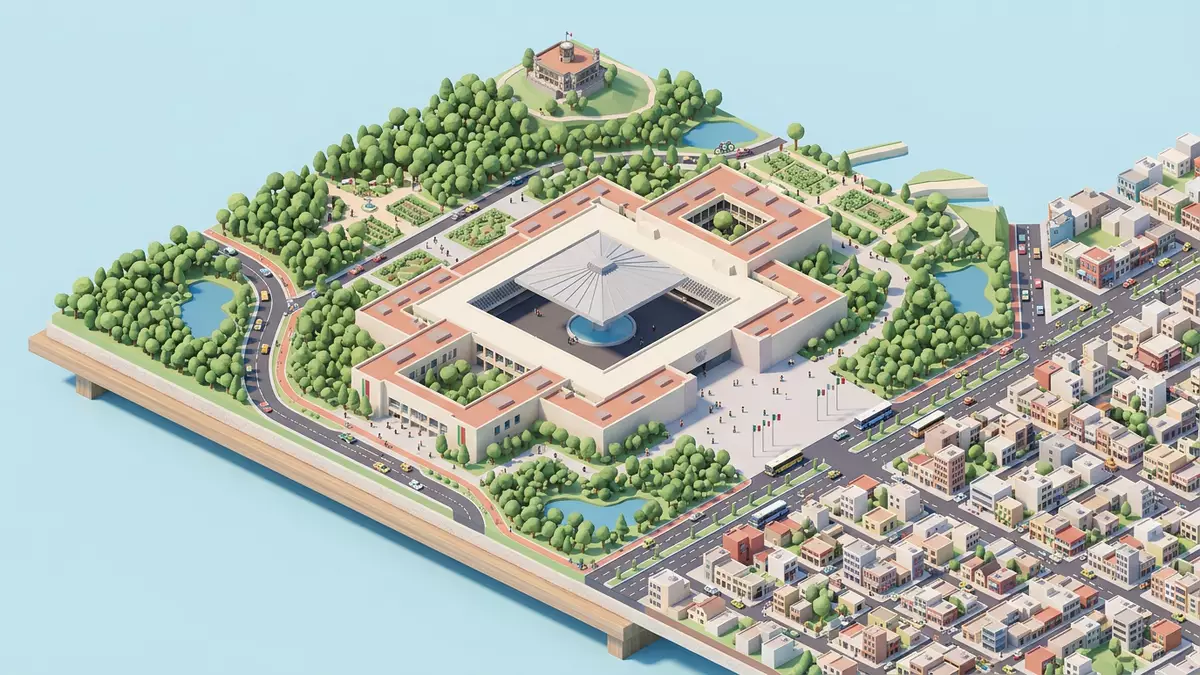
Museo Nacional de Antropologia in Mexiko-Stadt is a museum where the architecture is as memorable as the collections. Opened in 1964 and designed by Pedro Ramírez Vázquez, it arranges Mexico’s ancient and modern cultures around a courtyard framed by long stone galleries.
A modern museum in Chapultepec Park
Museo Nacional de Antropologia stands in the first section of Chapultepec Park, between Paseo de la Reforma and a road named for Mahatma Gandhi in the Miguel Hidalgo district of Mexico City.The museum occupies a site between Paseo de la Reforma and Mahatma Gandhi Street in Chapultepec Park The setting places it among tree-lined avenues and open parkland, with the city’s traffic running along the edge.
The museum is a national institution dedicated to the archaeology and ethnography of Mexico.It is described as a national museum of Mexico Its address on official listings gives Paseo de la Reforma and Calzada Gandhi in the Chapultepec Polanco neighbourhood, tying it closely to one of the capital’s most recognisable boulevards.The location is given as Paseo de la Reforma Avenue and Calzada Gandhi in Chapultepec Polanco
Pedro Ramírez Vázquez and an architecture of courtyards
The building was inaugurated in September 1964 during the presidency of Adolfo López Mateos, with architect Pedro Ramírez Vázquez leading the project alongside collaborators Jorge Campuzano and Rafael Mijares.The project credits Pedro Ramírez Vázquez with collaborators Jorge Campuzano and Rafael Mijares and records an inauguration on 17 September 1964 Construction began in February 1963 and the complex was completed in about 19 months, reflecting an ambitious building programme for a museum of this scale.The construction history records work between February 1963 and September 1964
The design arranges the museum’s halls around a large open courtyard. Long rectangular pavilions form a ring of galleries, with covered walkways facing the courtyard and glazed walls or interior corridors facing the city side.The museum occupies a vast building organised around a central courtyard The architecture draws on modern concrete construction while referencing pre-Hispanic forms in its monumental proportions and use of carved reliefs.
El Paraguas and the central courtyard
At the heart of Museo Nacional de Antropologia stands “El Paraguas”, a vast sculpted canopy supported on a single concrete column in the centre of the courtyard.The central courtyard is sheltered by El Paraguas, a giant carved umbrella supported on a single column with water falling around it Water falls from the edge of the canopy down around the column, creating a continuous curtain that marks the centre of the space without enclosing it.
The courtyard is paved and planted, with the surrounding galleries opening onto it through broad covered walkways. From this space, visitors see the facades of the different halls, some with abstract reliefs referencing pre-Columbian motifs.Commentary on the building highlights a mixture of abstract forms and references to pre-Columbian architecture with great monumentality The combination of stone, concrete and water gives the courtyard a distinct character, making it a gathering point as much as a circulation space.
Visiting Museo Nacional de Antropologia: what travellers from Western Europe should know
- Museo Nacional de Antropologia stands in the Chapultepec Polanco area of Miguel Hidalgo in Mexico City, at the junction of Paseo de la Reforma and Calzada Gandhi.
- The museum is reached by city public transport, with Metro Auditorio on Line 7 and Metro Chapultepec on Line 1 providing access to the surrounding streets.
- The building occupies a large plot inside Chapultepec Park, and visiting the galleries involves walking around an extensive courtyard with long covered walkways.
- The official language is Spanish and the currency is the Mexican peso.
- Entry requirements depend on your nationality; UK travellers can check the FCDO travel advice at gov.uk/foreign-travel-advice, Irish travellers the Department of Foreign Affairs at ireland.ie.
Searching for Museo Nacional de Antropologia on social platforms
These links open searches for Museo Nacional de Antropologia on each platform.
Frequently asked questions about Museo Nacional de Antropologia
Where is Museo Nacional de Antropologia located?
Museo Nacional de Antropologia stands in the first section of Chapultepec Park in the Miguel Hidalgo district of Mexico City, between Paseo de la Reforma and Calzada Gandhi.
What can visitors expect inside the museum?
Visitors encounter archaeological and ethnographic galleries arranged around a large courtyard, with spaces dedicated to cultures such as the Mexica and other regions of Mexico.
What makes the building distinctive?
The combination of a central courtyard, the El Paraguas canopy with falling water and long concrete galleries gives the museum a distinctive modern Mexican architectural character.


