
Museo Nacional de Antropologia and the courtyard of stone and water
Published on 08/29/2026 at 16:44 | Editorial responsibility: Rafael Müller, Editor-in-Chief AD HOC NEWS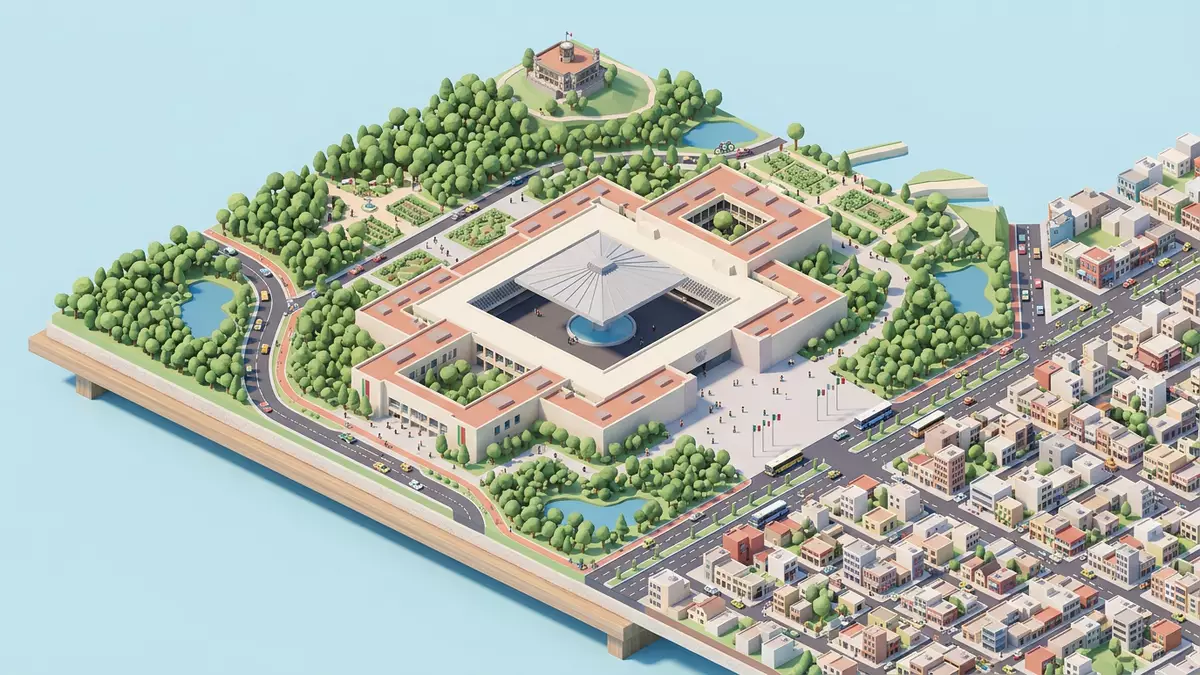
Museo Nacional de Antropologia in Mexiko-Stadt is both a landmark of Mexican modernist architecture and a vast museum of pre-Hispanic and indigenous cultures, centred on a courtyard of stone, water and carved reliefs. Opened in 1964 and designed under the direction of architect Pedro Ramírez Vázquez, it gathers Mexico’s archaeological and ethnographic collections under a single concrete roof in Bosque de Chapultepec.
A modern museum built around an open courtyard
Museo Nacional de Antropologia opened in 1964 during the presidency of Adolfo López Mateos, bringing together collections that had been assembled since the late eighteenth century, including the Aztec Stone of the Sun.The museum opened in 1964 The project was led by Mexican architect Pedro Ramírez Vázquez, working with collaborators Jorge Campuzano and Rafael Mijares, and the building was completed in a construction campaign recorded as lasting about 19 months between 1963 and 1964.Pedro Ramírez Vázquez worked with Rafael Mijares and Jorge Campuzano
The museum stands along Avenida Paseo de la Reforma on the edge of Bosque de Chapultepec, within the Miguel Hidalgo district of Mexico City.The address on Paseo de la Reforma places the museum beside Chapultepec The complex covers a large area, with long, low wings around a central open space, and has become a reference point in twentieth-century Mexican architecture for its combination of abstract geometry, exposed concrete and references to pre-Hispanic forms.The museum is described as a milestone of modern Mexican architecture
El Paraguas: the great umbrella of concrete and falling water
The defining feature of Museo Nacional de Antropologia is the large central courtyard dominated by El Paraguas, a vast concrete roof plate supported by a single sculpted column from which water falls in a continuous curtain.The roof, called El Paraguas, is supported by a single column The cantilevered roof has been documented with a span of roughly 82 by 54 metres, and it hovers above the paved courtyard so that the falling water marks the centre of the museum in both plan and sound.Measurements for the cantilevered roof span are recorded
Around this space, long galleries in concrete and stone open towards the courtyard, with reliefs and motifs that reference pre-Hispanic iconography such as serpents and shells.The building façade uses allegorical references to pre-Hispanic symbols The courtyard floor is paved and largely level, broken by the pool around the central column and by planted areas, so the full height of the column and the breadth of the roof can be taken in from multiple points along the perimeter.
Galleries that trace Mexico’s ancient and living cultures
Inside, Museo Nacional de Antropologia presents archaeological and ethnographic collections that cover Mexico’s territory from early human settlement through major pre-Hispanic civilisations and into the present.The museum holds archaeological and ethnographic collections The ground-floor galleries concentrate on archaeological cultures such as the Olmec, Maya and Mexica (Aztec), with large-scale stone sculptures, stelae, relief panels and temple elements displayed in spacious rooms that often open towards the courtyard.Ground-floor halls present pre-Hispanic cultures region by region
The upper level is organised as a sequence of ethnographic halls showing the material culture of indigenous communities across regions such as the north, the Gulf, Oaxaca and the Yucatán peninsula.Ethnographic halls occupy the upper level Among the most visited objects are the Stone of the Sun from the Mexica Templo Mayor precinct and colossal basalt heads from the Olmec heartlands of Tabasco and Veracruz, displayed with clear sightlines that emphasise their scale and carving.The Stone of the Sun and Olmec heads form part of the collection
Visiting Museo Nacional de Antropologia: what travellers from Western Europe should know
- Museo Nacional de Antropologia stands along Paseo de la Reforma beside Bosque de Chapultepec, in the Miguel Hidalgo district of Mexico City; the nearest surroundings include several other major museums.
- The building is spread horizontally rather than vertically, which means a visit involves substantial walking along level internal corridors and across the open courtyard.
- The courtyard around El Paraguas is open to the sky beyond the large concrete roof, so surfaces can be wet near the central column when the water curtain is running.
- Mexico’s official language is Spanish and the currency is the Mexican peso.
- Entry requirements depend on your nationality; UK travellers can check the FCDO travel advice at gov.uk/foreign-travel-advice, Irish travellers the Department of Foreign Affairs at ireland.ie.
Searching for Museo Nacional de Antropologia on social platforms
These links open searches for Museo Nacional de Antropologia on each platform.
Frequently asked questions about Museo Nacional de Antropologia
Where is Museo Nacional de Antropologia located?
Museo Nacional de Antropologia stands along Paseo de la Reforma beside Bosque de Chapultepec in the Miguel Hidalgo district of Mexico City.
What can visitors expect inside Museo Nacional de Antropologia?
Visitors encounter extensive archaeological galleries on the ground floor and ethnographic halls above, arranged around a central courtyard dominated by the El Paraguas roof and water column.
What makes Museo Nacional de Antropologia distinctive among museums?
The combination of a monumental concrete courtyard with a single-column umbrella roof and a comprehensive collection of Mexico’s ancient and indigenous cultures gives the museum its distinctive character.


