
Museo Nacional de Antropologia and its umbrella of stone
Published on 09/22/2026 at 09:49 | Editorial responsibility: Rafael Müller, Editor-in-Chief AD HOC NEWS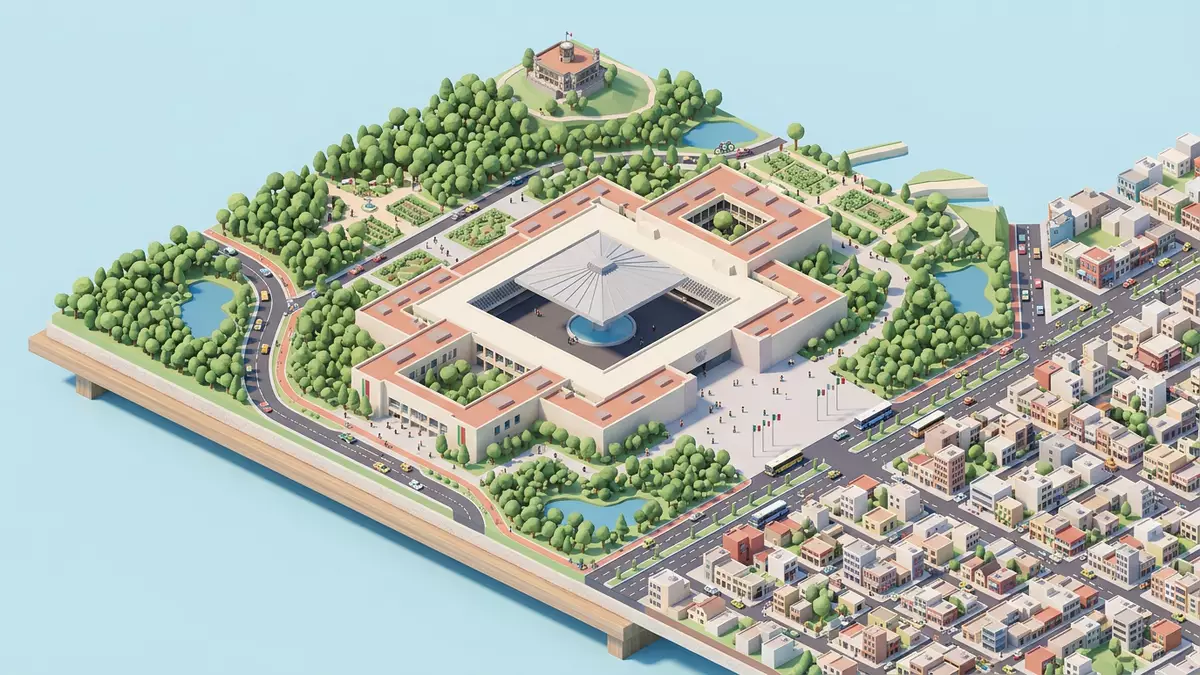
Museo Nacional de Antropologia is a museum in Mexiko-Stadt organised around a broad central courtyard and a monumental roof canopy. Its galleries present the cultures of Mexico from the earliest settled societies through the Spanish conquest and into the living traditions of Indigenous communities.
The museum opened in 1964, and the architect Pedro Ramírez Vázquez led its design. A single sculptural column supports the central canopy, while the courtyard, water and surrounding galleries form the building’s most recognisable architectural composition.
A courtyard beneath a single sculptural roof
The museum’s central courtyard is dominated by an immense roof supported by a column known as El Paraguas, or “The Umbrella”. Water falls beside the column, creating a strong vertical element beneath the horizontal canopy.
The canopy is not a separate ornament placed beside the galleries. It is part of the museum’s main spatial arrangement, with the exhibition rooms extending around the courtyard. The open centre brings sky, planting and water into the heart of a large cultural complex.
Pedro Ramírez Vázquez designed the museum with Jorge Campuzano and Rafael Mijares Alcérreca. The building uses reinforced concrete and a disciplined modernist vocabulary, while its scale and courtyard arrangement connect it with architectural traditions found across Mexico.
The museum’s address is on Avenida Paseo de la Reforma, beside Chapultepec Park. Its architecture therefore combines a formal urban frontage with an interior sequence of shaded galleries, courtyards and archaeological displays.
Mexico’s civilisations arranged in connected galleries
The collections are divided into archaeology and ethnography. Archaeological rooms examine societies that developed across the territory of present-day Mexico before Spanish rule, while ethnographic rooms present Indigenous peoples and their cultural practices.
The archaeological collection includes objects associated with the Mexica, Maya, Teotihuacan, Olmec, Zapotec and Mixtec cultures. Stone sculpture, ceramics, jewellery and monumental fragments appear alongside maps, reconstructions and explanatory displays.
A colossal stone head from the Olmec tradition is among the museum’s most recognisable objects. The Mexica gallery includes the Piedra del Sol, the large carved stone commonly known in English as the Aztec calendar stone.
The museum also presents material from Teotihuacan, the ancient city whose monumental pyramids and planned avenues shaped the history of central Mexico. Other galleries examine Oaxaca, the Maya world and northern Mexican cultures.
Ethnographic displays occupy the upper level. Textiles, masks, tools, musical instruments, domestic objects and ceremonial materials show the variety of communities living across Mexico’s regions.
The arrangement creates a dialogue between objects from distant periods and the communities whose traditions continue in Mexico. The museum is therefore both an archaeological institution and a place devoted to living cultural identities.
From ancient stonework to living traditions
The museum’s historical range is broad, but its strongest visual language comes from stone. Carved figures, reliefs, stelae and architectural fragments appear in rooms and courtyards, while reproductions and reconstructed settings suggest the scale of ancient ceremonial spaces.
The Mexica gallery is connected with Tenochtitlan, the capital established on an island in Lake Texcoco. The city became the centre of the Mexica empire before the Spanish conquest in 1521.
Maya objects are presented within a wider cultural area that extended across southern Mexico and parts of Central America. Hieroglyphic inscriptions, carved monuments and jade objects reveal a tradition with its own systems of writing, rulership and ritual.
The museum’s galleries also include the Olmec civilisation of the Gulf Coast, Teotihuacan in the Basin of Mexico, and the Zapotec and Mixtec cultures of Oaxaca. Each collection has its own materials, visual conventions and historical setting.
Large open spaces provide a counterpoint to the smaller objects in display cases. A carved monument can occupy an entire room, while a delicate ornament may require close attention. The museum moves repeatedly between monumental scale and finely worked detail.
The building’s courtyard remains central to this experience. The umbrella-like canopy, the falling water and the planted areas create a visible link between architecture and the museum’s collections without imitating an archaeological site.
Museo Nacional de Antropologia is part of Mexico’s national cultural institutions and remains closely associated with the presentation of the country’s pre-Hispanic heritage. Its collections are organised geographically and historically, giving the museum a clear relationship with Mexico’s regions.
Visiting Museo Nacional de Antropologia: what travellers from Western Europe should know
- Museo Nacional de Antropologia stands on Avenida Paseo de la Reforma beside Chapultepec Park in Mexiko-Stadt. The nearest Metro station is Auditorio, and city buses run along Reforma.
- The museum occupies a large complex with galleries on more than one level. The central courtyard includes paved routes, planting, water and the broad canopy of El Paraguas.
- The official language is Spanish and the currency is the Mexican peso.
- Chapultepec Park, Castillo de Chapultepec and the Museo de Arte Moderno are close to the museum on the same side of the city’s principal park.
Searching for Museo Nacional de Antropologia on social platforms
These links open searches for Museo Nacional de Antropologia on each platform.
Frequently asked questions about Museo Nacional de Antropologia
Where is Museo Nacional de Antropologia?
The museum is on Avenida Paseo de la Reforma beside Chapultepec Park in Mexiko-Stadt. Auditorio is the nearest Metro station.
What can visitors see inside?
The galleries contain archaeological objects from Mexico’s pre-Hispanic cultures and ethnographic displays about Indigenous communities.
What makes the museum distinctive?
Its central courtyard is covered by the large umbrella-like canopy of El Paraguas, supported by a sculptural column beside falling water.


