
Museo Guggenheim Bilbao and its titanium riverside architecture
Published on 09/21/2026 at 21:23 | Editorial responsibility: Rafael Müller, Editor-in-Chief AD HOC NEWS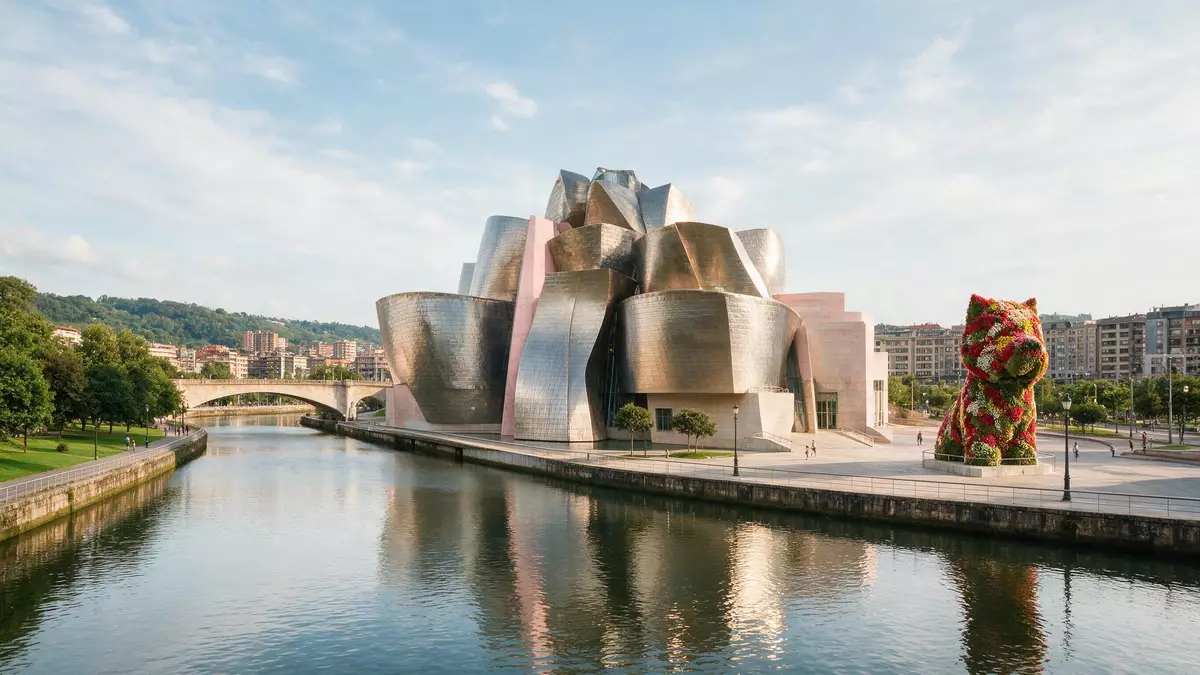
Museo Guggenheim Bilbao is a contemporary art museum on the riverfront in Bilbao, where architect Frank Gehry’s titanium, limestone and glass building has become a landmark of late twentieth-century design. Opened on 18 October 1997, it stands in Spain’s Basque Country as an encounter between sculptural architecture and modern and contemporary art.
Titanium, limestone and glass on the Nervión River
The museum occupies a riverside plot in the Abandoibarra district of Bilbao, alongside the Nervión River that runs through the city towards the Cantabrian Sea. Gehry’s design places the building on a bend in the river, so that its large forms and terraces engage directly with the waterfront and nearby bridges.Abandoibarra location
The outer skin of Museo Guggenheim Bilbao combines three principal materials: thin titanium panels, blocks of Spanish limestone and extensive glass surfaces.titanium sheets with limestone and glass Around 24,000 m² (258,000 sq ft) of floor area is organised within this envelope, with thousands of individual titanium tiles giving the building its metallic character.24,000 m² total floor area
Frank Gehry’s deconstructivist forms and central atrium
Museo Guggenheim Bilbao was designed by Canadian-American architect Frank Gehry of Gehry Partners, following an invited competition in the early 1990s.building by architect Frank Gehry Construction began in October 1993 and was completed in October 1997, with the museum inaugurated on 18 October 1997 as part of the Guggenheim Foundation network of institutions dedicated to modern and contemporary art.construction from October 1993 to October 1997
Architecturally, the building is associated with deconstructivist design, a movement that embraces fragmented forms, non-orthogonal geometries and expressive materials.association with deconstructivist architecture Titanium-clad volumes, limestone walls and glazed elements gather around a tall central atrium, from which walkways and staircases extend towards galleries of different sizes, including a very large space intended for monumental installations.
Galleries, artworks and riverside setting
Inside Museo Guggenheim Bilbao, exhibition spaces occupy thousands of square metres across a series of galleries that vary in height and plan, reflecting the complex external geometry. The largest gallery stretches for around 130 m (426 ft) along the riverfront and has been used for works on a grand scale, while more compact rooms host paintings, sculptures and media works.large riverfront gallery dimensions
The museum belongs to the Solomon R. Guggenheim Foundation family of museums and focuses on twentieth- and twenty-first-century art, with permanent installations and changing exhibitions in its galleries.contemporary art museum housing exhibitions Outside, the riverside paths, nearby bridges and public spaces frame views of the building’s titanium, limestone and glass surfaces, making the structure itself part of the experience of visiting the city’s renewed waterfront.
Visiting Museo Guggenheim Bilbao: what travellers from Western Europe should know
- Museo Guggenheim Bilbao stands in Abandoibarra in Bilbao, beside the Nervión River, within walking distance of the city’s central railway station and tram stops.
- The museum building rises from a riverside platform with steps and sloping walkways linking different levels between the street, the riverbank and the entrance.
- Bilbao lies in northern Spain’s Basque Country; the official languages are Spanish and Basque and the currency is the euro.
- The museum is close to other named sites along the river, including bridges and parks that can be reached on foot from the building.
Searching for Museo Guggenheim Bilbao on social platforms
These links open searches for Museo Guggenheim Bilbao on each platform.
Frequently asked questions about Museo Guggenheim Bilbao
Where is Museo Guggenheim Bilbao located?
Museo Guggenheim Bilbao stands in the Abandoibarra area of Bilbao in northern Spain, beside the Nervión River and close to the city centre.
What can visitors expect inside the museum?
Visitors encounter modern and contemporary artworks in galleries of varied sizes, arranged around a high central atrium that is itself an architectural highlight.
What makes Museo Guggenheim Bilbao distinctive?
The museum is distinctive for Gehry’s titanium, limestone and glass building, opened in 1997, whose sculptural riverside forms have become closely associated with Bilbao’s transformation.


