
Museo Egizio in Turin: an ancient world inside a Baroque palace
Published on 09/23/2026 at 21:50 | Editorial responsibility: Rafael Müller, Editor-in-Chief AD HOC NEWS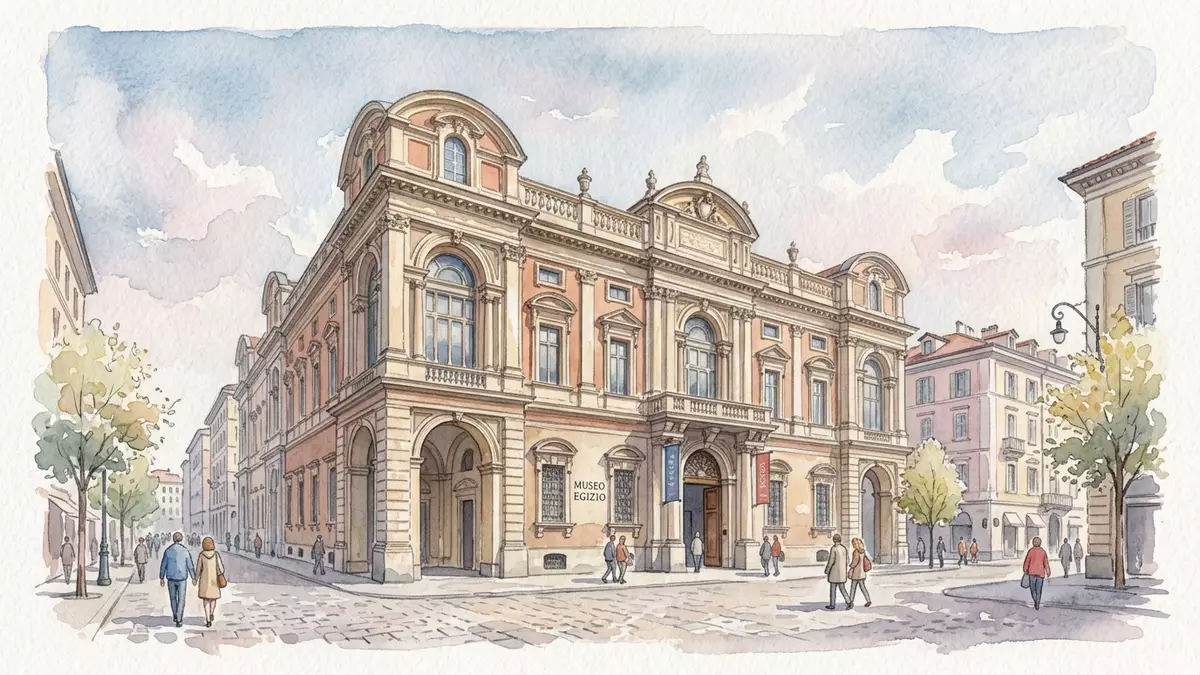
Museo Egizio occupies a Baroque palace in central Turin, yet its galleries preserve the material world of ancient Egypt. Founded in 1824 by King Carlo Felice of Savoy, the museum brings architecture from Piedmont into direct contact with statues, papyri, coffins and everyday objects from the Nile Valley.
The contrast begins at the entrance on Via Accademia delle Scienze. Beyond the urban palace façade, the collections extend across thousands of years, from prehistoric Egypt to the Coptic era. Museo Egizio is both a museum in a historic Turin building and a detailed record of Egyptian religious, royal and domestic life.
Museo Egizio began with Carlo Felice and Bernardino Drovetti
The museum’s foundation belongs to the early nineteenth century. In 1824, Carlo Felice purchased the collection assembled by Bernardino Drovetti, a Piedmontese diplomat who served as French consul in Egypt. The acquisition established the institution devoted entirely to ancient Egyptian culture.
The first displays were housed in the Collegio dei Nobili, a building begun from a design by Michelangelo Garove in 1679. The palace became the permanent setting for the Egyptian collection, linking a Turin institution with objects originating from temples, tombs, settlements and workshops along the Nile. the museum’s early history records this foundation and the building’s role.
Its collections grew through acquisitions and archaeological work. Ernesto Schiaparelli directed excavations in Egypt during the early twentieth century, and objects from those campaigns entered the Turin holdings. The result is a collection that connects royal monuments with smaller pieces of material culture.
From monumental statues to the details of daily life
Museo Egizio preserves about 40,000 objects, with material ranging from the Palaeolithic period to the Coptic era. The holdings include sculpture, funerary equipment, papyri, textiles, tools, jewellery and objects associated with religious practice.
Large stone figures provide the most immediate sense of scale. Statues of rulers and deities carry inscriptions, poses and attributes that identify their political or sacred roles. Reliefs and architectural fragments retain carved signs, while smaller objects show how writing, craft and ritual appeared in ordinary settings. the collection and research programme connects objects with the study of Egyptian history.
The funerary material forms a major part of the museum’s identity. Coffins, mummies, canopic equipment and Books of the Dead express beliefs about death, identity and the passage into the afterlife. Painted surfaces, hieroglyphic texts and carefully shaped containers make each object both an artwork and a historical document.
The tomb of Kha and Merit adds a concentrated view of elite life. Their funerary furnishings include coffins, furniture, clothing and personal objects. Together, these pieces show the relationship between domestic possessions and burial customs in ancient Egypt.
A seventeenth-century palace for an Egyptian collection
The museum remains within the former Collegio dei Nobili, part of the Palazzo dell’Accademia delle Scienze. Michelangelo Garove’s late seventeenth-century design gives the institution its Turin setting: courtyards, formal rooms and a restrained Baroque exterior frame galleries dedicated to another civilisation.
This arrangement creates a visible dialogue between two kinds of historic fabric. The palace belongs to the architectural history of Savoyard Turin, while the objects inside preserve temples, tombs and settlements from Egypt. A carved royal statue can therefore appear within a room shaped by the urban culture of northern Italy.
Museo Egizio’s address is Via Accademia delle Scienze 6, close to Piazza Castello and Turin’s historic centre. The museum’s identity rests on this fixed relationship between place and collection: ancient Egyptian archaeology is presented within a palace built for the intellectual institutions of Piedmont.
The displays also move between monumental and intimate scales. A large sculpture represents kingship in stone; a papyrus preserves writing on a fragile surface; jewellery, tools and household objects record individual lives. The range makes the collection a sequence of connected human activities rather than a display of monuments alone.
Research remains part of the museum’s work. Cataloguing, conservation, digital epigraphy and the study of papyri extend beyond the galleries, giving objects a continuing scholarly life. Museo Egizio in Turin combines exhibition rooms with collection-based research.
Visiting Museo Egizio: what travellers from Western Europe should know
- Museo Egizio stands at Via Accademia delle Scienze 6 in Turin’s historic centre, near Piazza Castello. Turin’s rail network and urban buses connect the centre with the wider city.
- The museum occupies a historic palace with courtyards, staircases and several gallery levels. The visit involves indoor walking between rooms containing both large monuments and small cases.
- The official language is Italian and the currency is the euro.
- Palazzo Madama, the Royal Palace of Turin and the central squares of the Savoy capital lie close to the museum.
Searching for Museo Egizio on social platforms
These links open searches for Museo Egizio on each platform.
Frequently asked questions about Museo Egizio
Where is Museo Egizio?
Museo Egizio is at Via Accademia delle Scienze 6 in central Turin, within the former Collegio dei Nobili and near Piazza Castello.
What can visitors see inside?
The galleries contain statues, reliefs, papyri, coffins, mummies, jewellery, tools and objects from Egyptian history. The collections span the Palaeolithic period to the Coptic era.
What makes Museo Egizio distinctive?
Its Egyptian collections occupy a Baroque palace in Turin. Founded in 1824 by Carlo Felice of Savoy, the museum joins a Piedmontese historic building with archaeology from the Nile Valley.


