
Museo del Oro in Bogota and its pre-Hispanic gold worlds
Published on 09/14/2026 at 14:28 | Editorial responsibility: Rafael Müller, Editor-in-Chief AD HOC NEWS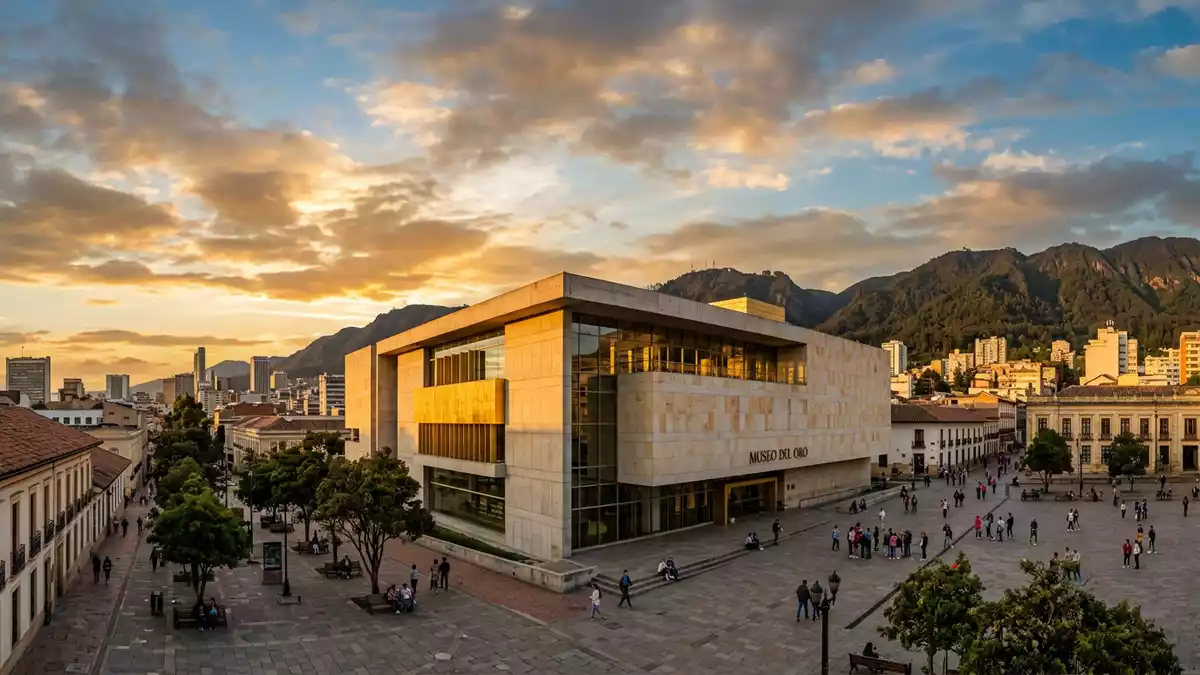
Museo del Oro in Bogota is an archaeology museum dedicated to pre-Hispanic goldwork, set in a modernist building on the edge of Santander Park in the historic centre of Colombia’s capital. The museum belongs to Banco de la República and took shape in the mid?twentieth century as a permanent home for an expanding collection of indigenous metalwork.
A modern museum for ancient metal
Museo del Oro occupies a purpose-built concrete and glass structure designed by Colombian architect Germán Samper Gnecco, whose project was inaugurated in 1968 beside Santander Park.designed by Germán Samper Gnecco and inaugurated in 1968 The building lines one side of the park at the junction of Carrera 6 and Calle 16, within the La Candelaria district where Bogota’s colonial streets and civic squares converge.situated in one corner of Santander Park between 6th Avenue and 16th Street
The museum’s architecture follows clean horizontal lines, with a solid base containing exhibition rooms and upper levels set back above, and broad façades punctuated by windows and metallic detailing. Inside, exhibition floors are arranged around circulation cores, so visitors move through successive galleries where low light levels, dark surfaces and carefully focused display cases place the emphasis on the gleam of gold.
The world’s largest pre-Hispanic goldwork collection
The core of Museo del Oro is a collection of tens of thousands of artefacts produced by societies that inhabited the territory of present?day Colombia before Spanish colonisation.pieces of orfebrería and alfarería from pre-Columbian cultures of present-day Colombia The museum holds more than 34,000 objects made in gold and related alloys, alongside many thousands of items in ceramic, stone, shell, bone and textiles.more than 34,000 pieces of gold and tumbaga and around 25,000 other objects
Named cultural groups such as the Muisca, Quimbaya, Calima, Tayrona, Zenú, Tolima and Tumaco are represented through their distinctive metalwork and ceramics, from miniature figurines and nose ornaments to large votive pieces and ritual vessels.objects belonging to cultures including Quimbaya, Calima, Tayrona, Zenú, Muisca, Tolima and Tumaco Galleries combine individual display mounts and full cases to show how gold was shaped into animal forms, geometric patterns and anthropomorphic figures, while accompanying texts explain the geographical regions and social contexts in which the pieces were produced.
Exhibitions, layout and setting in La Candelaria
The permanent exhibition is spread across multiple levels, with thematic rooms devoted to techniques of metalworking, regional variations and the symbolism of gold in ritual and daily life.Gold Museum visit information describing its thematic rooms One of the most striking spaces is an enclosed room where gold objects are displayed in a circular arrangement and light sequences highlight different clusters, emphasising the density of the collection.
Museo del Oro stands in La Candelaria, Bogota’s historic core, at Carrera 6 between Calle 15 and Calle 16, a short walk from Plaza de Bolívar and the cathedral.a museum in La Candelaria with its entrance on Carrera 6 number 15-82 by Santander Park The park frontage brings daylight, trees and city life to the threshold, while the interior maintains controlled conditions for fragile archaeological material. Around the museum, streets lined with republican and colonial buildings, bookshops and cafés make it easy to combine a visit to the collections with time in the older quarters of Colombia’s capital.
Visiting Museo del Oro: what travellers from Western Europe should know
- Museo del Oro stands on the north-eastern side of Santander Park in La Candelaria, reached along Carrera 6 and Calle 16 in central Bogota, with a TransMilenio station named Museo del Oro a short walk away.
- The museum interior is arranged over several floors connected by lifts and staircases, with some exhibition rooms kept at low light levels and others forming enclosed spaces where visitors stand among closely spaced display cases.
- The official language is Spanish and the currency is the Colombian peso.
- Entry requirements depend on your nationality; UK travellers can check the FCDO travel advice at gov.uk/foreign-travel-advice, Irish travellers the Department of Foreign Affairs at ireland.ie.
Searching for Museo del Oro on social platforms
These links open searches for Museo del Oro on each platform.
Frequently asked questions about Museo del Oro
Where is Museo del Oro located in Bogota?
Museo del Oro stands beside Santander Park in the La Candelaria district of central Bogota, at the junction of Carrera 6 and Calle 16.
What can visitors expect inside Museo del Oro?
Visitors move through a series of galleries displaying pre-Hispanic goldwork, ceramics and other archaeological material from Colombia’s indigenous cultures, arranged in thematic and regional rooms.
What makes Museo del Oro distinctive among museums?
Museo del Oro is distinctive for its very large collection of pre-Hispanic gold artefacts and its dedicated modern building, which together present Colombia’s ancient metalworking traditions on an exceptional scale.


