
Musei Vaticani and the long corridors of papal art
Published on 08/28/2026 at 17:20 | Editorial responsibility: Rafael Müller, Editor-in-Chief AD HOC NEWS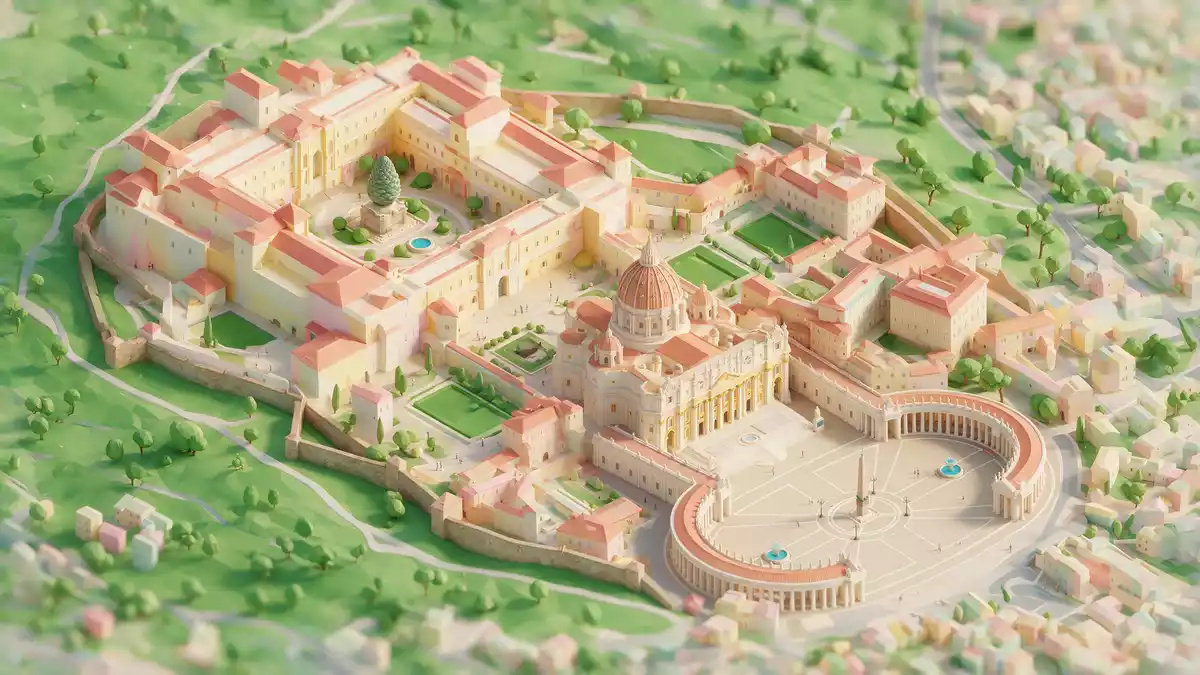
Musei Vaticani in Vatikanstadt is not a compact museum but a chain of palatial galleries, chapels and courtyards arranged along long ceremonial corridors inside the Vatican Palace. Founded as the public museums of the Holy See, they grew from collections assembled under popes such as Julius II in the early sixteenth century and now stretch across a complex begun in the Renaissance and expanded in later centuries.public museums of the Vatican City
Corridors as a route through papal history
The defining experience of Musei Vaticani is the walk along its corridors, where a practical circulation route becomes a grand sequence of state rooms hung with tapestries, maps and frescoes. The Gallery of the Tapestries and the Gallery of the Geographical Maps line these passageways with textiles and painted cartography, turning a simple connection between palace wings into a historical panorama of papal territories and devotional imagery.Gallery of the Tapestries Ceiling frescoes, stucco frames and marble floors emphasise the corridor’s length, drawing the eye forward while the collections unfold along the sides.
Beyond these famous galleries, smaller passageways link museums that focus on specific themes, from ancient sculpture to Christian antiquities. The Pio Clementino Museum presents classical statues and reliefs within vaulted rooms that open off the route, while the Gregorian Egyptian and Gregorian Etruscan Museums gather artefacts from ancient cultures in cabinets and halls further along the palace.Pio Clementino Museum The corridor system acts as a spine linking these specialised spaces, so that a visitor passes from sarcophagi and sculptures to maps and tapestries without stepping outside.
From Julius II to Raphael’s Rooms and the Sistine Chapel
The origins of Musei Vaticani reach back to 1506, when Pope Julius II ordered the display of classical sculpture in the Vatican Palace, a date regarded as the formal establishment of the museums.Established 1506 These early collections were housed in courtyards and loggias designed by architects such as Donato Bramante, whose work helped shape the palace complex that still contains parts of the museum route. Over the following centuries, successive popes expanded the collections to include archaeological material, religious art and ethnological objects, gradually turning private displays into an institution open to pilgrims and scholars.
Among the most renowned interiors along the museum route are Raphael’s Rooms, a suite of papal apartments decorated in the sixteenth century with frescoes by Raphael and his workshop.Raphael's Rooms Here the corridor system briefly narrows into domestic rooms where walls carry narrative scenes such as “The School of Athens”, painted directly onto the plaster while the papal court still occupied the space. Further along lies the Sistine Chapel, structurally a chapel of the Apostolic Palace but approached on foot through the museum galleries; its fifteenth-century fresco cycle and Michelangelo’s later ceiling form part of the visit even though the chapel retains its liturgical role.Sistine Chapel ceiling by Michelangelo
Collections across multiple museums and courtyards
Musei Vaticani comprises a group of separate museums, each dedicated to a particular collection, rather than a single undifferentiated gallery. The Chiaramonti Museum and its Lapidary Gallery focus on inscriptions and Roman sculpture, arranging statues along arcades and walls in long ranks.Chiaramonti Museum Nearby, the New Wing provides further space for ancient works, while the Christian Museum and Pius-Christian Museum bring together artefacts from early Christian history.
Other parts of the complex show how papal collecting adapted to later centuries. The Borgia Apartment carries frescoes from the Renaissance, while the Collection of Modern and Contemporary Art introduces works from the twentieth century and beyond into the Vatican context.Collection of Modern and Contemporary Art Courtyards such as the Cortile della Pigna, named after the bronze pinecone at its centre, open up the route with outdoor sculpture displays framed by the palace architecture. Taken together, these museums and courts form a continuous environment where sculpture, painting, maps and decorative arts occupy both formal state rooms and transitional spaces.
Visiting Musei Vaticani: what travellers from Western Europe should know
- Musei Vaticani stands within Vatikanstadt, entered from the northern side of the Vatican walls near Viale Vaticano in Rome, and is reached on foot or by city transport.
- The visit involves long walks along corridors, staircases between levels and time spent standing in galleries and chapels, including access to the Sistine Chapel via interior routes.
- The official language of Vatikanstadt is Italian and the currency is the euro.
Searching for Musei Vaticani on social platforms
These links open searches for Musei Vaticani on each platform.Frequently asked questions about Musei Vaticani
Where are Musei Vaticani located?
Musei Vaticani occupy part of the Vatican Palace inside Vatikanstadt, with visitor access from the northern boundary facing Viale Vaticano in Rome.
What should visitors expect on a visit to Musei Vaticani?
A visit involves moving through long corridors and state rooms containing themed museums, chapels such as the Sistine Chapel and outdoor courtyards with sculpture.
What makes Musei Vaticani distinctive among European museums?
Musei Vaticani combine papal apartments, chapels and courtyards with collections ranging from ancient sculpture to modern art, arranged along a ceremonial route inside a living palace.


