
Musee du Louvre where a medieval fortress meets glass
Published on 09/23/2026 at 17:10 | Editorial responsibility: Rafael Müller, Editor-in-Chief AD HOC NEWS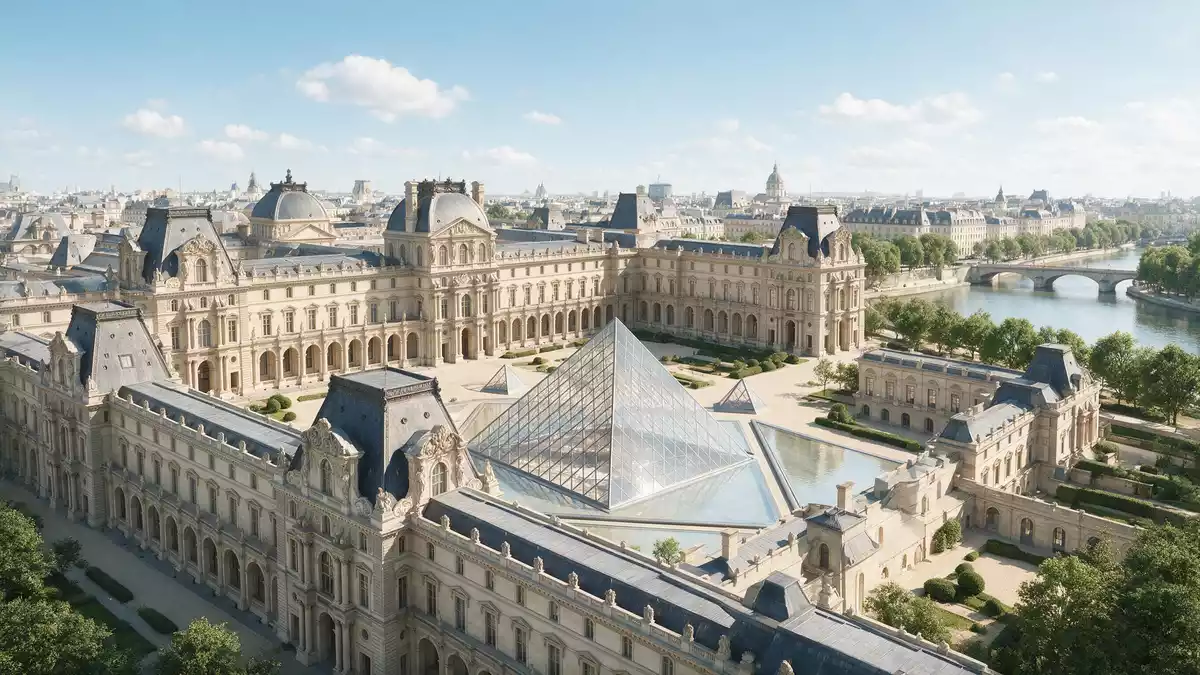
Musee du Louvre occupies a Paris palace whose courtyards contain a medieval fortress, Renaissance façades, classical colonnades and I.M. Pei’s glass pyramid. The museum’s visible identity is therefore architectural as well as artistic: stone galleries and transparent glass share the same complex.
Musee du Louvre and the fortress beneath the palace
Philippe Auguste began the Louvre as a fortress in 1190, with defensive walls beside the Seine. The remains of that medieval structure survive in the lower levels, where visitors can see masonry connected with the earliest phase of the site.
The building became a royal residence in 1364. Its form changed across the centuries, and the palace gathered medieval, Renaissance and classical elements within an expanding plan. The Grande Galerie was built between 1595 and 1610 during the reign of Henri IV, creating a long architectural link through the palace.
From royal residence to public museum
The French Revolution changed the Louvre’s public role. A decree in 1791 assigned the palace to a museum of the arts, and the Muséum Central des Arts opened in 1793. The institution placed art from many civilisations within a former royal setting.
That historical change remains visible in the building. The palace contains grand state rooms, decorated apartments, long galleries and courtyards, while the collections range from Egyptian Antiquities and Near Eastern Antiquities to Greek, Etruscan and Roman Antiquities.
The pyramid in the Cour Napoléon
In the centre of the Cour Napoléon, I.M. Pei’s Louvre Pyramid places a transparent modern structure against the palace’s stone façades. The pyramid was inaugurated on 29 March 1989, after the Grand Louvre project reshaped the museum’s central access spaces.
The glass structure is 21 metres high, with a base 35 metres wide. Its frame contains diamond-shaped and triangular glass panes, while smaller pyramids and an inverted pyramid form part of the wider entrance complex. The courtyard therefore brings several periods of architecture into one view.
Visiting Musee du Louvre: what travellers from Western Europe should know
- Musee du Louvre is in the 1st arrondissement of Paris, beside the Seine and the Tuileries Garden. The Palais Royal–Musée du Louvre and Louvre–Rivoli metro stations serve the surrounding district.
- The complex includes underground remains of the medieval fortress. The lower levels contain stone foundations and defensive elements connected with the Louvre’s first form.
- The palace extends across courtyards and galleries, with the Cour Napoléon, Cour Carrée, Grande Galerie and Tuileries Garden forming distinct parts of the setting.
- The official language is French and the currency is the euro.
Searching for Musee du Louvre on social platforms
These links open searches for Musee du Louvre on each platform.
Frequently asked questions about Musee du Louvre
Where is Musee du Louvre?
Musee du Louvre is in Paris’s 1st arrondissement, on the right bank of the Seine. The palace faces the Tuileries Garden and includes the Cour Napoléon.
What can visitors expect inside?
The museum combines archaeological remains, decorated palace rooms and galleries devoted to painting, sculpture, decorative arts, prints and drawings, and Islamic Art.
What makes Musee du Louvre distinctive?
The complex joins a fortress begun under Philippe Auguste in 1190, a royal palace and I.M. Pei’s glass pyramid, inaugurated in 1989.


