
Musee du Louvre and the layered palace in Paris
Published on 09/04/2026 at 14:02 | Editorial responsibility: Rafael Müller, Editor-in-Chief AD HOC NEWS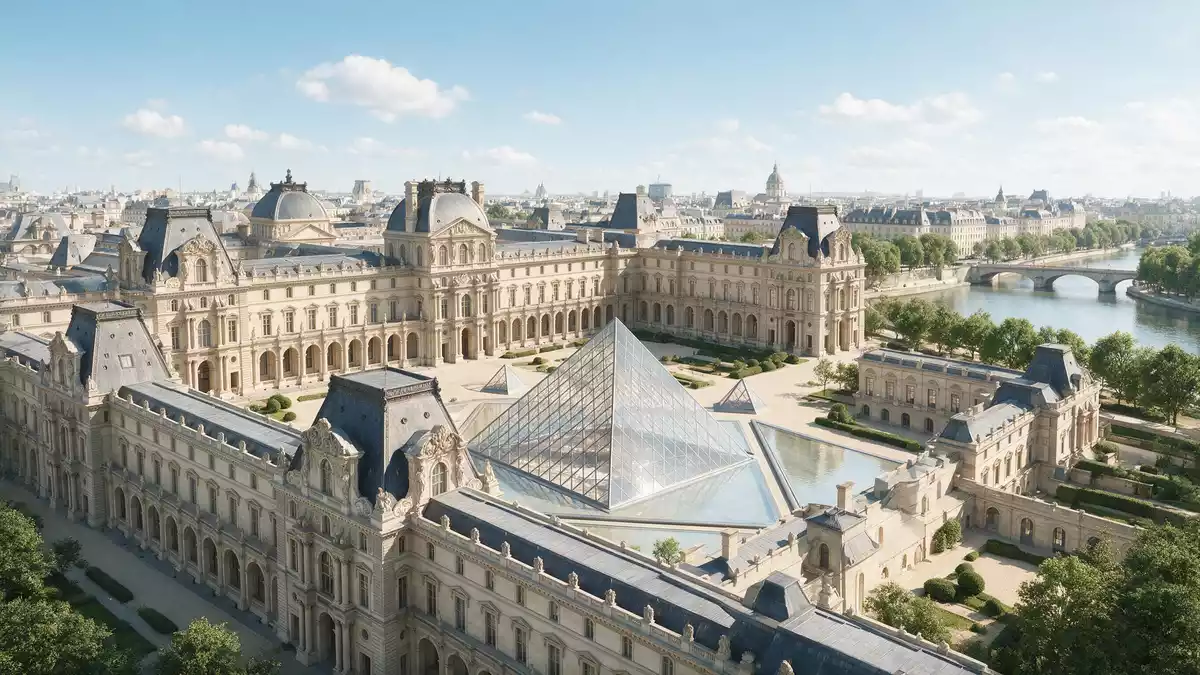
Musee du Louvre in Paris is a museum set within a former royal palace, with a fabric of stone wings that stretches around courtyards. Its profile brings together medieval origins, Renaissance façades and I. M. Pei’s glass Pyramid in a single urban ensemble.
A palace built across centuries
The Louvre began as a fortress under Philippe Auguste in the late twelfth century, and its later life as a palace gave it a layered form. Pierre Lescot’s work in the sixteenth century, followed by later additions under Jacques Lemercier, Louis Le Vau and Claude Perrault, left the building with changing fronts and courtyards.royal palace
That sequence is visible in the structure itself: medieval traces, classical symmetry and later monumental wings sit side by side. The palace was opened as a museum on 10 August 1793, a date that marks the shift from royal residence to public collection.opened in 1793
The Pyramid in the Cour Napoléon
The best-known modern intervention is the glass Pyramid in the Cour Napoléon, designed by I. M. Pei and inaugurated on 29 March 1989. It stands 21 m high, with a base width of 35 m, and its geometry is sharply different from the surrounding palace façades.I. M. Pei
Its glazed surfaces sit in open contrast to the limestone walls around it, while the central court keeps the composition legible from several sides. The same complex also includes the Cour Carrée, one of the most recognisable enclosed spaces of the palace, framed by wings that belong to different building campaigns.glass Pyramid
Stone, courts and wings
The museum’s identity comes from its material contrasts as much as its chronology. Stone façades, carved classical details and broad courtyards create a dense architectural sequence, while the Pyramid introduces a separate language of glass and metal.
That mixture is why the Louvre reads as a palace rather than a single-purpose museum building. It retains the dimensions and ceremonial scale of a residence of power, yet its interior life belongs to galleries, passageways and large public rooms.ceremonial scale
Visiting Musee du Louvre: what travellers from Western Europe should know
- The museum is on Rue de Rivoli in the 1st arrondissement of Paris, and the métro stop Palais Royal - Musée du Louvre serves the area. The Pyramid sits in the central court.Rue de Rivoli
- The palace complex covers courtyards, wings and long interior routes, so the place is far larger than a single gallery hall. Much of the experience lies in moving through connected spaces rather than in one enclosed room.
- The Louvre brings together medieval masonry, Renaissance work and later classical additions. That range is visible in its façades, courtyards and transitions between older and newer sections.
- French is the main language on site, and the currency is the euro.
Searching for Musee du Louvre on social platforms
These links open searches for Musee du Louvre on each platform.
Frequently asked questions about Musee du Louvre
Where is Musee du Louvre?
It stands on Rue de Rivoli in central Paris, in the 1st arrondissement. The Pyramid marks the main court of the palace complex.
What does a visit involve?
The Louvre is a very large palace complex with wings, courtyards and long routes between galleries. A visit means moving through a building made from several architectural periods.
What makes Musee du Louvre distinctive?
Its distinctiveness lies in the combination of a former royal palace, a museum opening in 1793, and the modern Pyramid by I. M. Pei. Few major landmarks in Paris show such a clear layering of periods in one site.


