
Musee du Bardo and the palace of Tunisian mosaics
Published on 09/24/2026 at 01:06 | Editorial responsibility: Rafael Müller, Editor-in-Chief AD HOC NEWS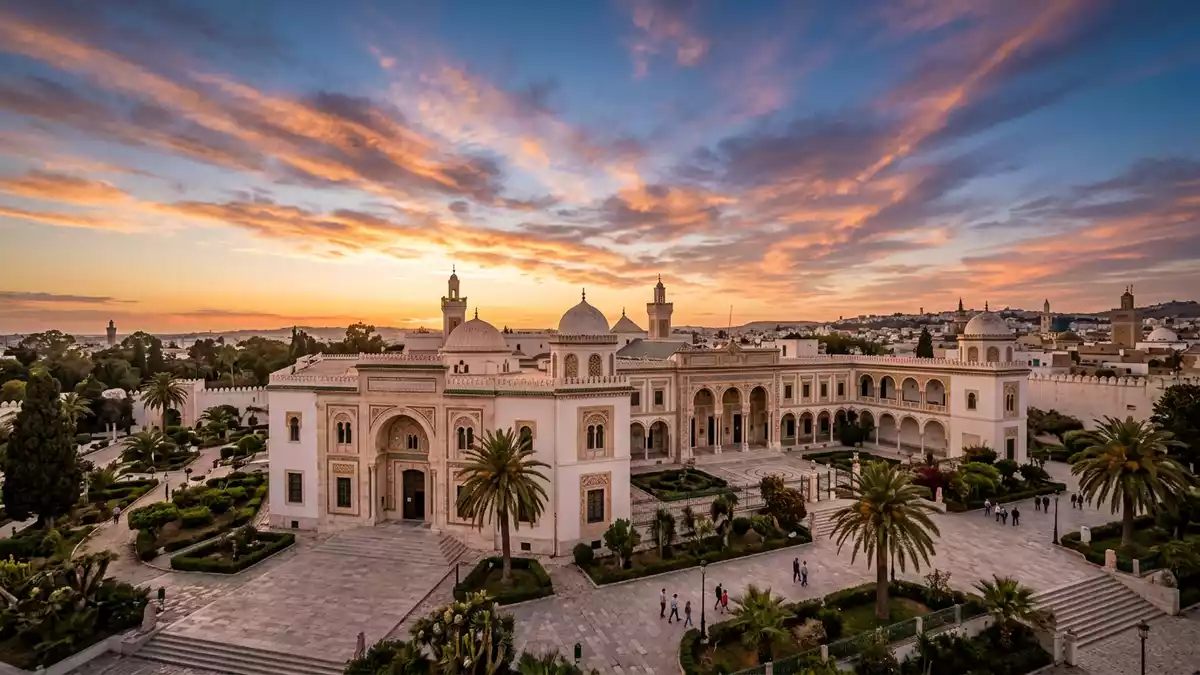
Musee du Bardo occupies a nineteenth-century beylical palace in Le Bardo, west of Tunis. Inside its decorated halls, mosaics, sculpture, jewellery and manuscripts trace Tunisia’s history from prehistory through the Islamic and Ottoman eras.
Musee du Bardo inside a nineteenth-century palace
The museum was formally inaugurated on 7 May 1888 as the Aloui Museum, named after Ali Bey III, who ruled Tunisia from 1882 to 1902. In March 1956, after Tunisia’s independence, it took the name Musee du Bardo.
The building is a historical monument and a royal palace from the nineteenth century. Its decoration combines Andalusian-Moorish, Ottoman and Italian influences, with courtyards, tiled surfaces, carved details and ceremonial rooms forming the setting for the collections. museum history and architecture
Roman mosaics across the galleries
Roman mosaics form the museum’s central visual language. Their surfaces preserve figures, animals, plants, geometric designs and scenes connected with mythology, agriculture, entertainment and domestic life.
Many mosaics came from archaeological sites across Tunisia, including Carthage, Dougga, El Jem, Utica, Bulla Regia and Sousse. The collection includes the celebrated Virgil mosaic, which depicts the Roman poet seated between figures associated with his literary work. mosaics from Tunisian sites
Other galleries contain Roman sarcophagi, Christian baptisteries, marble sculpture and inscriptions. The exhibits turn fragments recovered from different parts of the country into a broad record of ancient North African society.
From prehistoric Tunisia to Islamic art
Musee du Bardo is an archaeological museum covering a long sequence of Tunisian history. Its collections include prehistoric and protohistoric material, Libyco-Punic objects, Numidian finds, Greek and Roman works, early Christian pieces, Byzantine artefacts, Islamic art and Ottoman material.
Punic jewellery and objects connect the museum with Carthage and the communities that shaped the central Mediterranean before Roman rule. Roman rooms present Tunisia as part of a larger imperial world, while later galleries contain ceramics, manuscripts, textiles, metalwork and architectural elements from Islamic and Ottoman periods. collections across Tunisian history
The displays are arranged through the palace’s ground floor and upper levels. Moving between decorated rooms and archaeological galleries brings together the country’s ancient sites, religious traditions and courtly arts within one complex. the museum’s Islamic collections
Visiting Musee du Bardo: what travellers from Western Europe should know
- Musee du Bardo is in Le Bardo, a district west of central Tunis. Métro Léger line 4 serves the Le Bardo stop.
- The museum occupies a palace with decorated rooms, tiled floors, staircases and galleries distributed across several levels.
- The official language is Arabic and the currency is the Tunisian dinar.
- Entry requirements depend on your nationality; UK travellers can check the FCDO travel advice at gov.uk/foreign-travel-advice, Irish travellers the Department of Foreign Affairs at ireland.ie.
Searching for Musee du Bardo on social platforms
These links open searches for Musee du Bardo on each platform.
Frequently asked questions about Musee du Bardo
Where is Musee du Bardo?
Musee du Bardo is in Le Bardo, west of central Tunis, Tunisia. The district is served by Métro Léger line 4.
What can visitors expect inside?
The palace contains mosaics, sculpture, jewellery, inscriptions, sarcophagi, baptisteries and manuscripts. The displays cover Tunisia from prehistory through the Islamic and Ottoman periods.
What makes Musee du Bardo distinctive?
Its galleries combine a nineteenth-century royal palace with an extensive collection of Roman mosaics from Tunisian archaeological sites. The setting and the collections belong to different historical periods within the same complex.


