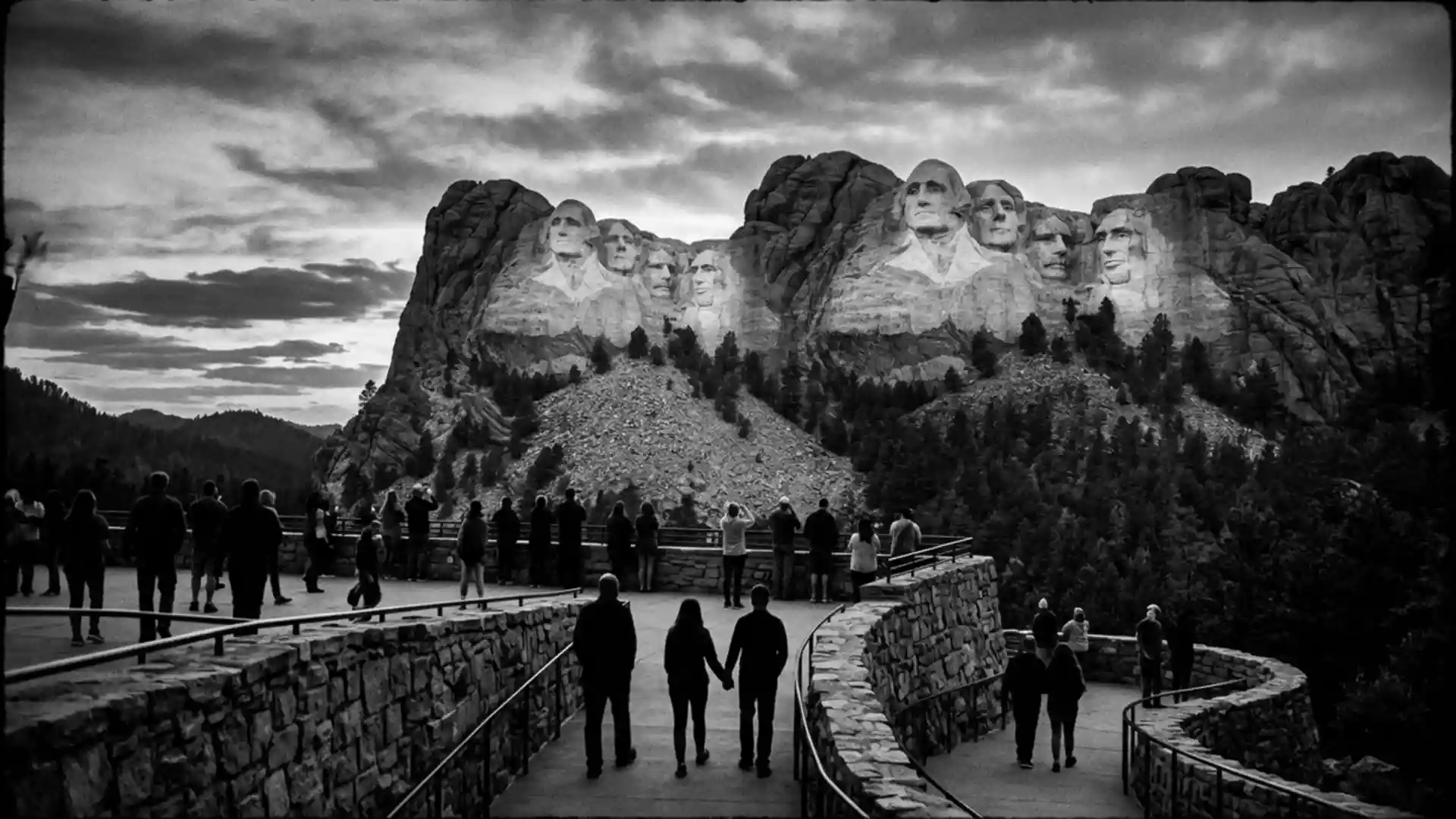
Mount Rushmore’s colossal presidents above the Black Hills
Published on 09/07/2026 at 06:07 | Editorial responsibility: Rafael Müller, Editor-in-Chief AD HOC NEWS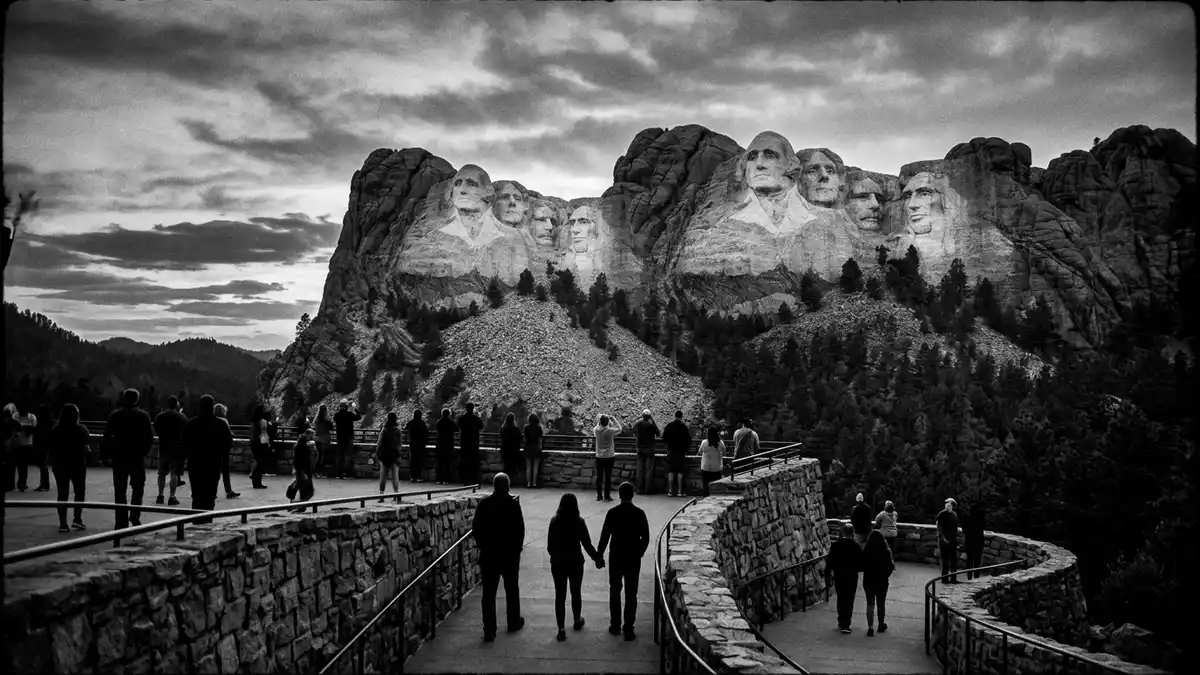
High above the pine-covered slopes near Keystone in South Dakota, a granite peak carries one of the most recognisable ensembles in American landscape art: four colossal presidential faces carved directly into Mount Rushmore during the first half of the twentieth century. The memorial fixes the profiles of George Washington, Thomas Jefferson, Theodore Roosevelt and Abraham Lincoln into the rock, a stone portrait gallery that has become intertwined with the Black Hills around it.
A mountain renamed and recast in stone
Mount Rushmore rises in the Black Hills of South Dakota, a compact range of granite and other hard rocks that interrupts the surrounding plains with rugged peaks and forested ridges.The mountain itself reaches an elevation of 1,745 m (5,725 ft), giving the carved cliff a broad backdrop of stone above the visitor area.The summit stands south-west of Keystone in Pennington County, surrounded by dense woodland and other outcrops.
The peak took its modern name in 1885, when New York lawyer Charles E. Rushmore visited the Black Hills on business and his surname was adopted for the mountain.The later decision to carve presidents into the same mass of granite turned an already named natural feature into a national memorial. Around the cliff a formal site grew, with paths, viewing terraces and facilities arranged below the sculpted face of the mountain.
From idea to national memorial
The notion of a monumental carving in the Black Hills emerged in the 1920s, when South Dakota state historian Doane Robinson proposed large sculptures to attract wider attention to the region.His suggestion in 1923 led to authorisation of a carving project and the designation of Mount Rushmore as a national memorial in 1925. Federal involvement followed, and the site came under the administration of the United States National Park Service in 1933, bringing it into the system that oversees many major American parks and monuments.The memorial area covers roughly 5 square kilometres, framing the cliff within protected land.
Sculptor Gutzon Borglum was appointed to realise the design and arrived at Mount Rushmore with ambitious plans for the rock face.Work on the mountain began in October 1927, with ceremonial drilling and the first use of dynamite to remove large volumes of granite.Over the following years dedications marked the completion of individual faces, and the memorial was declared finished on 31 October 1941 after roughly fourteen years of intermittent carving.By that date Borglum had died and his son Lincoln Borglum directed the final phase, closing work on the cliff.
The four presidents in granite
The carved ensemble depicts four presidents whose terms span from the eighteenth to the early twentieth century: George Washington, born in 1732; Thomas Jefferson, born in 1743; Abraham Lincoln, born in 1809; and Theodore Roosevelt, born in 1858.From left to right on the cliff the faces follow that sequence, each cut with strong profiles and prominent features. The heads are monumental in scale: each face rises about 18 m (60 ft) from chin to crown, a size that gives individual features the height of storeys on a multi-level building.The carving as a whole has been described as matching a figure hundreds of feet tall, emphasising the sheer size of the composition.
The presidents were intended to represent different aspects of United States history, with Washington associated with the founding of the country, Jefferson with westward expansion, Lincoln with preservation of the Union and Roosevelt with development in the industrial age.Gutzon Borglum summarised this vision in a statement about founding, expansion, preservation and unification. Beyond symbolism, visitors encounter the physical detail of the granite: carved eyelids, noses and mouths, and the suggestion of clothing and hair emerging from the cliff, all cut from the same pale stone.
Visiting Mount Rushmore: what travellers from Western Europe should know
- The memorial lies south-west of Keystone in the Black Hills of South Dakota, reached by road along Highway 244 from the town and regional routes from Rapid City.
- The main viewpoints sit below the cliff on constructed terraces and paths, with solid surfaces and steps between levels that require steady footing but no specialised equipment.
- The surrounding terrain combines forest and exposed rock, so weather and altitude can make the air cooler than on the plains, and light conditions on the faces change through the day.
- The official language is English and the currency is the United States dollar.
- Entry requirements depend on your nationality; UK travellers can check the FCDO travel advice at gov.uk/foreign-travel-advice, Irish travellers the Department of Foreign Affairs at ireland.ie.
Searching for Mount Rushmore on social platforms
These links open searches for Mount Rushmore on each platform.
Frequently asked questions about Mount Rushmore
Where is Mount Rushmore located?
Mount Rushmore stands in the Black Hills of South Dakota, south-west of Keystone in Pennington County, within a protected national memorial area.
What can visitors expect when they arrive?
Visitors encounter a granite cliff bearing four huge presidential faces above viewing terraces, paths and facilities laid out in front of the mountain.
What makes Mount Rushmore distinctive among historic sites?
The memorial combines a natural peak named in the nineteenth century with twentieth-century stone portraits of four presidents, carved at a scale rarely attempted on exposed rock.