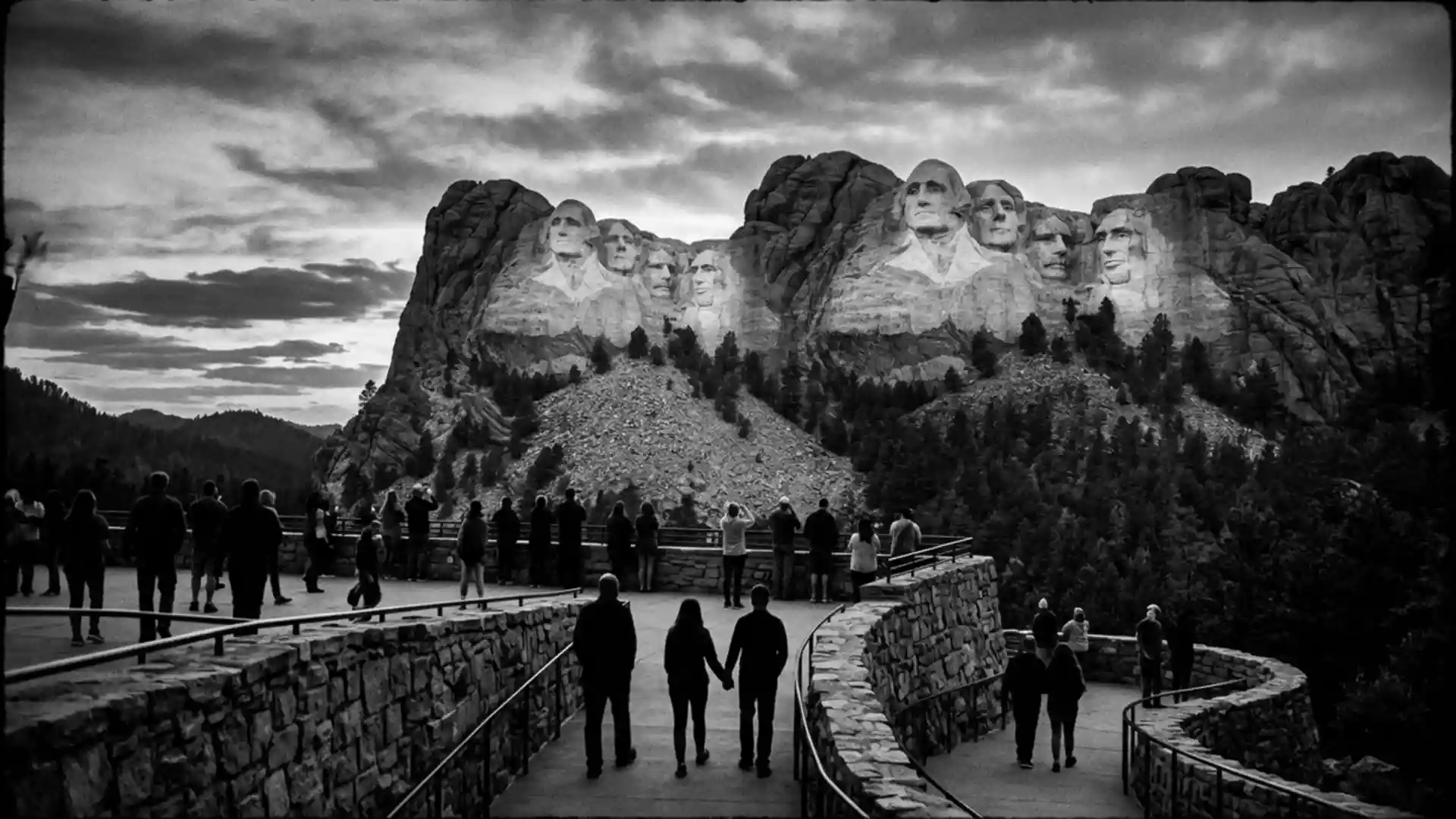
Mount Rushmore and the presidential faces above Keystone
Published on 09/14/2026 at 19:08 | Editorial responsibility: Rafael Müller, Editor-in-Chief AD HOC NEWS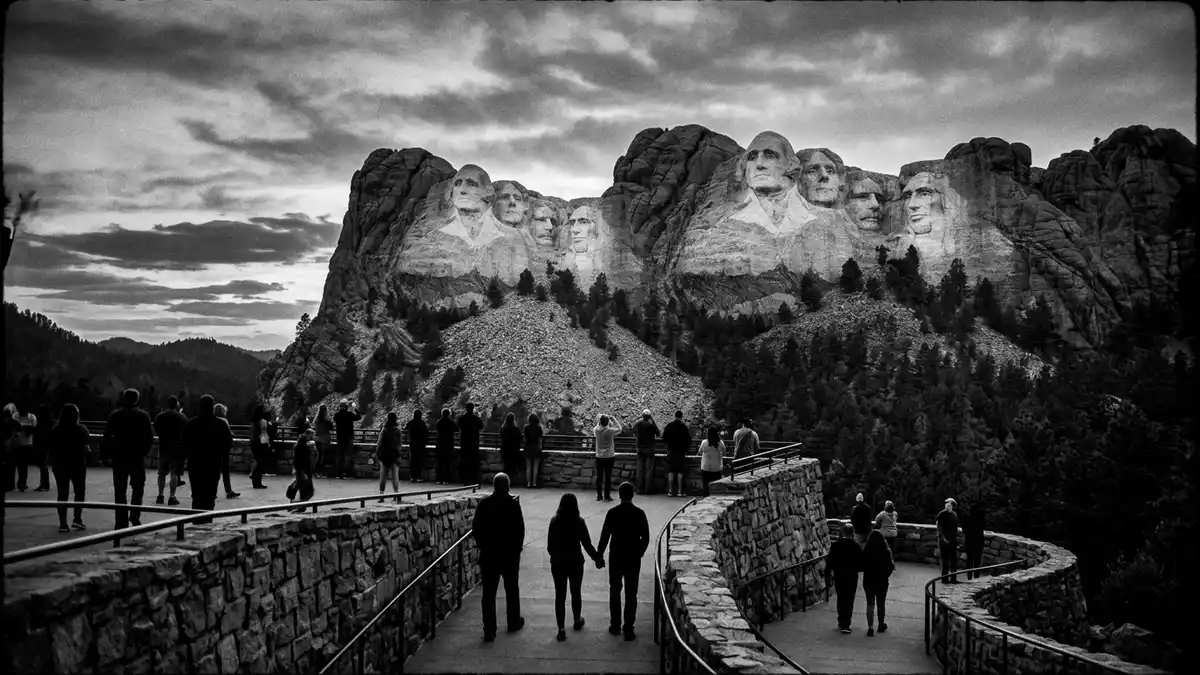
High above the pine-covered slopes near Keystone in South Dakota’s Black Hills, Mount Rushmore presents four colossal presidential faces cut directly into the granite of the mountain itself. The memorial, conceived in the 1920s and completed in 1941, turns an exposed cliff into a monumental portrait of George Washington, Thomas Jefferson, Theodore Roosevelt and Abraham Lincoln, all framed by rock and forest.
A granite cliff turned into a presidential gallery
Mount Rushmore is a granite mountain in the Black Hills, a region of rugged hills and dense woodland in South Dakota in the north-central United States. The National Memorial occupies the southeast face of the mountain, near the small town of Keystone and within reach of other Black Hills landmarks such as Custer State Park and Rapid City.Black Hills of southwestern South Dakota The mountain was named in 1885 for Charles E. Rushmore, a New York lawyer whose surname the peak still carries.named in 1885 for Charles E. Rushmore
The memorial itself is carved into Harney Peak granite, a hard, pale rock that gives the faces a light colour against the darker trees below.faces are carved from Harney Peak granite The heads of the four presidents rise above the lower slopes, each about 18 m (60 ft) tall, with noses, brows and mouths shaped out of the cliff. Together they occupy a wide band of the mountain, with Washington on the left, followed by Jefferson, Roosevelt and Lincoln on the right.60-foot sculptures of the heads of former presidents The summit of Mount Rushmore reaches around 1,745 m (5,725 ft) above sea level, so the sculpture sits high above the surrounding terrain and can be seen from a distance as visitors approach.top of Mount Rushmore is 5,725 feet above sea level
From concept in the 1920s to completion in 1941
The idea of carving giant figures into the Black Hills arose in the early 1920s, when South Dakota historian Jonah “Doane” Robinson proposed using monumental sculpture to bring attention to the region’s landscape. In 1925 the site at Mount Rushmore was designated as a national memorial, and two years later, on 4 October 1927, work on the carving began under sculptor Gutzon Borglum.work commenced officially on October 4, 1927 Borglum worked with his son Lincoln Borglum and a large team of workers, using jackhammers and drills but also relying heavily on carefully controlled dynamite to remove rock.
Construction ran through the late 1920s and 1930s, with individual presidential heads unveiled in stages. Washington’s head was revealed first in 1930, followed by Jefferson, Lincoln and Roosevelt as carving progressed.Washington unveiled in 1930, Jefferson in 1936, Lincoln in 1937, Roosevelt in 1939 The memorial was deemed complete on 31 October 1941, the year of Gutzon Borglum’s death, after about 14 years of work on the mountain.completed in 1941 Since then the carved faces have remained essentially unchanged, slowly weathering at an estimated rate of about an inch every 10,000 years.
Walking the memorial and its Black Hills setting
Mount Rushmore National Memorial covers several square kilometres of mountain, forest and developed visitor areas, all managed by the United States National Park Service.managed by the National Park Service An approach road leads to a structured parking area, from which visitors enter a formal forecourt and an avenue lined with flagpoles before reaching the main viewing terrace. From this terrace the four granite faces dominate the view, with the tree-covered slopes below and the bare rock above.
The memorial includes paths and facilities that let visitors experience the mountain more closely. A loop trail passes through forest and across constructed walkways, giving changing angles on the carving and glimpses of the drill holes and rock debris that reveal the techniques used on the cliff. Exhibits and a visitor centre present models, photographs and explanations of how Borglum and his team translated small-scale designs into marks on the mountain, using measurement points to keep the proportions of the presidential heads consistent.
Visiting Mount Rushmore: what travellers from Western Europe should know
- Mount Rushmore lies near Keystone in South Dakota’s Black Hills, reached by road from Rapid City via U.S. Highway 16 and Highway 244 or from Highway 385 from the south.
Commercial flights arrive at Rapid City Regional Airport, from which hire cars and organised excursions serve the memorial. - The developed area around the viewing terrace is at mountain elevation, with paved surfaces, steps and ramps; walking the loop trail involves short uphill and downhill sections on constructed paths.
- Nearby sights in the Black Hills include Custer State Park and other scenic roads, so many itineraries combine Mount Rushmore with further drives through forested hills and granite outcrops.
- The official language is English and the currency is the United States dollar.
- Entry requirements depend on your nationality; UK travellers can check the FCDO travel advice at gov.uk/foreign-travel-advice, Irish travellers the Department of Foreign Affairs at ireland.ie.
Searching for Mount Rushmore on social platforms
These links open searches for Mount Rushmore on each platform.
Frequently asked questions about Mount Rushmore
Where is Mount Rushmore located?
Mount Rushmore National Memorial stands on a granite mountain in the Black Hills of South Dakota, near Keystone and southwest of Rapid City.
What should visitors expect when they arrive?
Visitors encounter a developed forecourt, an avenue of flags and a broad viewing terrace facing the carved presidents, with paths and facilities set among the surrounding forested slopes.
What makes Mount Rushmore distinctive among monuments?
The memorial is distinctive for carving four large presidential heads directly into a mountain cliff, combining portrait sculpture with the scale and setting of the Black Hills landscape.