
Mount Kenya National Park’s high-altitude landscapes above Nanyuki
Published on 09/05/2026 at 10:35 | Editorial responsibility: Rafael Müller, Editor-in-Chief AD HOC NEWS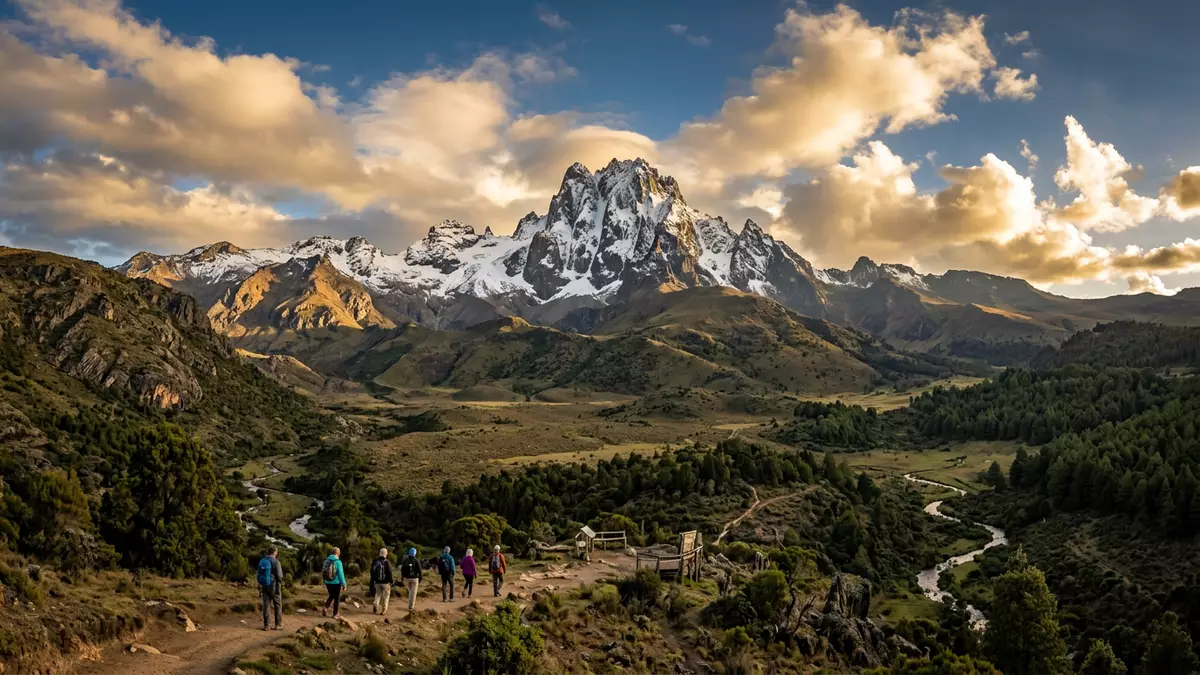
Mount Kenya National Park rises above the town of Nanyuki in central Kenya, wrapping a high volcanic massif in protected forest, moorland and rock. In 1949 the area around Mount Kenya was officially gazetted as a national park, creating a core conservation zone for the mountain’s upper slopes.gazetted as a national park in 1949 In 1997 Mount Kenya National Park and parts of the surrounding forest reserve were inscribed together on the UNESCO World Heritage List as “Mount Kenya National Park/Natural Forest”, recognising the mountain’s Afro-alpine ecosystems and dramatic glaciated peaks.inscribed on the UNESCO World Heritage List in 1997
Mount Kenya’s peaks and protected mountain environment
The centrepiece of Mount Kenya National Park is Mount Kenya itself, an extinct stratovolcano whose highest summit reaches 5,199 m (17,060 ft) above sea level, making it the second-highest mountain in Africa after Kilimanjaro.second-highest mountain in Africa at 5,199 m The upper part of the massif is carved into sharp ridges, rock towers and cirques left by ancient glaciers, with the main peaks known as Batian and Nelion rising above cliffs and scree slopes.upper massif and main peaks Batian and Nelion Around this core, the national park protects a belt of Afro-alpine and montane habitats that form one of East Africa’s important “water towers”, feeding major rivers flowing towards lowland Kenya.
Mount Kenya lies almost astride the Equator in central Kenya, yet its height produces a stepped sequence of climate and vegetation from foothills to summit.lies almost astride the Equator in central Kenya Below the Afro-alpine zone, moist montane forest occupies elevations from roughly 1,800 m (5,900 ft) upwards, giving way higher up to a zone dominated by tree-like heathers and then to open moorland and tussock grasslands with giant lobelias and senecios characteristic of high tropical mountains.moist afromontane forest and heather belt Above these lie bare rock and remnant glaciers close to the main peaks, creating a pronounced contrast between green lower slopes and dark upper crags.
Forest belts, wildlife and the Mount Kenya World Heritage property
Mount Kenya National Park forms the higher zone of a larger protected mosaic officially recognised by UNESCO as “Mount Kenya National Park/Natural Forest”. The inscription combines the national park, managed by Kenya Wildlife Service, with parts of the surrounding Mount Kenya Forest Reserve, which fall under Kenya Forest Service.Mount Kenya National Park/Natural Forest serial property Together, these areas conserve the full altitudinal range from montane forest through subalpine heath to Afro-alpine ecosystems, as well as important wildlife corridors linking the mountain to adjacent ranges.
The forested flanks of Mount Kenya hold dense stands of bamboo, podocarp and other indigenous trees, interspersed with clearings and river valleys. This varied terrain supports mammals such as forest antelope, primates and larger species ranging out of the forest onto open slopes.protected area managed by Kenya Wildlife Service Above the tree line, Afro-alpine vegetation adapted to cold nights and intense sunlight gives the upper mountain its distinctive character, with giant rosettes and cushions scattered among rocks and tarns. The combination of steep volcanic relief, radial valleys and vegetation belts forms a clear visual structure that is easy to read when travelling around the mountain.
Approach routes from Nanyuki and other gateway towns
Several traditional approach routes lead into Mount Kenya National Park, each aligned with a different face of the mountain and linked to nearby towns. On the north-western side, Nanyuki serves as a principal base town, providing road access towards the Sirimon and Burguret gates on the drier flank of the massif.Nanyuki on the north-west side as a base town The Sirimon Gate stands at an elevation of around 2,650 m (8,700 ft), where montane forest gives way to open glades and tracks heading towards higher camps.Sirimon Gate near Nanyuki at about 2,650 m
To the south-west, the Naro Moru route rises from agricultural land and foothill villages toward the Park Headquarters at Naro Moru and the forest edge.Park Headquarters located at Naro Moru On the eastern side, the Chogoria route approaches the mountain from Embu and Chogoria, passing through lower forest and eventually emerging near high tarns and ridges overlooking the main peaks.main access routes at Naro Moru, Sirimon and Chogoria These different access points give travellers contrasting views of Mount Kenya’s profile, from softer forested slopes to abrupt rock faces and the broken skyline of Batian, Nelion and neighbouring pinnacles.
Visiting Mount Kenya National Park: what travellers from Western Europe should know
- Mount Kenya National Park lies in central Kenya, north of Nairobi, with Nanyuki on the north-western flank acting as a common staging point for park visits. Road approaches run from Nairobi through towns such as Karatina and Nanyuki toward gates including Sirimon and Naro Moru.
- The terrain inside the park is steep and high-altitude, rising from montane forest to Afro-alpine moorland and rocky ridges. Approaches to viewpoints and summit routes involve sustained ascents on foot and sections of rough track or path at elevations well above 3,000 m (9,800 ft).
- The official language is Swahili and English, and the currency is the Kenyan shilling.
- Entry requirements depend on your nationality; UK travellers can check the FCDO travel advice at gov.uk/foreign-travel-advice, Irish travellers the Department of Foreign Affairs at ireland.ie.
Searching for Mount Kenya National Park on social platforms
These links open searches for Mount Kenya National Park on each platform.Frequently asked questions about Mount Kenya National Park
Where is Mount Kenya National Park located?
Mount Kenya National Park is in central Kenya, surrounding the Mount Kenya massif north of Nairobi, with gateway towns such as Nanyuki and Naro Moru on its lower slopes.
What can visitors expect on a visit to Mount Kenya National Park?
Visitors encounter steep highland terrain that climbs from montane forest through heather and moorland to bare rock, with views of jagged volcanic peaks and Afro-alpine vegetation above the tree line.
What makes Mount Kenya National Park distinctive among African mountain parks?
Mount Kenya National Park combines an equatorial location with altitudes above 5,000 m (16,400 ft), creating a clear sequence of forest belts and Afro-alpine habitats around Africa’s second-highest peak.


