
Mount Kenya National Park and the high forests above Nanyuki
Published on 09/12/2026 at 21:36 | Editorial responsibility: Rafael Müller, Editor-in-Chief AD HOC NEWS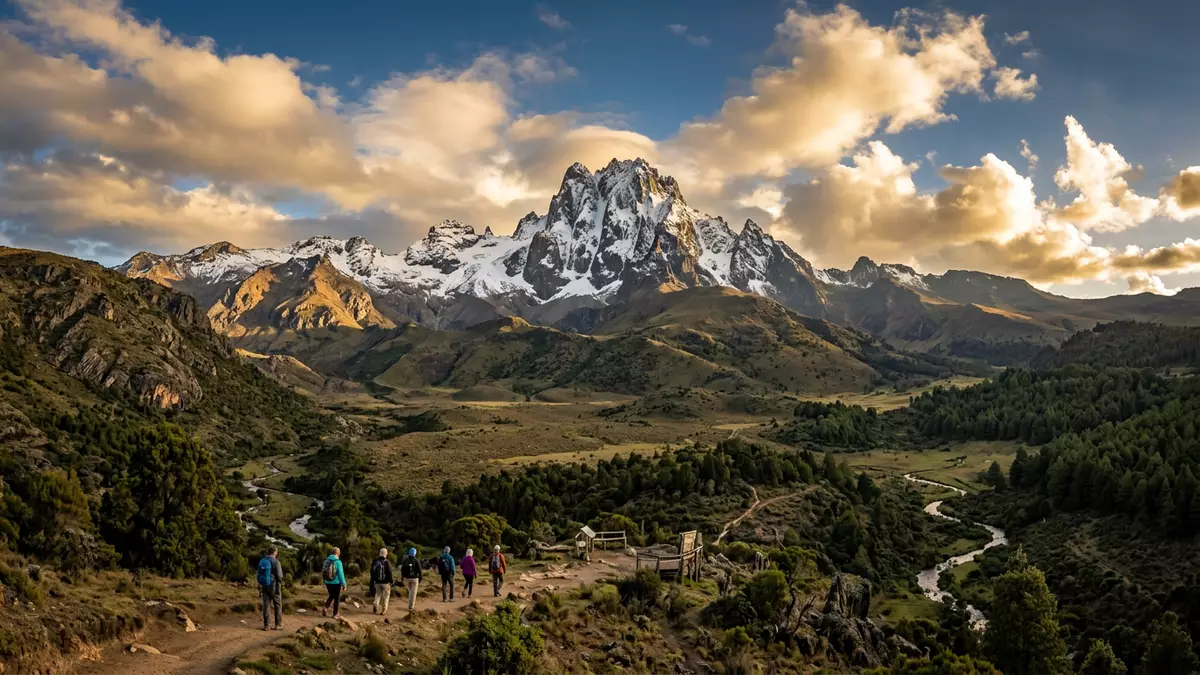
Mount Kenya National Park wraps around Mount Kenya in central Kenya, rising above the town of Nanyuki where forest, bamboo and high moorland climb towards Africa’s second-highest peak. Established in 1949 as a protected area around the mountain, it later gained recognition as a UNESCO World Heritage Site for its distinctive high-altitude ecosystems and dramatic volcanic relief.
Mount Kenya as a high volcanic massif
The core of Mount Kenya National Park is the mountain itself, an ancient extinct volcano whose highest summit reaches 5,199 m (17,057 ft), making it the second highest peak on the African continent after Kilimanjaro.second highest peak The massif rises just south of the equator, with its slopes forming a broad dome that dominates the surrounding highlands of central Kenya.situated on the equator From the forest belt upwards, the mountain is ringed by bands of vegetation that reflect altitude and exposure, ranging from dense montane forest to afro-alpine moorland.
The park encompasses steep glacial valleys, sharp ridges and a cluster of main summits, including Batian and Nelion, which rise above a ring of secondary peaks and high plateaus.Batian and Nelion On the upper slopes a series of remnant glaciers survive in sheltered hollows, feeding streams that descend through U-shaped valleys cut during past glaciations.remnant glaciers and glacial valleys The combination of volcanic rock structures and glacial forms gives Mount Kenya a jagged skyline that visitors from Nanyuki can see shifting in profile as they move around the mountain’s western flank.
Protected status and forested slopes
Mount Kenya National Park was formally gazetted in 1949 to safeguard the mountain’s upper slopes and surrounding habitats, and it became part of a biosphere reserve in 1978.gazetted in 1949 and biosphere reserve In 1997 the park and adjacent forest reserves were inscribed together on the UNESCO World Heritage List as Mount Kenya National Park/Natural Forest, recognising both the volcanic landforms and the extensive montane forests that cloak the lower slopes.World Heritage inscription The protected area is managed by the Kenya Wildlife Service in partnership with the Kenya Forest Service, reflecting the mix of national park and forest reserve within the serial property.management by Kenyan agencies
The forests and natural vegetation within and around Mount Kenya National Park form part of a major water catchment for central Kenya, feeding rivers that flow towards the plains and agricultural areas.regional water tower The World Heritage documentation assigns an area of 182,500 ha to the Mount Kenya National Park/Natural Forest property, underlining the scale of the conserved landscape stretching around the mountain.182,500 ha property Within this expanse, visitors encounter belts of mixed forest, bamboo stands and higher-altitude heath, each supporting distinct assemblages of wildlife adapted to cooler temperatures and varied moisture levels on the slopes.
Nanyuki, approaches and equatorial scenery
Nanyuki lies on the north-western side of Mount Kenya and serves as a common base town for visits to Mount Kenya National Park, with road links to Sirimon Gate and other western approaches.Nanyuki as base town The Kenya Wildlife Service describes three principal road routes into the high park area, via Naro Moru, Sirimon and Chogoria, each climbing through farmland and forest before reaching the park gates.main access routes From Nanyuki, the Sirimon Gate on the north-west side provides access to trails that gradually ascend through forest and open moorland towards the mountain’s western ridges.
Mount Kenya stands astride the equator, and the national park’s scenery reflects the combination of equatorial light with altitude-driven climates, from humid lower forests to cool alpine zones with rocky outcrops and glacial cirques.equatorial location On clear days the high peaks, including Batian and Nelion, rise above belts of cloud, forming a backdrop visible across central Kenya and especially from vantage points near Nanyuki and the Nanyuki Airstrip.views from Nanyuki area The mosaic of forests, moorlands and glaciers within the park has made Mount Kenya a significant reference point in descriptions of East African mountain landscapes.
Visiting Mount Kenya National Park: what travellers from Western Europe should know
- Mount Kenya National Park lies in central Kenya north-east of Nairobi, with Nanyuki on its north-western flank connected by main roads and regional flights.
- The terrain inside the park shifts from montane forest to high moorland and rocky ridges, and approaches to the upper slopes involve sustained ascents at altitude.
- Access by road commonly uses the Naro Moru, Sirimon or Chogoria routes, with Sirimon Gate reached from the Nanyuki–Meru road and Naro Moru Gate from the Nyeri–Nanyuki road.
- The official language is Swahili and English and the currency is the Kenyan shilling.
- Entry requirements depend on your nationality; UK travellers can check the FCDO travel advice at gov.uk/foreign-travel-advice, Irish travellers the Department of Foreign Affairs at ireland.ie.
Searching for Mount Kenya National Park on social platforms
These links open searches for Mount Kenya National Park on each platform.Frequently asked questions about Mount Kenya National Park
Where is Mount Kenya National Park located?
Mount Kenya National Park is in central Kenya around Mount Kenya, north-east of Nairobi, with Nanyuki as a common base town on its north-western side.
What can visitors expect on a visit to Mount Kenya National Park?
Visitors encounter a high mountain landscape with montane forest, bamboo, open moorland and rocky ridges, together forming a protected belt around the volcanic peaks.
What makes Mount Kenya National Park distinctive among African mountain parks?
The park combines an equatorial location, an extinct volcanic massif reaching 5,199 m (17,057 ft) and a ring of remnant glaciers and forests recognised as a UNESCO World Heritage Site.


