
Mount Kenya National Park and the high equatorial peaks above Nanyuki
Published on 08/16/2026 at 14:06 | Editorial responsibility: Rafael Müller, Editor-in-Chief AD HOC NEWS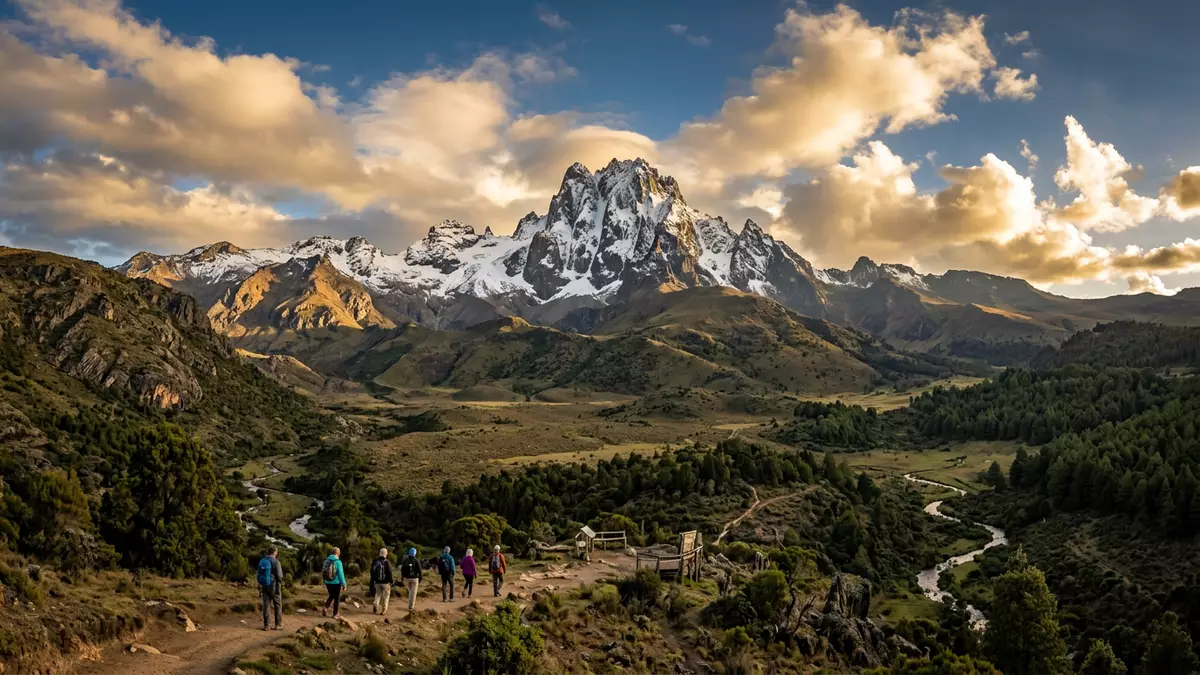
Mount Kenya National Park in central Kenya combines high equatorial peaks, receding glaciers and layered forest belts into one of Africa’s most distinctive mountain landscapes. Rising above towns such as Nanyuki, the park frames the rocky summit mass of Mount Kenya, an extinct volcano that has become a protected sanctuary for afro?alpine ecosystems and a major watershed for the surrounding highlands.
The mountain and its protected status
Mount Kenya is an ancient extinct stratovolcano whose highest summit, Batian, reaches 5,199 m (17,057 ft), making it Africa’s second highest mountain after Kilimanjaro.Africa’s second highest mountain The mountain stands almost astride the Equator in central Kenya, rising steeply from cultivated foothills into jagged rock spires, glaciers and high cirques surrounded by bands of forest and moorland.Mount Kenya straddles the equator
The surrounding area was designated as Mount Kenya National Park in 1949 to protect the mountainous environment and wildlife from deforestation and hunting, and it later gained recognition as a UNESCO World Heritage Site in 1997 as “Mount Kenya National Park/Natural Forest”.national park established in 1949 The park covers around 715 km² (276 sq mi), while the adjoining Mount Kenya Forest Reserve extends protection across a larger belt of montane forest and bamboo.715 square kilometres of protected land Together, these linked areas form a serial World Heritage property managed by national conservation agencies, safeguarding both high alpine terrain and lower forest ecosystems.
Layers of forest, moorland and ice
One of the most striking aspects of Mount Kenya National Park is the clear sequence of vegetation zones that ring the mountain. At lower elevations, dense montane forests and bamboo thickets climb the slopes, giving way higher up to open heath and tussock?covered moorland dotted with giant lobelias and senecios typical of afro?alpine environments.afro-alpine vegetation zones Above this belt, rocky ridges and cirques encircle the main peaks, where remnant glaciers cling to shaded gullies and steep faces.
The park protects several named summits within the central massif, including Batian, Nelion at 5,188 m (17,021 ft) and Point Lenana at 4,985 m (16,355 ft), each rising above glaciers and high passes that form the core alpine zone of the mountain.Batian, Nelion and Lenana peaks These heights, combined with the equatorial location, create a landscape where ice, rock and equatorial sunlight meet in close proximity, and where the upper slopes function as a crucial water catchment for rivers that flow across central Kenya.
Wildlife, culture and routes from Nanyuki
Mount Kenya National Park and the connected forest reserve shelter a rich mix of wildlife. Forest belts support species such as African elephants and bushbuck, while higher slopes provide habitat for hyrax, sunbirds and specialised afro?alpine plants adapted to cold nights and strong equatorial light.wildlife on the mountain slopes The wider World Heritage property also links to conservancies in the foothills that lie along established elephant migration routes, illustrating how the mountain’s protected core connects to surrounding savannah and woodland landscapes.migration route for African elephants
Access to Mount Kenya National Park from Nanyuki and neighbouring towns takes advantage of roads that lead to several official park gates. Sirimon Gate lies off the Nanyuki–Meru road to the north of the mountain, while Naro Moru Gate sits along the Nyeri–Nanyuki road near Naro Moru town, and Chogoria Gate stands on the Embu–Meru road to the east.Sirimon, Naro Moru and Chogoria gates These approach routes lead into valleys and ridges that offer walking paths, climbing routes and views across the surrounding counties of Nyeri, Kirinyaga, Embu, Meru and Tharaka?Nithi, where the mountain dominates the skyline.mountain spanning several counties
Visiting Mount Kenya National Park: what travellers from Western Europe should know
- Mount Kenya National Park lies in central Kenya north of Nairobi, with road approaches from towns such as Nanyuki, Naro Moru and Chogoria along main highways.
- Terrain within the park ranges from forest paths to high?altitude moorland and steep rocky slopes, and approaches to the main peaks involve sustained ascents at high elevation.
- The official language is Swahili and English, and the currency is the Kenyan shilling.
- Entry requirements depend on your nationality; UK travellers can check the FCDO travel advice at gov.uk/foreign-travel-advice, Irish travellers the Department of Foreign Affairs at ireland.ie.
Searching for Mount Kenya National Park on social platforms
These links open searches for Mount Kenya National Park on each platform.
Frequently asked questions about Mount Kenya National Park
Where is Mount Kenya National Park located?
Mount Kenya National Park lies in central Kenya north of Nairobi, surrounding the summit massif of Mount Kenya and extending into counties such as Nyeri and Meru.
What should visitors expect on a visit to the park?
Visitors encounter forested foothills, bamboo, high?altitude moorland and glaciated peaks, with mountain weather and steep ascents shaping time spent on the trails.
What makes Mount Kenya National Park distinctive among African mountain areas?
The combination of equatorial location, high rocky summits, remnant glaciers and afro?alpine ecosystems within a long?established World Heritage protected area sets the park apart.


