
Mosteiro dos Jeronimos and the stone lace of Portugal’s discoveries
Published on 09/16/2026 at 18:45 | Editorial responsibility: Rafael Müller, Editor-in-Chief AD HOC NEWS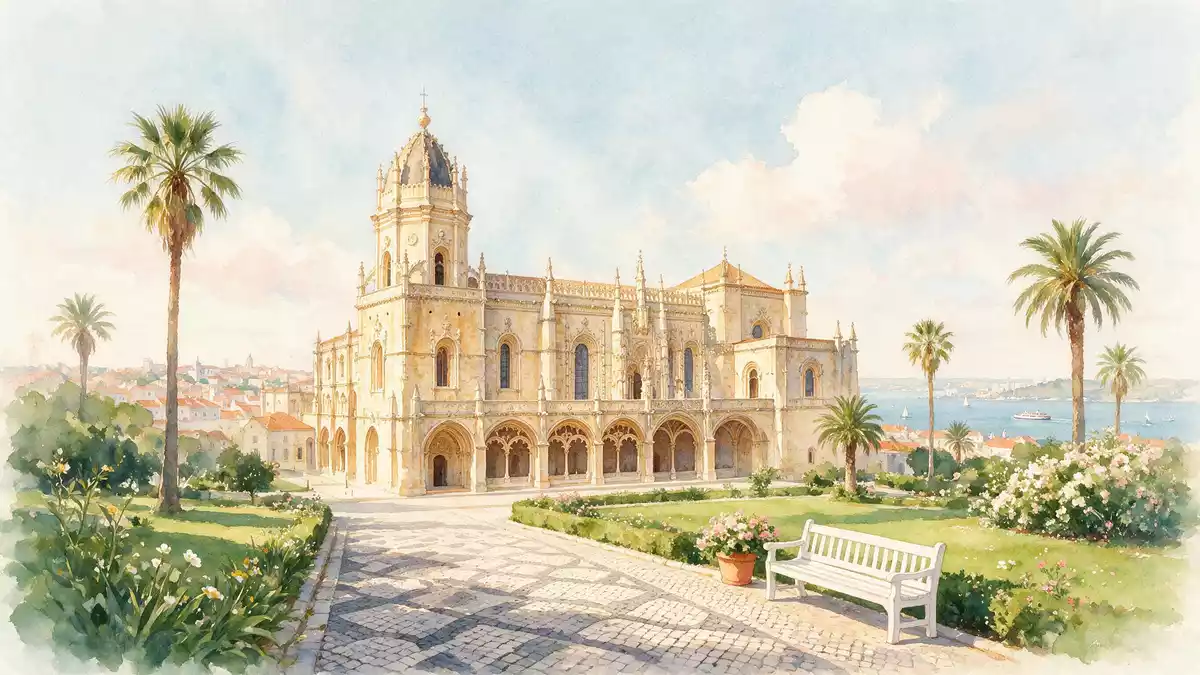
Mosteiro dos Jeronimos in Lissabon is a vast limestone monastery where Portugal’s maritime Age of Discoveries is written into carved stone, cloister arcades and royal tombs. Commissioned by King Manuel I around the turn of the sixteenth century and developed through the early 1500s, it stands beside the Tagus in Belém as a Manueline complex that later gained National Monument status and, in 1983, entered the UNESCO World Heritage List with the nearby Tower of Belém.
Manueline stonework beside the Tagus
The monastery occupies a prominent stretch of the Belém waterfront, close to the point from which Vasco da Gama departed on his pioneering voyage to India in 1497, tying the complex physically to the waters that carried Portugal’s ocean?bound fleets.Near the Tagus river Conceived as the Royal Monastery of Santa Maria de Belém and given to the Hieronymite Order, it became both a spiritual harbour for seafarers and a dynastic foundation linked to the Portuguese crown.Royal foundation for the Hieronymites
Construction began in 1501 under King Manuel I, whose reign ran from 1495 to 1521, and extended for around a century under successive master builders, creating a complex that reads as a continuous late Gothic ensemble despite its long gestation.Commissioned by King Manuel I The funding drew heavily on taxes from overseas trade, embedding the stone fabric of Mosteiro dos Jeronimos in the economics of exploration and the expansion of Portuguese routes towards Africa, Asia and the Americas.Construction began in 1501
A cloistered world of Manueline detail
Architecturally, Mosteiro dos Jeronimos is one of the clearest expressions of the Manueline style, a Portuguese variant of late Gothic enriched with maritime emblems, armillary spheres and royal badges carved into limestone surfaces.Example of Manueline architecture The cloister forms the heart of this world, with arcades carried on elaborately carved supports and a courtyard defined by tracery that reads almost as stone lace when seen from the upper walkways.Limestone cloister arcades
The church attached to the monastery continues this Manueline vocabulary on a larger scale, rising as a hall?type interior with high vaults and a nave flanked by aisles carried on sculpted columns. Maritime symbols, ropes, botanical motifs and royal coats of arms appear throughout, tying religious space to the imagery of Portugal’s voyages. Within this setting lie the tombs of key figures of the Portuguese Age of Discoveries, including Vasco da Gama, whose burial in the church reinforces the link between the monastery and the history of seafaring expeditions from Lissabon.Hall church and royal tombs
From royal monastery to World Heritage complex
Mosteiro dos Jeronimos was initially a working home for the Hieronymite monks, who occupied the complex until the nineteenth century, when religious orders were dissolved and the monastery passed to other uses.Residence of Hieronymite monks Parts of the buildings later housed functions such as an orphanage and, in its present form, museum and cultural spaces, but the essential layout of cloister, refectory and church remains legible as a monastic plan shaped in the early 1500s.Construction over about a century
The artistic and historical weight of the complex was recognised formally when it was declared a National Monument in 1907 and, later, when UNESCO inscribed the Monastery of the Hieronymites and the Tower of Belém as a single World Heritage property in 1983.National Monument in 1907UNESCO inscription in 1983 Together, they mark the Belém waterfront as a dense zone of stone memory for Portugal’s fifteenth? and sixteenth?century voyages, with Mosteiro dos Jeronimos providing the monastic, dynastic and artistic centrepiece.
Visiting Mosteiro dos Jeronimos: what travellers from Western Europe should know
- The monastery stands in the Belém district of Lissabon, on the northern bank of the Tagus, and is reached by urban transport routes serving the western part of the city.
- Within the complex, the cloister and upper level walks are accessed by staircases, and the visit involves moving between interior church space and open courtyard surfaces paved in stone.
- A riverside promenade, gardens and the nearby Tower of Belém lie within walking distance, creating a compact area of waterfront monuments linked to the Age of Discoveries.
- The official language is Portuguese and the currency is the euro.
Searching for Mosteiro dos Jeronimos on social platforms
These links open searches for Mosteiro dos Jeronimos on each platform.
Frequently asked questions about Mosteiro dos Jeronimos
Where is Mosteiro dos Jeronimos located in Lissabon?
Mosteiro dos Jeronimos stands in the Belém district of Lissabon, on the northern bank of the Tagus river, west of the historic city centre.
What should visitors expect when exploring the monastery?
A visit involves moving through a large hall?type church, cloister arcades around a stone courtyard and monastic rooms that show the scale of a sixteenth?century royal foundation.
What makes Mosteiro dos Jeronimos distinctive among Portuguese monuments?
Its Manueline limestone carving, its close association with Vasco da Gama and its dual role as royal monastery and pantheon, later recognised by UNESCO, make it a key monument of Portugal’s Age of Discoveries.


