
Mosteiro dos Jeronimos and the stone lace of Belém
Published on 09/10/2026 at 18:54 | Editorial responsibility: Rafael Müller, Editor-in-Chief AD HOC NEWS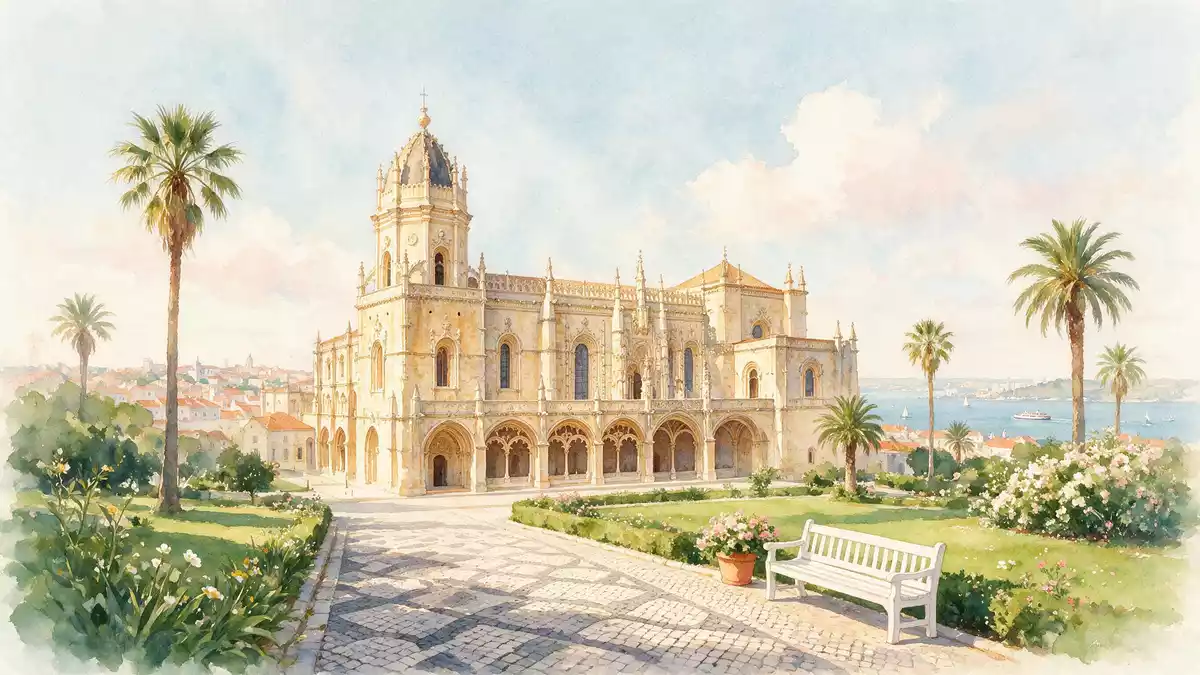
Mosteiro dos Jeronimos in Lissabon is one of the clearest places where Portugal’s age of ocean voyages has been turned into stone. Rising beside the Tagus in Belém, the monastery combines late medieval origins with the elaborate Manueline style and holds the tombs of Vasco da Gama and Luís de Camões within its church, tying architecture directly to the country’s maritime history.Jerónimos Monastery
Manueline stonework and a riverside setting
The monastery stands in the Belém district on the northern bank of the Tagus, west of central Lisbon, where ships once departed towards Africa, Asia and South America.Mosteiro dos Jerónimos Commissioned under King Manuel I in the late fifteenth century, its construction began at the start of the sixteenth century and extended for decades, leaving a vast ensemble of church and cloister built in limestone and laden with carved detail.Bau des Jerónimos-Klosters
From the outside, Mosteiro dos Jeronimos reads as a long horizontal mass parallel to the river, punctuated by buttresses, pinnacles and a church portal carved with saints, heraldic emblems and maritime motifs. The Manueline style is visible in the way ropes, spheres and vegetation are entwined into the stone, a decorative language associated with the reign of Manuel I and the wealth drawn from ocean trade.estilo manuelino The location beside the broad water and the nearby Torre de Belém makes the monastery part of a continuous waterfront ensemble of early sixteenth-century monuments.
Cloisters, church and royal memory
Inside the complex, the cloister forms a square courtyard surrounded by two tiers of arcades, each bay framed by slender columns and dense tracery, turning the inner walkways into a kind of stone lace. The cloister, secularised during the nineteenth century, now leads to museum spaces in former monastic wings, while retaining its carved balustrades, bosses and sculpted details shaped in the early sixteenth century.Jerónimos Monastery cloister
The church of Santa Maria de Belém is attached to one side of the cloister and runs along the street frontage, with a high vaulted interior supported by slender columns. Within this church lie the tombs of Vasco da Gama, whose voyage to India at the end of the fifteenth century reshaped Portugal’s trade routes, and the poet Luís de Camões, author of “Os Lusíadas”, whose epic verses narrate those voyages.tombs of Vasco da Gama Their presence turns the monastery into a place where royal, religious and literary memory intersect, extending its role beyond monastic life into a national pantheon function.
From royal foundation to UNESCO World Heritage
Mosteiro dos Jeronimos originated as a royal foundation, endowed by Manuel I and entrusted to the Order of Saint Jerome, whose monks lived and prayed here for centuries before religious orders were dissolved in the nineteenth century.Mosteiro de Santa Maria de Belém In 1907 it was declared a Monumento Nacional, recognising its importance in Portuguese architecture, and in 1983 it was inscribed on the UNESCO World Heritage List together with the nearby Belém Tower, placing the complex among the protected sites linked to the era of the discoveries.UNESCO inscription 1983
The building has survived major events in Lisbon’s history, including the 1755 earthquake, which damaged but did not destroy the monastery, allowing its Manueline cloister and church to remain in use and later be adapted for museum functions.Erdbeben von 1755 Today the complex houses the National Archaeology Museum and the Maritime Museum in parts of its former convent buildings, while the church continues to serve as a parish church and national pantheon, reflecting the layered religious and civic roles the site has accumulated.
Visiting Mosteiro dos Jeronimos: what travellers from Western Europe should know
- Mosteiro dos Jeronimos stands in the Belém district of Lissabon, beside Praça do Império and close to the riverfront; it is reached by city trams and suburban trains serving Belém station.
- The cloister and upper levels are accessed by stairways, and visiting the complex involves walking along stone arcades and through large interior spaces.
- English is widely used, yet the official language is Portuguese and the currency is the euro.
Searching for Mosteiro dos Jeronimos on social platforms
These links open searches for Mosteiro dos Jeronimos on each platform.
Frequently asked questions about Mosteiro dos Jeronimos
Where is Mosteiro dos Jeronimos located in Lissabon?
Mosteiro dos Jeronimos stands in the Belém parish on the Tagus river’s northern bank, west of Lissabon’s historic centre and close to Praça do Império.
What can visitors expect when exploring the monastery?
Visitors encounter a Manueline church with royal tombs, a two-level cloister with dense stone carving, and museum spaces occupying former convent wings.
What makes Mosteiro dos Jeronimos distinctive among Portuguese monuments?
The monastery combines Manueline architecture, a royal foundation under Manuel I, tombs of key figures of the discoveries and UNESCO World Heritage status alongside the Belém Tower.


