
Mosteiro dos Jeronimos and the stone lace of Belém
Published on 09/08/2026 at 14:24 | Editorial responsibility: Rafael Müller, Editor-in-Chief AD HOC NEWS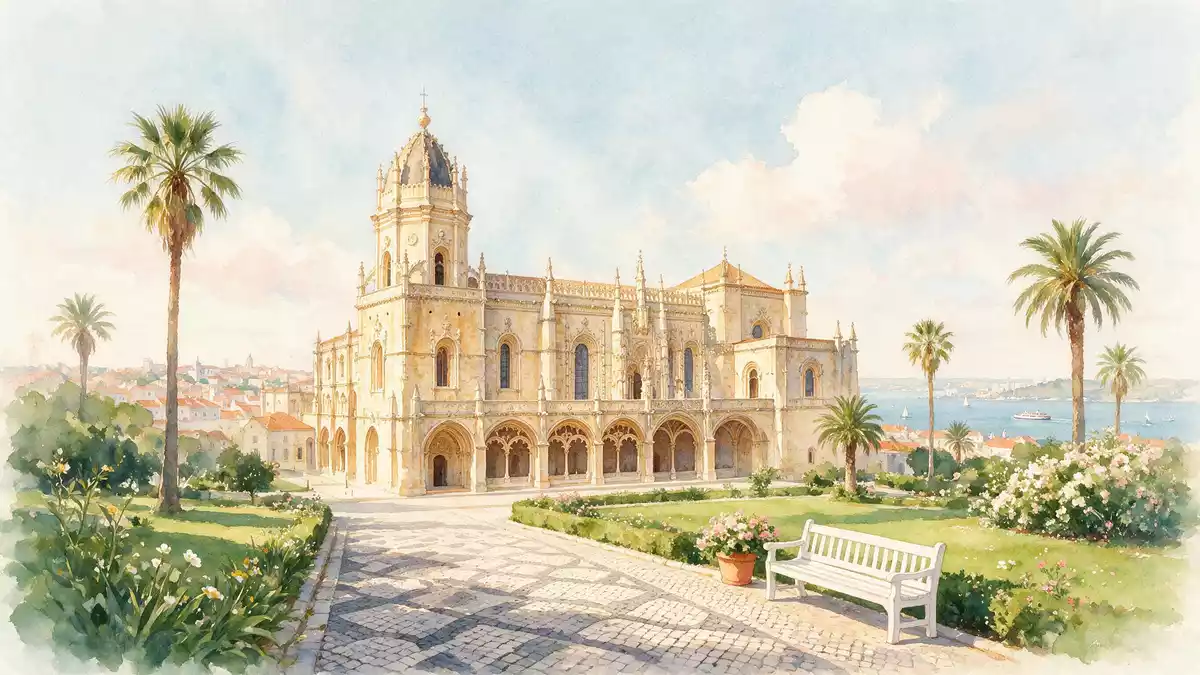
Mosteiro dos Jeronimos stands on the waterfront at Belém in Lissabon, a vast monastery whose Manueline stonework turns its façades and cloisters into intricate lace carved in limestone. Commissioned by King Manuel I in the late fifteenth century and largely built through the sixteenth century, it anchors Portugal’s Age of Discovery on a site where expeditions once left the Tagus for Africa and Asia.
Manueline grandeur on the Tagus
The monastery forms part of the Belém riverside, in the parish of Santa Maria de Belém on the northern bank of the Tagus estuary, west of central Lisbon. The complex stretches along Praça do Império, its church of Santa Maria de Belém marking the eastern end and the cloister wings extending inland behind the main façade.Santa Maria de Belém, Lisbon Across the avenue, lawns and water features separate the monastery from the riverfront promenade, with views across the Tagus towards Almada.
The royal monastery was founded as the Monastery of Santa Maria de Belém and entrusted to the Order of Saint Jerome, whose contemplative life unfolded within its church, refectory and cloisters.Order of Saint Jerome King Manuel I obtained papal approval for the foundation in 1496, and construction followed under royal patronage during his reign and that of King João III. The ensemble was later declared a Monumento Nacional in 1907 and inscribed as a UNESCO World Heritage Site in 1983 together with the nearby Torre de Belém, recognising both its architectural importance and its role in maritime history.UNESCO World Heritage Site since 1983
Manueline stone lace and maritime motifs
Mosteiro dos Jeronimos is one of the clearest expressions of Manueline architecture, an ornate Portuguese variant of late Gothic that integrates maritime and royal symbols into its fabric. Pinnacles, buttresses and arcades are thick with carved details, while portals and windows are framed by bands of sculpted foliage, ropes and heraldic emblems.“joia” of Manueline style The stone used throughout the complex is pale limestone, which catches the Atlantic light and heightens the depth of the carving.
Maritime motifs appear everywhere in the decoration, echoing the voyages that left the Tagus nearby. Ropes and knots wrap around columns, armillary spheres and crosses punctuate façades, and sculpted creatures such as seahorses and shells sit among foliage.seafaring motifs in stone Inside the cloister, arcades run around a central courtyard, each bay carrying traceried openings and slender supports carved with vegetal and nautical themes. The effect is of architecture and sculpture fused into a continuous surface of stone filigree, with the two storeys of the cloister offering changing perspectives on the courtyard and its delicate detailing.
Church, cloister and royal memory
The church of Santa Maria de Belém forms the spiritual heart of Mosteiro dos Jeronimos, with a high nave supported by clustered columns that rise into a ribbed vault. The plan follows a hall-church arrangement, with the nave and aisles almost the same height, creating an open volume under a single canopy of stone vaulting. Light enters through clerestory openings and side windows, catching carved capitals and sculpted tombs set along the walls.
Within the church and adjoining spaces, important figures of Portuguese history are buried, linking the monastery directly to the Age of Discovery. The tomb of Vasco da Gama, whose expedition reached India by sea in 1498, lies inside the church, as does that of the poet Luís de Camões, associated with “Os Lusíadas”.tombs of Vasco da Gama and Luís de Camões The complex has also acquired the status of National Pantheon in recent years, further reinforcing its role as a place of royal and national memory.statuto de Panteão Nacional
Visiting Mosteiro dos Jeronimos: what travellers from Western Europe should know
- Mosteiro dos Jeronimos stands in the Belém district of Lissabon, west of the historic centre, facing Praça do Império and close to the Tagus riverfront promenade.
- The complex includes the church of Santa Maria de Belém and extensive cloisters, with interiors reached by broad stone staircases and long corridors laid out around a central courtyard.
- Belém is linked to central Lisbon by urban rail from Cais do Sodré towards Cascais, with a stop at Belém station, and by tram and bus routes that serve the Mosteiro Jeronimos area.
- The official language is Portuguese and the currency is the euro.
- Entry requirements depend on your nationality; UK travellers can check the FCDO travel advice at gov.uk/foreign-travel-advice, Irish travellers the Department of Foreign Affairs at ireland.ie.
Searching for Mosteiro dos Jeronimos on social platforms
These links open searches for Mosteiro dos Jeronimos on each platform.
Frequently asked questions about Mosteiro dos Jeronimos
Where is Mosteiro dos Jeronimos located in Lissabon?
Mosteiro dos Jeronimos stands in the Santa Maria de Belém parish of Lissabon, facing Praça do Império near the Tagus river in the western part of the city.
What can visitors expect inside the monastery complex?
Visitors encounter the high-vaulted church of Santa Maria de Belém, twin-storey cloisters built in Manueline style and a sequence of monastic spaces arranged around a central courtyard.
What makes Mosteiro dos Jeronimos distinctive among Portuguese landmarks?
Its elaborate Manueline stonework, maritime motifs, royal foundation under King Manuel I and the presence of Vasco da Gama’s tomb combine to make it a central monument of Portugal’s Age of Discovery.


