
Mosteiro dos Jeronimos and the Manueline stonework of Belém
Published on 09/12/2026 at 14:49 | Editorial responsibility: Rafael Müller, Editor-in-Chief AD HOC NEWS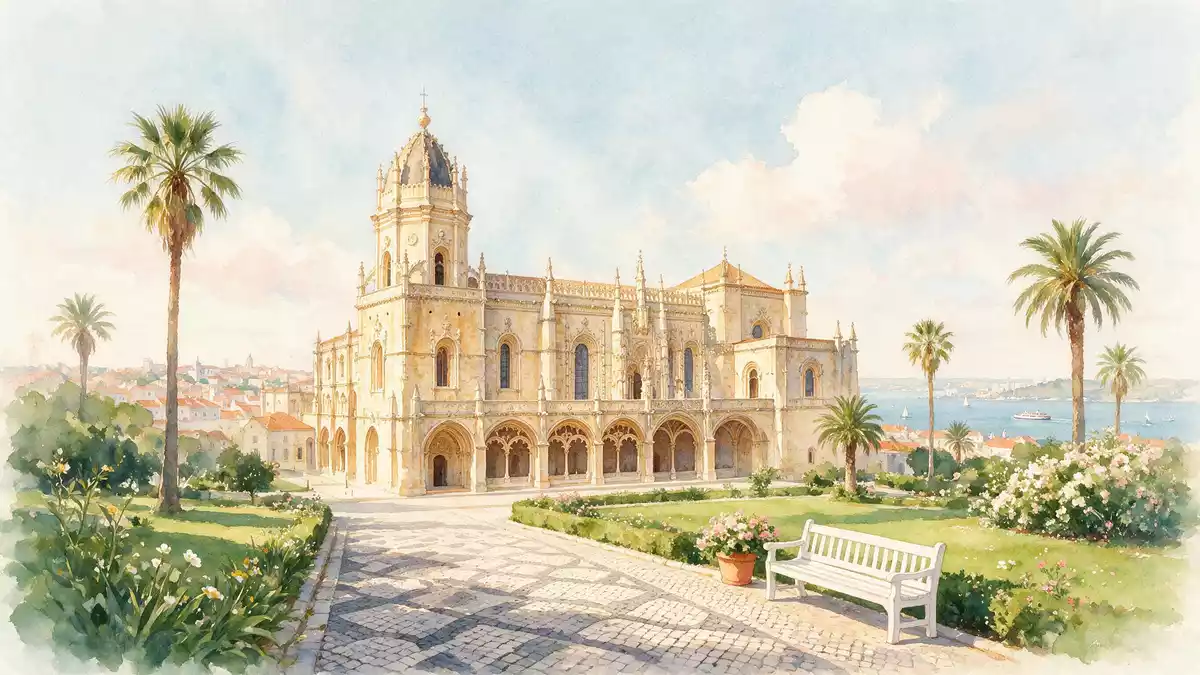
Mosteiro dos Jeronimos in Lissabon is a limestone complex in Belém, closely tied to King Manuel I and the late fifteenth century. Its long church front, cloister and carved portals make the building’s Manueline stonework visible at once.
Mosteiro dos Jeronimos and Manueline stonework
The monastery began in 1502 and became one of the clearest expressions of Portuguese Manueline architecture. Its ornate surface belongs to a royal foundation linked with the Royal Monastery of Santa Maria de Belém, a title that places the building within courtly and religious history.
Manuel I commissioned the work, and the monastery stood within the ceremonial landscape of the Tagus riverfront. The UNESCO listing describes it as part of the Belém complex, a property that represents Portuguese art at its height.
King Manuel I, Diogo de Boitaca and the 1500s
The first phase is associated with Diogo de Boitaca, followed by João de Castilho and later masters. The sequence of names reflects a building campaign that developed across the sixteenth century, with the church and cloister taking their present form over generations.
Inside, the monastery holds the tombs of Vasco da Gama and Luís de Camões, while the church retains its role as a religious space. These names connect the building to navigation, literature and royal patronage, without separating it from its monastic setting.
Belém, the Tagus and the heritage setting
The monastery stands near the Tagus and shares its setting with the Tower of Belém. UNESCO treats the pair as a serial World Heritage property, united by their position at the entrance to Lisbon harbour.
The UNESCO record also notes the continuation of original materials, form and design in the property’s authenticity. That makes the complex legible as a major stone monument rather than a reconstruction of an older church.
Visiting Mosteiro dos Jeronimos: what travellers from Western Europe should know
- The monastery stands in Belém, west of central Lissabon, near the Tagus and the Tower of Belém. It is reached by urban transport within the riverside district.
- The church and cloister are entered on foot through stone fabric and open arcades. The monastery is a large limestone complex, so the visit is centred on architectural surfaces rather than landscape paths.
- The site belongs to the parish of Santa Maria de Belém, and the church remains a religious space. That gives the complex a living liturgical use alongside its heritage role.
- The official language is Portuguese and the currency is the euro.
- Entry requirements depend on your nationality; UK travellers can check the FCDO travel advice at gov.uk/foreign-travel-advice, Irish travellers the Department of Foreign Affairs at ireland.ie.
Searching for Mosteiro dos Jeronimos on social platforms
These links open searches for Mosteiro dos Jeronimos on each platform.
Frequently asked questions about Mosteiro dos Jeronimos
Where is Mosteiro dos Jeronimos?
It stands in Belém, in western Lissabon, close to the Tagus riverfront. The monastery is part of the same heritage landscape as the Tower of Belém.
What can be seen on a visit?
The main elements are the church, the cloister and the richly carved stonework. The building also preserves tombs connected with Vasco da Gama and Luís de Camões.
What makes it distinctive?
Its Manueline decoration and royal origin define the place. The monastery belongs to the UNESCO-listed Belém complex and keeps a strong link with the age of Portuguese maritime expansion.


