
Mosteiro da Batalha, Portugal’s limestone Gothic landmark
Published on 09/15/2026 at 15:05 | Editorial responsibility: Rafael Müller, Editor-in-Chief AD HOC NEWS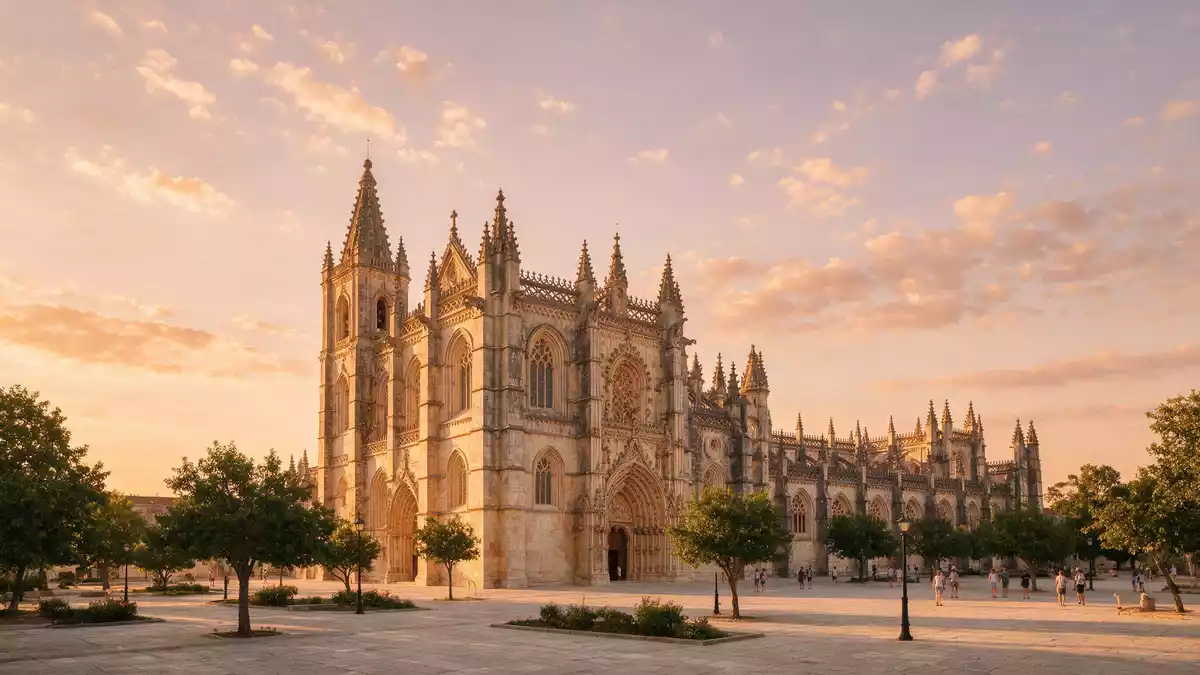
Mosteiro da Batalha in Batalha is a Dominican monastery of warm-coloured limestone, built from the late fourteenth century as a memorial to the Battle of Aljubarrota and as a royal pantheon for the Avis dynasty of Portugal.Dominican Monastery of Batalha
A monastery born from a battlefield vow
The official name of the complex is the Monastery of Saint Mary of the Victory, Mosteiro de Santa Maria da Vitória, a title that recalls its origin in the political and spiritual aftermath of the Battle of Aljubarrota in 1385.Monastery of Saint Mary of the Victory The battle took place close to the site and secured the throne for João I, Master of Avis, against Castilian claims, reinforcing Portugal’s independence and ushering in the Avis dynasty.victory at Aljubarrota
Construction began in the late 1380s under the patronage of King João I, and work continued for more than 150 years under seven Portuguese monarchs, with phases of building stretching into the early sixteenth century.works lasted for more than 150 years The monastery was entrusted to the Dominican Order, making it both a dynastic monument and a working convent whose community occupied parts of the complex while masonry work progressed.
Limestone Gothic and Manueline architecture in one ensemble
Mosteiro da Batalha is recognised as one of the most significant buildings of Portuguese Gothic, with late Flamboyant Gothic forms interwoven with early Manueline ornament that foreshadows sixteenth-century Portuguese architecture.masterpiece of Gothic and Manueline art The fabric is built largely in a soft, golden-toned limestone, carved into buttresses, pinnacles and traceried walls that give the exterior a crystalline, almost mineral character.stone of warm tone
The main church presents a tall nave with several bays, ribbed vaults and slender clustered piers leading towards the high choir, a space that shows the evolution from late medieval structural Gothic to richer decorative forms.ornate Gothic creation Around it, cloisters and chapels display Manueline details, including elaborate portals and vegetal carving, reflecting work in the early sixteenth century under masters such as Mateus Fernandes, whose interventions are associated with the most profuse decoration in the complex.Mateus Fernandes and Manueline style
Royal pantheon, unfinished chapels and UNESCO status
Within the ensemble, the Founder’s Chapel serves as the burial place of King João I, his queen Filipa of Lancaster and their immediate descendants, making Mosteiro da Batalha the first true royal pantheon in Portugal.first royal pantheon in Portugal Another striking feature is the set of Capelas Imperfeitas, the “Unfinished Chapels”, a free-standing octagonal structure adjoining the chevet that was left without roofing, where sculpted portals and traceried walls stand open to the sky.
The entire monastery complex, including church, cloisters and associated structures, is inscribed as a UNESCO World Heritage Site, recognised since 1983 for its outstanding Gothic architecture and historical significance in the formation of Portugal.Monastery of Batalha UNESCO inscription In the national context it is listed as a National Monument, and it also appears among major Portuguese heritage sites highlighted in cultural and tourism programmes, reflecting its role as a landmark of the country’s architectural and dynastic history.National Monument in Batalha
Visiting Mosteiro da Batalha: what travellers from Western Europe should know
- Mosteiro da Batalha stands in the town of Batalha in central Portugal, in the district of Leiria; it occupies a large square known as Largo de Santa Maria da Vitória.
- The complex is built on gently sloping ground with extensive interior spaces, and visits involve walking through cloisters, chapels and the main church on stone floors.
- The surrounding town provides services and road connections; the monastery sits beside urban streets and is signposted on approaches to Batalha from the wider region.
- The official language is Portuguese and the currency is the euro.
Searching for Mosteiro da Batalha on social platforms
These links open searches for Mosteiro da Batalha on each platform.
Frequently asked questions about Mosteiro da Batalha
Where is Mosteiro da Batalha located?
Mosteiro da Batalha is in the town of Batalha in central Portugal, in the district of Leiria, where it occupies a prominent position beside the main square.
What can visitors expect inside the monastery complex?
Visitors encounter a tall Gothic church, cloisters, chapels including the Founder’s Chapel, and the open Unfinished Chapels, all built in warm-toned limestone and arranged around courts and passageways.
What makes Mosteiro da Batalha distinctive among Portuguese monuments?
It combines late Gothic and Manueline architecture in a single limestone ensemble and serves as a royal pantheon linked directly to the victory at Aljubarrota and the rise of the Avis dynasty.


