
Mosteiro da Batalha and the stone poetry of Portugal’s late Gothic
Published on 09/18/2026 at 14:40 | Editorial responsibility: Rafael Müller, Editor-in-Chief AD HOC NEWS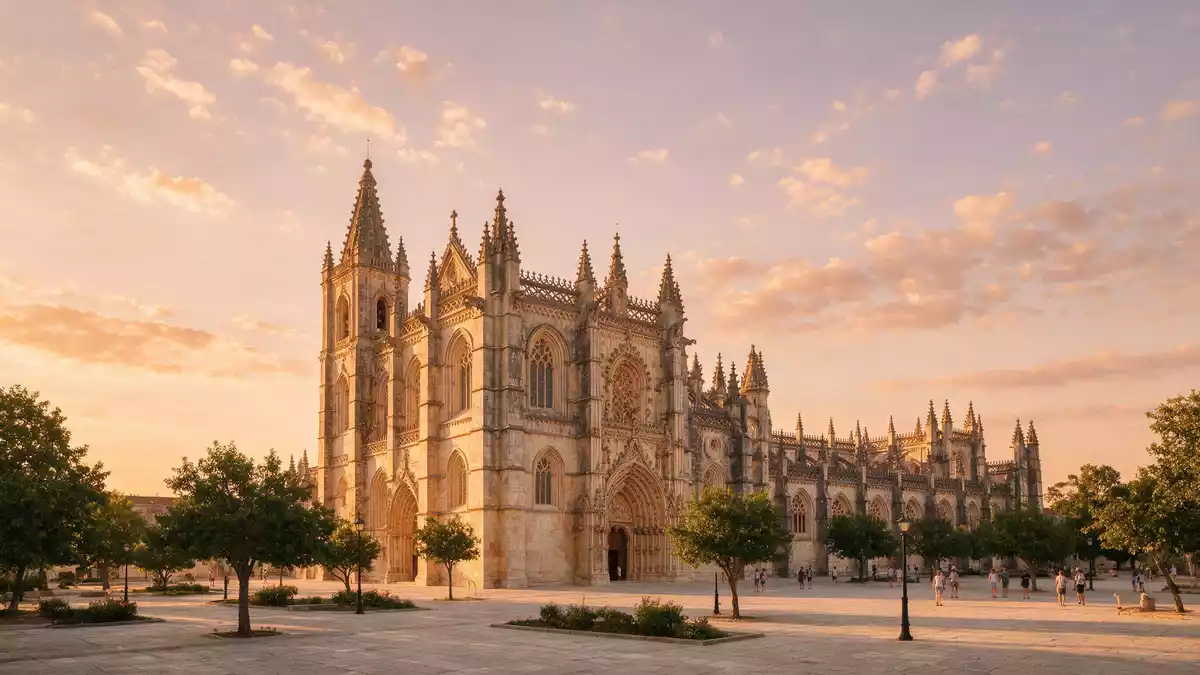
Mosteiro da Batalha in Batalha is a Dominican monastery where Portuguese late Gothic and Manueline stone carving turns a royal vow into an intricate stone landscape. Commissioned by King João I in the late fourteenth century, it became both a memorial to the Battle of Aljubarrota in 1385 and a dynastic pantheon for the Aviz monarchy.
A monastery born from a medieval battlefield
The official name of the complex is the Monastery of Saint Mary of the Victory, a title that links the building directly to the Battle of Aljubarrota fought in 1385 between Portuguese and Castilian forces.Battle of Aljubarrota King João I made a vow that, if victorious, he would found a great monastery dedicated to the Virgin Mary, and construction began in the late fourteenth century under his patronage.patronage of King João I
The monastery stands in the centre of Batalha in the Centro region of Portugal, occupying a broad platform above the surrounding townscape.centre of the town of Batalha It was built as a Dominican convent and later became both a museum and a national pantheon, holding the tombs of João I and his English queen, Philippa of Lancaster, as well as other members of the Aviz dynasty.Aviz dynasty pantheon
Portuguese late Gothic and Manueline stonework
Mosteiro da Batalha is considered one of the most significant examples of Portuguese Gothic architecture, with its church, cloisters and chapels forming a showcase of late medieval design.most significant building of Portuguese Gothic The initial phase follows a High Gothic vocabulary, with pointed arches, ribbed vaults and slender columns shaping a spacious nave and transept.
Later work introduced Manueline ornament, a Portuguese variation on late Gothic characterised by elaborate sculpted detail and maritime motifs.estilo manuelino The Royal Cloister, added under King Manuel I, combines the structural rhythm of Gothic arcades with traceries carved into complex patterns, while the so?called Unfinished Chapels display profusely decorated portals and buttresses that remain open to the sky where vaults were never completed.Unfinished Chapels with Manueline carving
Royal tombs, cloisters and a national symbol
At the heart of the complex stands the church, whose Founder’s Chapel houses the tombs of João I and Philippa of Lancaster and their sons, under intricately carved stonework that emphasises the monastery’s role as a royal burial place.Founder’s Chapel and royal tombs Nearby, the Chapter House is known for a vaulted ceiling without central supports, a structural feat that now also serves as the tomb of Portugal’s Unknown Soldiers, tying medieval architecture to twentieth?century memory.Chapter House and Unknown Soldiers
The monastery’s cloisters organise daily monastic life around open courtyards framed by arcades, mixing simple Gothic lines with later Manueline additions. In 1983 Mosteiro da Batalha was inscribed on the UNESCO World Heritage List as an outstanding example of Gothic art and a monument linked directly to Portuguese independence.UNESCO World Heritage site since 1983 The building is now managed as a national monument with cultural, devotional and visitor functions alongside its historical role.National Monument with cultural role
Visiting Mosteiro da Batalha: what travellers from Western Europe should know
- Mosteiro da Batalha stands in the town of Batalha in central Portugal, reached by road from Leiria and as a day excursion from Lisbon.
- The complex is laid out around cloisters and courtyards, with stone floors and flights of steps connecting the church, Chapter House and Unfinished Chapels.
- The official language is Portuguese and the currency is the euro.
- Entry requirements depend on your nationality; UK travellers can check the FCDO travel advice at gov.uk/foreign-travel-advice, Irish travellers the Department of Foreign Affairs at ireland.ie.
Searching for Mosteiro da Batalha on social platforms
These links open searches for Mosteiro da Batalha on each platform.
Frequently asked questions about Mosteiro da Batalha
Where is Mosteiro da Batalha located?
Mosteiro da Batalha is in the town of Batalha in the Centro region of Portugal, north of Lisbon in the district of Leiria.
What can visitors expect on a visit?
Visitors encounter a large Gothic church, cloisters, royal tombs and open?roofed chapels, all built in finely carved stone with both Gothic and Manueline detailing.
What makes Mosteiro da Batalha distinctive?
Its origins in the Battle of Aljubarrota, its role as a royal pantheon and its combination of Portuguese Gothic and Manueline stonework make it a landmark of national history and architecture.


