
Mosquee Koutoubia and its Almohad minaret in Marrakesch
Published on 09/16/2026 at 12:44 | Editorial responsibility: Rafael Müller, Editor-in-Chief AD HOC NEWS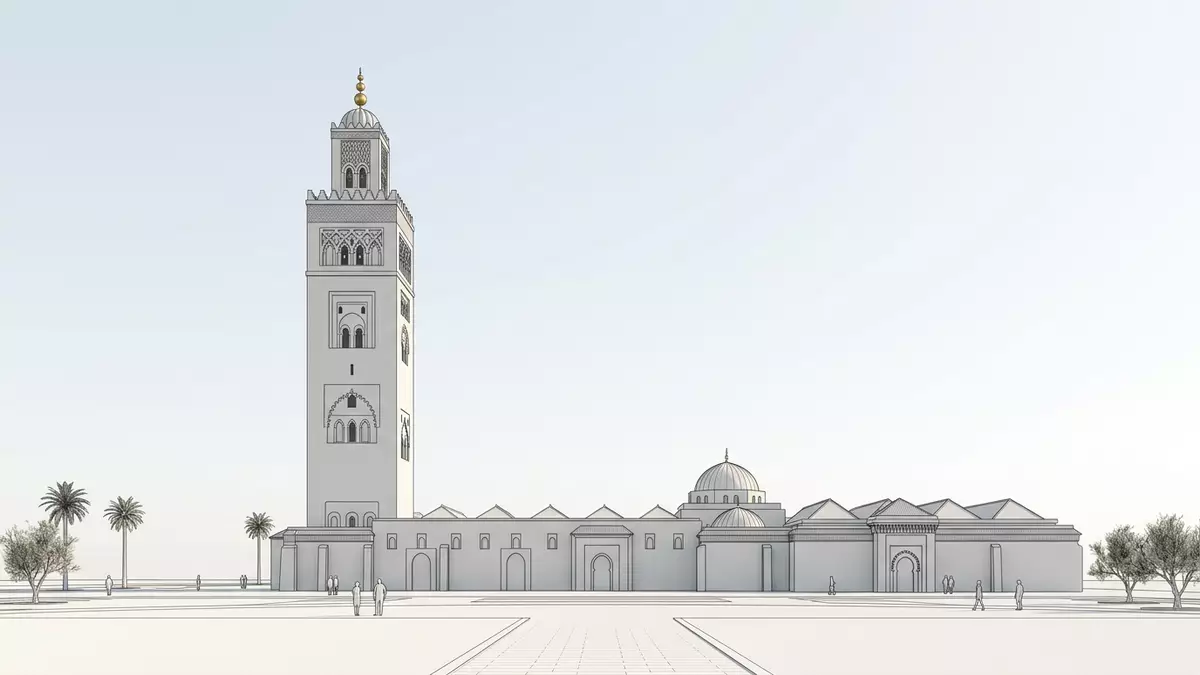
Mosquee Koutoubia in Marrakesch is the great Almohad mosque whose stone minaret has watched over the city’s old medina since the twelfth century, linking faith, power and urban life in one landmark. Built under the Almohad caliph Abd al?Mu’min and completed later in the same century under his grandson Abu Yusuf Ya’qub al?Mansur, it distils the geometry and restraint of Almohad architecture into a single towering volume. The name “Koutoubia” reaches back to the book sellers who once traded around its walls, rooting this vast structure in the everyday commerce of the city.
The twelfth?century Almohad mosque at the city’s heart
Mosquee Koutoubia stands at the south?western edge of the old medina of Marrakesch, close to the open space of Jemaa el?Fna and the avenues that lead towards the newer districts. It is a congregational mosque laid out as a broad prayer hall supported by repeated rows of pillars, forming a field of aisles oriented towards the qibla wall. Historical sources describe how Abd al?Mu’min, the first Almohad caliph, ordered construction of a mosque here soon after his forces took Marrakesch from the Almoravids in 1147, setting out a new religious and political centre for his dynasty.Abd al?Mu’min’s mosque project
The building history is complex, with two successive Koutoubia mosques raised on the same site in the twelfth century. The first version was begun shortly after 1147 and completed in the 1150s, while a second mosque of similar scale was aligned beside it and brought into use by 1158.Twelfth?century phases of construction Later in the century, during the reign of Abu Yusuf Ya’qub al?Mansur, the complex was consolidated, and work on the minaret reached its final form around the 1190s.Completion under Ya’qub al?Mansur The result is the mosque ensemble seen today, with its rhythm of interior pillars and the great tower rising above the surrounding gardens.
The stone minaret that shaped a wider architectural family
The minaret of Mosquee Koutoubia, in stone and brick, is one of the most recognisable structures in Marrakesch, rising to around 77 m (253 ft) in a square shaft layered with restrained ornament.The 77?metre minaret Its faces are articulated with panels, blind arches and decorative bands that catch light and shadow rather than relying on lavish surface decoration. This disciplined treatment is characteristic of Almohad religious architecture, which favours clarity of form over exuberant carved detail. The tower’s proportions and stepped top became a reference point for later minarets across Morocco and in former Almohad territories.
Mosquee Koutoubia is closely linked to other major twelfth?century projects, including the Giralda in Seville and the Hassan Tower in Rabat, whose designs echo its stacked volumes and ornamental vocabulary.Architectural kinship with Giralda and Hassan Tower The relationship between these structures illustrates how the Almohad dynasty projected its authority through a shared architectural language stretching from Marrakesch into al?Andalus. Standing in the city, the Koutoubia minaret anchors views across the medina, while in architectural history it anchors an entire family of towers that adapted its composition to different sites and scales.
From booksellers’ quarter to landscaped setting
The name “Koutoubia” derives from the Arabic “al?kutubiyyin”, a term associated with booksellers who historically operated around the mosque, giving the building a direct link to written culture and trade.Name rooted in booksellers Accounts of the site emphasise the presence of merchants dealing in books and manuscripts in the surrounding streets, an activity that added an intellectual dimension to the religious function of the mosque. The connection between the great ritual space and the circulation of texts reflects the importance of scholarship and learning in the city during the Almohad period.
Today Mosquee Koutoubia stands amid open spaces and planted areas that separate its enclosure from the surrounding traffic routes, giving clear views of the minaret from many approaches. Traces of the earlier mosque layout can be identified in the ground beside the current building, where archaeological remains of foundations recall the first phase of construction on the site.Remains of the first mosque Within the prayer hall, a grid of columns divides the space into aisles that lead the eye towards the mihrab in the qibla wall, while exterior façades express the same ordered rhythm at a larger scale.
Visiting Mosquee Koutoubia: what travellers from Western Europe should know
- Mosquee Koutoubia stands near Jemaa el?Fna in central Marrakesch, a short walk from the surrounding medina streets and the avenues leading towards the city’s newer quarters.
- The mosque’s setting includes paved squares and gardens, and the surrounding area is largely flat; approaches involve ordinary urban walking rather than steep climbs.
- For travellers whose first language is not Arabic or French, it is helpful that Marrakesch is accustomed to international visitors and basic English is encountered in many nearby businesses.
- The official language is Arabic and the currency is the Moroccan dirham.
- Entry requirements depend on your nationality; UK travellers can check the FCDO travel advice at gov.uk/foreign-travel-advice, Irish travellers the Department of Foreign Affairs at ireland.ie.
Searching for Mosquee Koutoubia on social platforms
These links open searches for Mosquee Koutoubia on each platform.
Frequently asked questions about Mosquee Koutoubia
Where is Mosquee Koutoubia located in Marrakesch?
Mosquee Koutoubia stands on the south?western side of the medina of Marrakesch, close to Jemaa el?Fna and major thoroughfares leading towards the modern city.
What can visitors expect when they see Mosquee Koutoubia?
Visitors encounter a large Almohad mosque with a high stone minaret, landscaped surroundings and views that connect the tower with the dense fabric of the old city.
What makes Mosquee Koutoubia distinctive among Moroccan mosques?
Its twelfth?century Almohad minaret, its role as a model for towers like the Giralda in Seville and Hassan Tower in Rabat, and its historical link to booksellers give it a distinctive place in Moroccan architecture.


