
Mosquee Hassan II and the Atlantic edge of Casablanca
Published on 09/07/2026 at 16:52 | Editorial responsibility: Rafael Müller, Editor-in-Chief AD HOC NEWS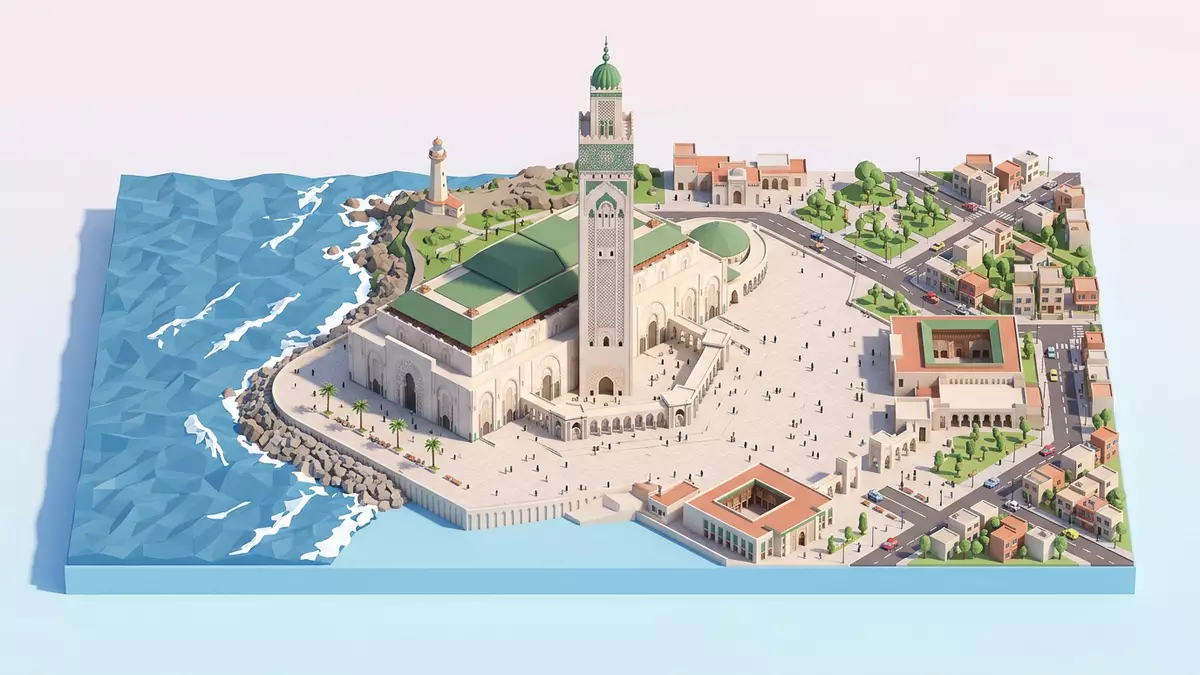
Mosquee Hassan II in Casablanca is a monumental ocean?edge mosque whose vast stone terraces and soaring minaret rise above the Atlantic, binding religious architecture to the city’s shoreline. Completed in 1993 and named for King Hassan II, it was designed by the French architect Michel Pinseau and built by Moroccan artisans drawing on centuries of decorative tradition.
An Atlantic mosque built partly over the sea
Mosquee Hassan II stands on the north?western edge of Casablanca, on Boulevard Sidi Mohammed Ben Abdallah where the city meets the Atlantic Ocean. The mosque complex occupies a land platform and a rocky promontory, with part of its foundation extending over the water on a reinforced structure that carries stone terraces and prayer spaces above the waves.stands on a promontory above the Atlantic Ocean The building’s relationship with the sea is immediate: from the outer esplanade the Atlantic surf is visible below the outer edge, and the main prayer hall rises from this coastal base rather than from an inland courtyard.
The mosque is a late twentieth?century structure, inaugurated in 1993 under King Hassan II after several years of construction that reshaped this stretch of shoreline into a religious and civic platform.completed in 1993 The complex extends over a site measured in hectares, combining the main prayer hall with ancillary spaces such as ablution areas, baths, a madrasa, a library, a museum and an academy of traditional arts, all integrated into a single composition facing the ocean.un complexe religieux et culturel aménagé sur neuf hectares
A soaring minaret and vast prayer hall
The most striking single element of Mosquee Hassan II is its minaret, which rises to about 210 m (689 ft) and is recognised among the highest religious towers in the world.minaret is 210 metres The tower’s height makes it a landmark along the Atlantic coast and across Casablanca, and a laser mounted near its summit projects horizontally towards Mecca over a distance measured in tens of kilometres.its 210-meter minaret holds a laser pointing 30 kilometers toward Mecca At the base of the minaret, the main prayer hall stretches across a broad footprint, with a roof line around 60 m (197 ft) above the floor and structural spans that carry large areas of uninterrupted space.
The interior of the prayer hall is organised on a longitudinal plan that has been described as basilican, with processional axes and side aisles framed by arcades, rather than the T?shaped layout known from some older North African mosques.building follows a basilican plan Beneath and beside the main hall are further spaces, including ablution rooms and ancillary facilities linked by staircases and corridors, all built within the same reinforced concrete framework. The entire complex is engineered to accommodate tens of thousands of worshippers inside and on the surrounding esplanade, with circulation routes that connect the indoor hall to the open terraces facing the ocean.accommodates 25,000 worshippers inside the main prayer hall and another 80,000 in the surrounding outdoor plaza
Late twentieth?century craftsmanship in stone, wood and tile
Mosquee Hassan II belongs to the late twentieth century yet draws heavily on older Moroccan and Andalusi traditions of decoration and craft. Michel Pinseau’s design combines reinforced concrete structural frames with extensive use of stonework, carved plaster, carved and painted wood ceilings, and zellige tile panels on both interior and exterior surfaces.designed by the French architect Michel Pinseau The decorative programme takes motifs familiar from mosques and madrasas in cities such as Marrakesh, Rabat and Fez, translating them into a much larger scale on the Atlantic seafront.
The mosque’s surfaces include expansive stone arcades, marble columns, intricately carved wooden doors and painted ceilings that highlight geometric and floral patterns, all executed by artisans brought together for the project from across Morocco.artisans from across Morocco contributed carved plaster, painted ceilings, zellige tilework and carved wood Along the outer terraces, decorative stone balustrades and tiled bands run beside the sea, and the transition from the urban fabric of Casablanca to the mosque complex is marked by a large paved esplanade that functions as both forecourt and gathering space.
Visiting Mosquee Hassan II: what travellers from Western Europe should know
- Mosquee Hassan II stands on Boulevard Sidi Mohammed Ben Abdallah on Casablanca’s Atlantic waterfront, north?west of the historic medina and port district. It is reached over city streets from Casa?Port railway station and the corniche seafront.
- The site consists of a broad paved esplanade, stone terraces and stairways, with substantial areas exposed to the ocean. Approaches involve walking across open paving and using staircases within the complex.
- Casablanca lies in Morocco; the official language is Arabic and the currency is the Moroccan dirham.
- Entry requirements depend on your nationality; UK travellers can check the FCDO travel advice at gov.uk/foreign-travel-advice, Irish travellers the Department of Foreign Affairs at ireland.ie.
Searching for Mosquee Hassan II on social platforms
These links open searches for Mosquee Hassan II on each platform.
Frequently asked questions about Mosquee Hassan II
Where is Mosquee Hassan II located in Casablanca?
Mosquee Hassan II stands on Boulevard Sidi Mohammed Ben Abdallah on Casablanca’s Atlantic seafront, north?west of the historic medina and port area.
What can visitors expect when entering the complex?
Visitors encounter a large paved esplanade leading to the main mosque building, with stone terraces, stairways and interior spaces that include the vast prayer hall and ancillary facilities.
What makes Mosquee Hassan II distinctive among modern mosques?
The mosque is distinctive for its 210 m minaret, its partial construction over the Atlantic on a coastal promontory, and the extensive use of Moroccan craft on a late twentieth?century structural scale.


