

Mosquee Hassan II and Casablanca's seafront skyline
Published on 08/23/2026 at 07:53 | Editorial responsibility: Rafael Müller, Editor-in-Chief AD HOC NEWS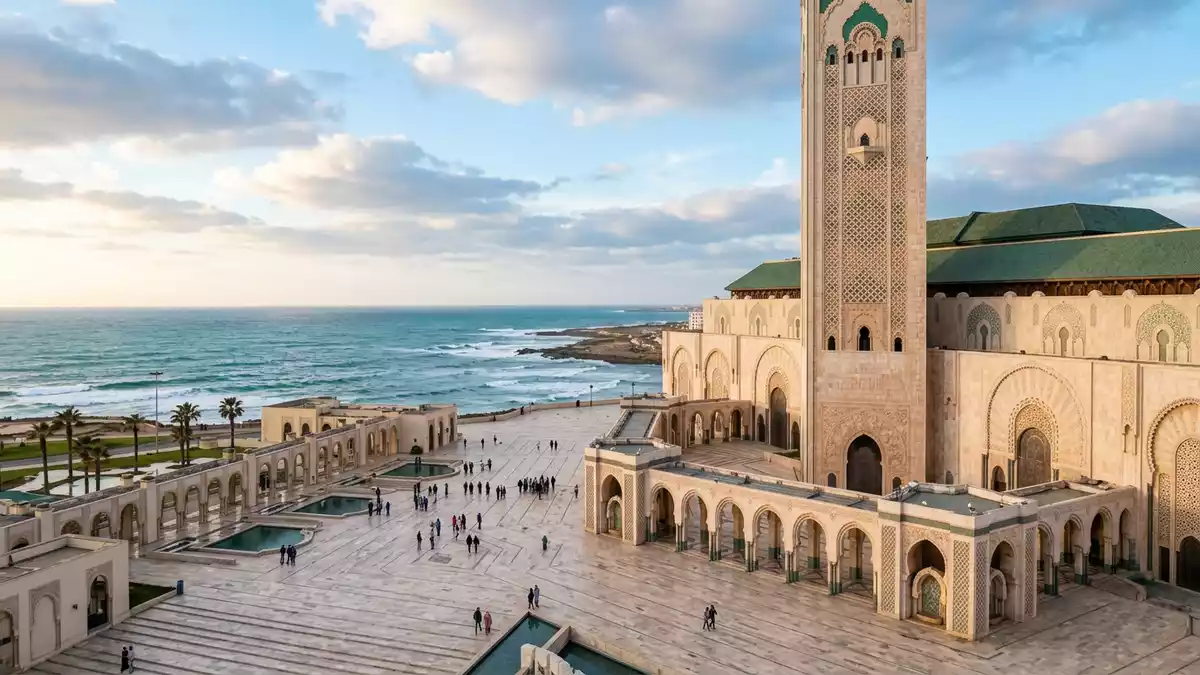
Mosquee Hassan II rises over Casablanca with a 210-metre minaret and a prayer hall facing the Atlantic. Designed by Michel Pinseau and completed in 1993, it combines a clear modern profile with Moroccan architectural language.
A minaret that dominates the Casablanca skyline
The mosque’s most visible element is the minaret, which stands 210 metres tall. Its height and square shaft make the building readable from the coast and from the city’s broad avenues, while the rest of the complex stays low and horizontal.
The mosque was designed by Michel Pinseau under the patronage of King Hassan II, and completed in 1993. The building’s form brings together a monumental prayer hall, a single tower, and broad exterior spaces for prayer.
Stone, marble and the Atlantic edge
Seen close up, the mosque is a study in carved surfaces, marble, and restrained geometry. The walls use handcrafted marble, and the exterior carries the language of Moroccan and Andalusian ornament without becoming overloaded.
The building stands on a promontory above the Atlantic Ocean, and its setting gives the complex a strong edge-to-water relationship. One published plan places the mosque in Casablanca and notes its prominent position by the sea, with the structure partly over the water and partly on land.
The complex is among the largest mosque ensembles in Africa, and its scale is reinforced by the long horizontal roofline and the broad open prayer areas. The minaret was once the tallest of its kind, and its laser beam remains one of the mosque’s most recognisable features.
A 1993 landmark with Moroccan workmanship
Mosquee Hassan II belongs to the final years of the twentieth century, but its visual vocabulary reaches back to historic Moroccan and Moorish forms. The design uses arches, ornamented surfaces, and a formal balance between mass and decoration.
Construction finished in 1993, after work that began in 1986, and the mosque remains closely associated with Michel Pinseau and King Hassan II. The combination of date, patron, architect, and scale gives the building a clear historical identity, while its coastal siting keeps the composition firmly rooted in Casablanca.
Visiting Mosquee Hassan II: what travellers from Western Europe should know
- It stands in Casablanca on the Atlantic edge, close to the Corniche district and the city’s seafront. The mosque is reached by city transport and by road from central Casablanca.
- The complex includes extensive exterior prayer space, so the approach feels broad and open. The minaret rises far above the surrounding fabric, making orientation straightforward from several directions.
- The building uses marble, carved plaster, woodwork and tile in a dense decorative scheme. Its sea-facing platform and prominent tower give it a strong coastal character.
- Mosquee Hassan II is an active mosque and a major piece of modern Moroccan religious architecture. Its design links 1993, Michel Pinseau and King Hassan II in one landmark composition.
Searching for Mosquee Hassan II on social platforms
These links open searches for Mosquee Hassan II on each platform.
Frequently asked questions about Mosquee Hassan II
Where is Mosquee Hassan II?
It stands in Casablanca, on the Atlantic side of the city. The mosque sits on the coastal edge, near the Corniche.
What does a visit involve?
The complex presents a large prayer hall, broad exterior spaces and a tall minaret. Marble, tile and carved surfaces give the building its main visual character.
What makes it distinctive?
Its 210-metre minaret and sea-edge setting define it at once. The building also carries the names of Michel Pinseau and King Hassan II, with 1993 as its completion year.


