
Moorea’s volcanic peaks and lagoon ring in French Polynesia
Published on 09/10/2026 at 21:10 | Editorial responsibility: Rafael Müller, Editor-in-Chief AD HOC NEWS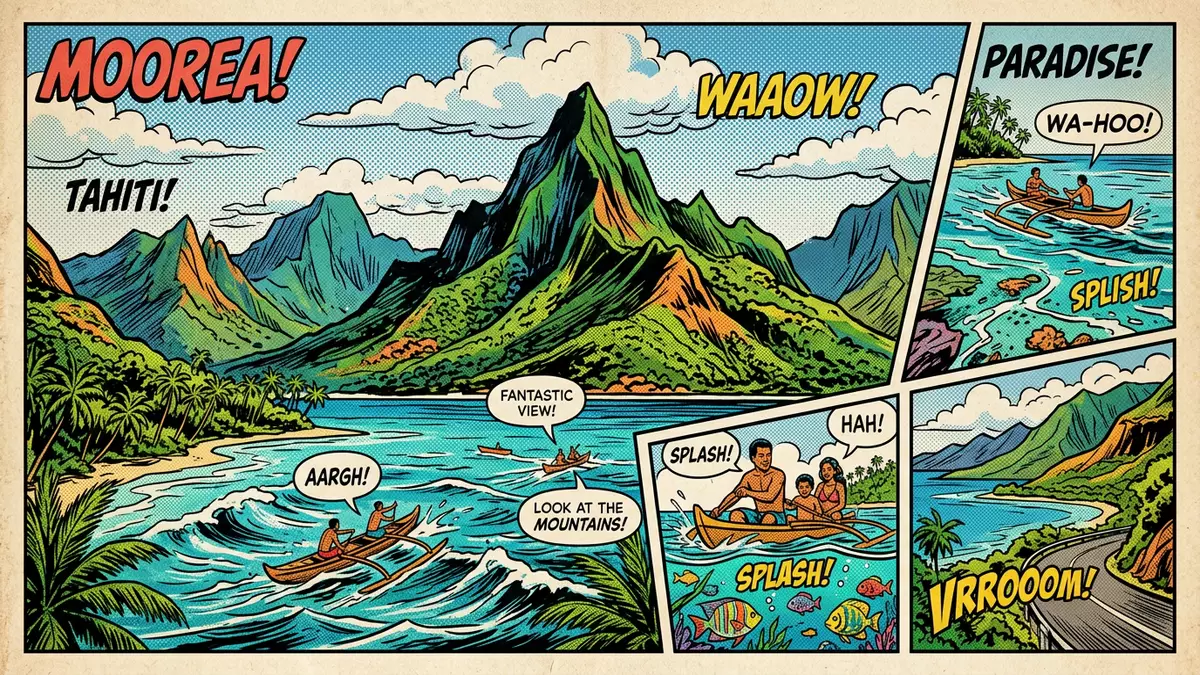
Moorea in French Polynesia is a compact volcanic island where jagged green peaks rise directly above a calm lagoon and deep-cut bays. Lying northwest of Tahiti in the Society Islands, it brings dramatic mountain ridges and sheltered coastal waters together in one small, easily grasped landscape.
A crown of mountains above a tropical lagoon
Moorea belongs to the Windward Islands group within the Society Islands archipelago, one of the main island chains of French Polynesia in the central South Pacific Ocean.Windward Islands group The island is volcanic in origin and preserves the steep outer slopes of an ancient, partly eroded volcano, giving its skyline a serrated, crown-like outline that is visible from the sea and from Tahiti.
The interior of Moorea is rugged and mountainous, with narrow ridges that fall sharply towards a fringe of coastal lowland. Streams run down from the high ground and have carved valleys that open towards the island’s bays, creating a clear progression from summit to lagoon along each valley floor.rugged and mountainous interior Offshore, a coral reef encircles much of the shoreline, enclosing shallow turquoise water between the reef and the land.
From ancient settlement to French Polynesia
Human settlement on Moorea reaches back many centuries, with archaeological evidence indicating occupation by Polynesian communities by around 800 AD.occupation by Polynesian communities These early inhabitants established coastal villages and inland ceremonial spaces, using the valleys and shore as the main settings of daily life. Stone temples known as marae were built in places such as the Opunohu Valley, marking Moorea as one of the centres of pre-Christian religious and political activity in the Society Islands.
European contact began in the eighteenth century, when expeditions led by figures including Samuel Wallis and Louis Antoine de Bougainville visited the island and gave it new names on their charts.eighteenth-century expeditions In the nineteenth century Moorea became closely linked with the history of Tahiti and the wider archipelago: it served as a refuge for King Pomare II in the early 1800s and later came under French protection, before being formally annexed by France in 1880 as part of what is now French Polynesia.annexed by France in 1880
An island of bays, villages and coastal roads
Moorea lies a short distance northwest of Tahiti, across a narrow strait, and the two islands form the largest members of the Windward Islands subgroup.largest members of the Windward Islands The outline of Moorea is roughly triangular, with two deeply indented bays on its northern side that cut into the land from the lagoon towards the interior. These bays provide natural harbours and anchor points for settlements and small ports.
A coastal road follows the low ground around Moorea, passing villages, small churches and agricultural plots that sit between the slopes and the lagoon. Inland, tracks and minor roads climb into the valleys, giving views back over the coral reef and the line of peaks. The highest point on the island is Mount Tohivea, which rises above the central massif and anchors many views of Moorea’s skyline.Mount Tohivea
Visiting Moorea: what travellers from Western Europe should know
- Moorea is part of French Polynesia in the South Pacific and lies northwest of Tahiti; ferries and domestic flights link the island with Papeete on Tahiti.link the island with Papeete
- The terrain is mountainous, with steep ridges and valleys; roads and paths between coastal areas and interior viewpoints involve noticeable gradients and, in places, sustained climbs on foot.mountain ridges dividing the island
- Lagoons and coral reefs fringe much of the coastline, and access to the water is generally via beaches, piers or boat jetties rather than long, straight harbour promenades.
- The official languages are French and Tahitian, and the currency is the Pacific franc (XPF).
- Entry requirements depend on your nationality; UK travellers can check the FCDO travel advice at gov.uk/foreign-travel-advice, Irish travellers the Department of Foreign Affairs at ireland.ie.
Searching for Moorea on social platforms
These links open searches for Moorea on each platform.Frequently asked questions about Moorea
Where is Moorea and how is it related to Tahiti?
Moorea is a volcanic island in French Polynesia, lying northwest of Tahiti in the Society Islands archipelago; together the two are the largest Windward Islands.
What kind of landscape should visitors expect on Moorea?
Visitors encounter steep volcanic peaks, deep-cut bays and a coastal fringe of villages, roads and beaches beside a lagoon that is largely enclosed by a coral reef.
What makes Moorea distinctive among the islands of French Polynesia?
Moorea stands out through the close pairing of a rugged mountainous interior and an accessible lagoon ring, all within a relatively small island that sits within sight of Tahiti.


