
Monument Valley’s sandstone towers above Oljato
Published on 09/09/2026 at 19:01 | Editorial responsibility: Rafael Müller, Editor-in-Chief AD HOC NEWS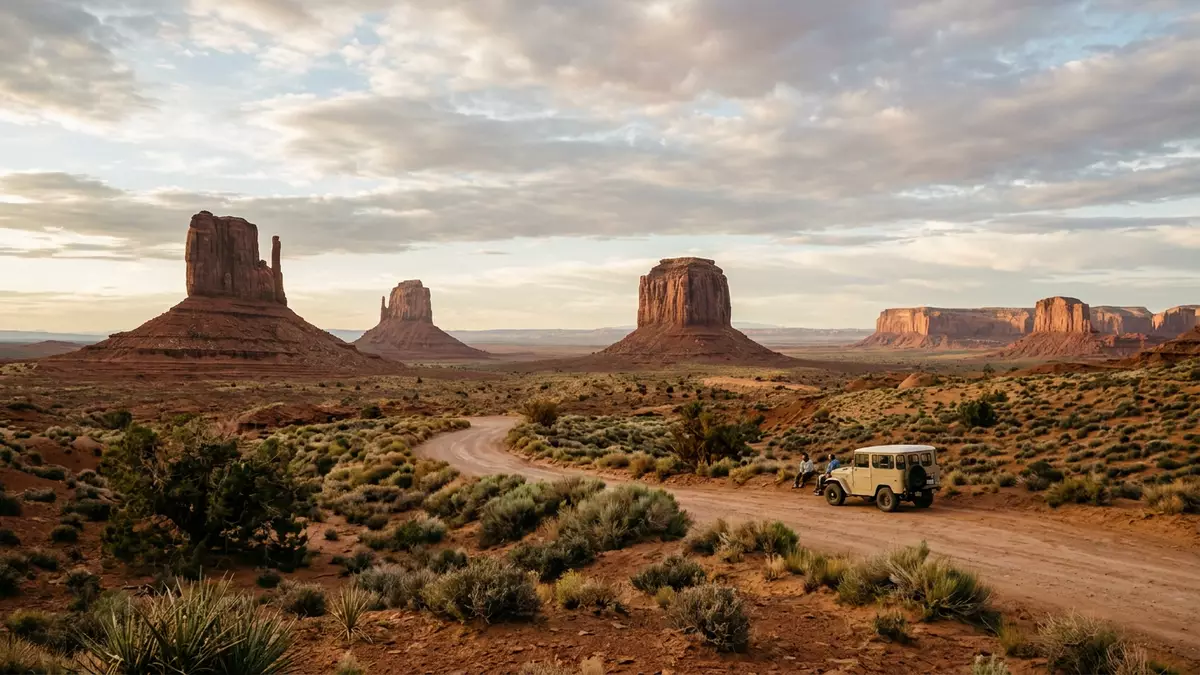
Monument Valley in Oljato, USA is a desert basin lined with rust-red sandstone towers that rise high above the Colorado Plateau and the Navajo Nation landscape. The valley floor sits around 1,500 to 1,800 m (4,900 to 5,900 ft) above sea level, framed by isolated buttes and mesas that record Permian and Triassic geology in their striped cliffs.elevation of the valley floor
Sandstone giants on the Colorado Plateau
Monument Valley lies near the centre of the Colorado Plateau, close to the border between Utah and Arizona, where the plateau surface breaks into mesas, buttes, spires and pinnacles.near the center of the Colorado Plateau The valley forms part of Navajo Nation land and is organised as Monument Valley Navajo Tribal Park, with the buttes and mesas rising from a broad sandy basin.
The towers are erosional remnants of sedimentary rock layers that once covered the region, carved into isolated monoliths as wind and water stripped away softer material. The largest sandstone buttes rise roughly 300 m (about 1,000 ft) above the valley floor, their flat tops and sheer sides forming the silhouettes familiar from countless Western films.1,000-foot sandstone buttes Around them, broad talus slopes of red siltstone sweep down onto the sandy plain, giving the entire basin a deep, rust-coloured hue.
Layered rock: Organ Rock, de Chelly and Moenkopi
Each major butte in Monument Valley reveals three principal rock layers: a soft base of Organ Rock shale or siltstone, a middle cliff-forming unit of de Chelly Sandstone, and an upper cap of Moenkopi shale and Shinarump Conglomerate.Organ Rock, de Chelly and Moenkopi These formations span the Permian and Triassic periods, representing environments that ranged from floodplains to dune fields and braided rivers tens of millions of years apart.
The broad, sloping lower reaches of the monuments consist mainly of Organ Rock Shale, a dark red mudstone and siltstone deposited on ancient floodplains.Organ Rock Shale floodplain deposits Above them, the sheer vertical faces are formed by massive de Chelly Sandstone, an aeolian sandstone laid down as wind-blown dunes. The uppermost ledges and mesa tops are capped by Moenkopi strata and the very erosion?resistant Shinarump Conglomerate, whose hardness slows the retreat of the cliffs and preserves the isolated towers.Moenkopi and Shinarump caprock
From lowland basin to carved valley
Long before the present landscape emerged, the area of Monument Valley formed part of a lowland basin where sediments from the ancestral Rocky Mountains accumulated over hundreds of millions of years.lowland basin filled with sediment These layers were slowly buried, compacted and lithified into sandstone, siltstone and shale. Later uplift of the Colorado Plateau raised the rock to its current high elevation, exposing it to intense erosion.
For roughly the last 50 million years, streams, rivers, rain and wind have cut into the plateau and peeled away softer rock, sculpting the mesas, buttes and pinnacles that define Monument Valley.erosion over the last 50 million years The valley’s vivid red coloration comes from iron oxide in the weathered siltstone and sandstone, while darker blue?grey streaks and varnish on many cliffs are linked to manganese oxide.iron and manganese oxide colours Together, these colours emphasise the stepped profiles of the towers, where resistant caprock stands above gentler slopes undermined by erosion.
Visiting Monument Valley: what travellers from Western Europe should know
- Monument Valley lies in the desert of south?eastern Utah near the Arizona state line, reached by road along US Route 163 and local approaches from Oljato.
- The terrain consists of a high desert basin with soft sand underfoot and unshaded stretches, with viewpoints and tracks crossing gently sloping ground beneath the buttes.
- Monument Valley sits within Navajo Nation land, and local Navajo?run guiding services and community facilities play a central role in organising access around the tribal park.
- The official language in the area is English alongside Navajo, and the currency is the United States dollar (USD).
- Entry requirements depend on your nationality; UK travellers can check the FCDO travel advice at gov.uk/foreign-travel-advice, Irish travellers the Department of Foreign Affairs at ireland.ie.
Searching for Monument Valley on social platforms
These links open searches for Monument Valley on each platform.
Frequently asked questions about Monument Valley
Where is Monument Valley located?
Monument Valley lies on Navajo Nation land near Oljato in south?eastern Utah, close to the border with Arizona on the high Colorado Plateau.
What should visitors expect on a visit?
Visitors encounter a high?elevation desert basin with rust?red sand, isolated sandstone buttes rising hundreds of metres, and wide views across mesas and pinnacles.
What makes Monument Valley distinctive?
Monument Valley is distinctive for its tall, flat?topped sandstone towers built from Organ Rock, de Chelly and Moenkopi formations, standing as erosional remnants above the Navajo Nation desert.


