

Montjuic, Barcelona’s hillside of fortresses, art and sport
Published on 09/01/2026 at 22:16 | Editorial responsibility: Rafael Müller, Editor-in-Chief AD HOC NEWS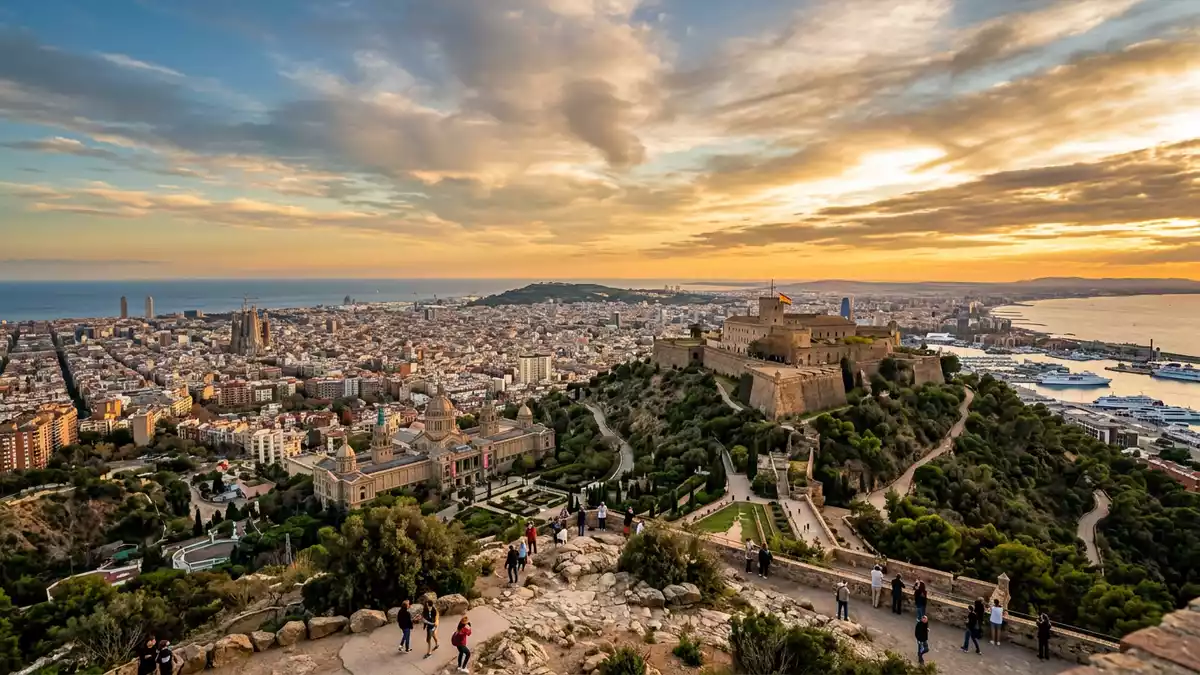
Montjuic is a broad hill on the south-west side of Barcelona, overlooking the city and the harbour with a visible mix of fortress walls, exhibition palaces, gardens and sports venues. Rising above the urban grid, it carries the Castell de Montjuïc at its summit and the Palau Nacional on its slopes, two landmarks that anchor the skyline and connect military history with Catalan art from the medieval period through the twentieth century.
Montjuic: a hill shaped by fortifications and exhibitions
The name Montjuic is linked to a medieval Jewish cemetery, which gave rise to the description “Jewish mountain” for the hill above Barcelona’s port.medieval Jewish cemetery Long before modern Barcelona expanded around it, the slope served as a vantage point over the harbour and surrounding plain, making it a natural site for defensive structures and later for showpiece buildings.
At the highest point stands Montjuic Castle, a stone fortress whose core dates from the seventeenth century, when a permanent stronghold was established during the conflict known locally as the Reapers’ War in 1640.stronghold established in 1640 Later works in the eighteenth century gave the castle its present outline of bastions and ramparts. From the outer walls and terraces the view opens wide across Barcelona, the industrial port and the coastline, underlining how closely the fortress is tied to control of the harbour approaches.
The Palau Nacional and Catalan art on the slope
On the central slope of Montjuic, the Palau Nacional forms one of Barcelona’s most conspicuous buildings, facing the city with a broad façade and domes rising above cascades and terraces. The palace was constructed for the International Exposition of 1929 and designed in a historicising style that draws on Spanish Renaissance forms, with colonnades, towers and sculpted ornament overlooking the ceremonial avenues below.constructed for the International Exposition of 1929
The Palau Nacional now houses the Museu Nacional d’Art de Catalunya (MNAC), the national museum dedicated to Catalan visual art.Museu Nacional d’Art de Catalunya Inside, galleries trace Catalan art from Romanesque frescoes and medieval church painting through Gothic, Renaissance and Baroque works to modernisme, noucentisme and later movements. The building’s position on Montjuic, with terraces stepping down towards Plaça d’Espanya, means that exterior staircases and platforms become part of the visit, linking the museum to fountains, exhibition pavilions and landscaped slopes.
Gardens, Olympic venues and cultural institutions
Beyond the castle and the Palau Nacional, Montjuic’s slopes carry a dense concentration of gardens, cultural institutions and sports venues. Among them is the Fundació Joan Miró, a museum dedicated to the Catalan artist Joan Miró, which holds paintings, sculptures and graphic works in a light-filled building set within parkland.Fundació Joan Miró Nearby, Poble Espanyol occupies a corner of the hill as an open-air architectural museum, where reconstructed streets and squares present stylised versions of buildings from different regions of Spain, a legacy of the 1929 exposition.
Montjuic also holds major facilities from the 1992 Summer Olympic Games, including the Olympic Stadium and surrounding sports complex, which reused and extended structures from the early twentieth century.facilities from the 1992 Summer Olympic Games Together with theatres such as the Greek Theatre and extensive parkland, these venues give the hill a layered character: military stonework on the summit, exhibition palaces on the central terraces, stadiums and pools further along, and a sequence of viewpoints, paths and planted areas connecting them.
Visiting Montjuic: what travellers from Western Europe should know
- Montjuic rises south-west of Barcelona’s historic centre, above the city’s harbour; it is reached by urban roads, buses, the Funicular de Montjuïc and cable cars linking lower districts with the summit.
- The terrain involves sustained gradients, long outdoor staircases and paths that climb between terraces, gardens and fortifications, so moving around the hill means repeated ascents and descents on foot.
- Several districts lie close to Montjuic, including the area around Plaça d’Espanya at the foot of the Palau Nacional and the waterfront quarter near the harbour cable car’s lower station.
- The official language is Spanish (alongside Catalan) and the currency is the euro.
Searching for Montjuic on social platforms
These links open searches for Montjuic on each platform.
Frequently asked questions about Montjuic
Where is Montjuic in relation to Barcelona?
Montjuic is a broad hill on the south-west side of Barcelona, rising between the city’s central districts and the harbour and forming a distinct height above the urban area.
What can visitors expect on a visit to Montjuic?
A visit to Montjuic combines fortress architecture at the summit, the Palau Nacional and the National Art Museum on the slope, gardens, cultural venues and Olympic sports facilities linked by paths and terraces.
What makes Montjuic distinctive among Barcelona’s sights?
Montjuic is distinctive for bringing together military structures, grand exhibition palaces, major museums and Olympic venues on a single hill, with wide views across Barcelona and the Mediterranean from many points.


