

Montjuic, Barcelona’s hillside of art, sport and views
Published on 08/26/2026 at 21:44 | Editorial responsibility: Rafael Müller, Editor-in-Chief AD HOC NEWS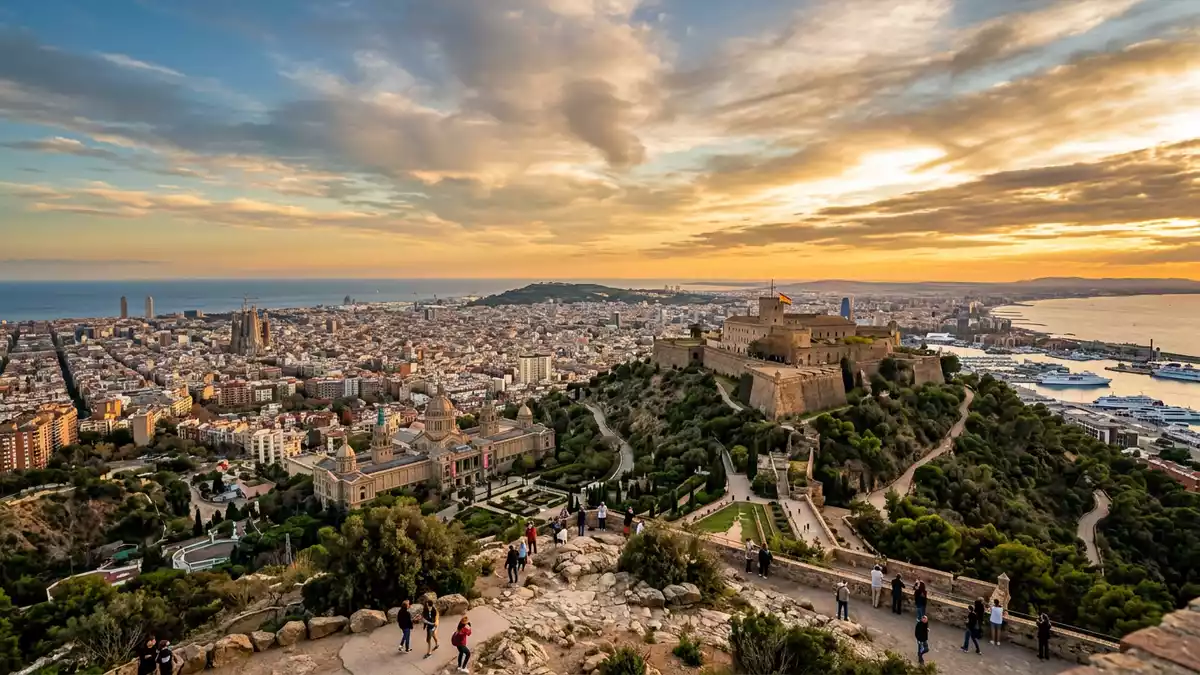
Montjuic is the broad hill that rises above the seafront of Barcelona, carrying gardens, museums and Olympic venues across its terraces while the Castell de Montjuic watches from the summit. Rooted in medieval history yet reshaped in the twentieth century, it brings together fortified walls, exhibition palaces and sports arenas on one continuous slope.
A city hill shaped by history and exhibitions
Montjuic stands to the south-west of Barcelona’s central districts, forming a long ridge between Plaça d’Espanya and the commercial port. The name refers to “Jewish mountain” in Catalan, linked to a medieval Jewish burial ground on the hill, a reminder that this piece of topography has carried human structures for many centuries.Jewish burial ground
The most visible historic structure is Castell de Montjuic, the fortress that crowns the highest part of the hill with ramparts, bastions and open courtyards. Its military character is a product of the early modern and nineteenth centuries, when the hill’s altitude above the harbour gave strategic control over the city and the sea. Later, in the twentieth century, Montjuic became a setting for grand exhibitions, most notably the 1929 International Exposition, which left behind palaces and stairways that still define large parts of the slope today.1929 International Exposition
Palau Nacional, museums and gardens on the slopes
One of the most striking buildings on Montjuic is the Palau Nacional, a grand palace built in the late 1920s that now houses the National Art Museum of Catalonia (Museu Nacional d’Art de Catalunya, MNAC). Its broad staircase and cascading fountains climb up from Plaça d’Espanya, leading the eye to domes and towers that stand against the skyline.Palau Nacional Inside, MNAC presents collections ranging from Romanesque mural painting and Gothic altarpieces to modern Catalan art, turning the hill into one of Barcelona’s key centres for visual culture.
Nearby lies the Magic Fountain of Montjuic, a large water feature installed for the 1929 exposition. Its basins and jets sit below the Palau Nacional, framed by formal steps and avenues, and form part of a sequence of public spaces that connect the exhibition area with the rest of the city.Magic Fountain Elsewhere on the hill, Poble Espanyol presents a compact village of streets and squares with buildings representing architectural styles from different regions of Spain, while cultural institutions such as Fundació Joan Miró and Mercat de les Flors sit within landscaped surroundings.
Olympic legacy and ways up the hill
Montjuic’s sporting side is a result of the 1992 Summer Olympics, when the Estadi Olímpic Lluís Companys and other facilities were modernised and integrated into the hillside. The main stadium stands within an earlier structure dating from the late 1920s, enlarged and adapted for the Games, and is accompanied by arenas, swimming venues and open plazas that look out over Barcelona.Estadi Ol%C3%ADmpic Llu%C3%ADs Companys These sports structures form a second layer of Montjuic’s architecture, distinct from the palaces and gardens yet sharing the same slopes.
The hill is reached by several forms of transport. The Montjuïc Funicular, opened in 1928, rises from the Paral·lel metro station on lines L2 and L3 and connects the city’s underground network with the upper part of the hill.Montju%C3%AFc Funicular From near its upper station, the Telefèric de Montjuïc gondola lift continues up to the vicinity of Montjuic Castle along an aerial route of about 750 m (2,460 ft), providing elevated views of the port, the city grid and the Mediterranean.Telef%C3%A8ric de Montju%C3%AFc
Visiting Montjuic: what travellers from Western Europe should know
- Montjuic rises south-west of central Barcelona between Plaça d’Espanya and the city’s port, and can be reached by metro to Paral·lel followed by the Montjuïc Funicular.
- The hill is extensive and layered, with long slopes, staircases and terraced paths; visiting different areas involves walking on gradients and climbing flights of steps.
- Road access reaches the upper sectors, and bus line 150 connects the area near the funicular’s upper station with Castell de Montjuic along the crest of the hill.
- The official language is Catalan and Spanish, and the currency is the euro (EUR); card payments are accepted widely in Barcelona.
Searching for Montjuic on social platforms
These links open searches for Montjuic on each platform.
Frequently asked questions about Montjuic
Where is Montjuic in Barcelona?
Montjuic is the hill that rises south-west of central Barcelona, between Plaça d’Espanya and the city’s harbour, forming a broad ridge above the seafront.
What should visitors expect on a first visit to Montjuic?
Visitors encounter a large hillside with Castell de Montjuic at the summit, museums such as MNAC on the slopes, formal stairs, gardens and Olympic sports venues.
What makes Montjuic distinctive among Barcelona’s districts?
Montjuic combines a fortress, exhibition palaces, art museums and Olympic facilities on one continuous hill, offering elevated views and a mix of culture and sport.


