
Montjuic, Barcelona’s hill of gardens, art and memory
Published on 09/19/2026 at 21:59 | Editorial responsibility: Rafael Müller, Editor-in-Chief AD HOC NEWS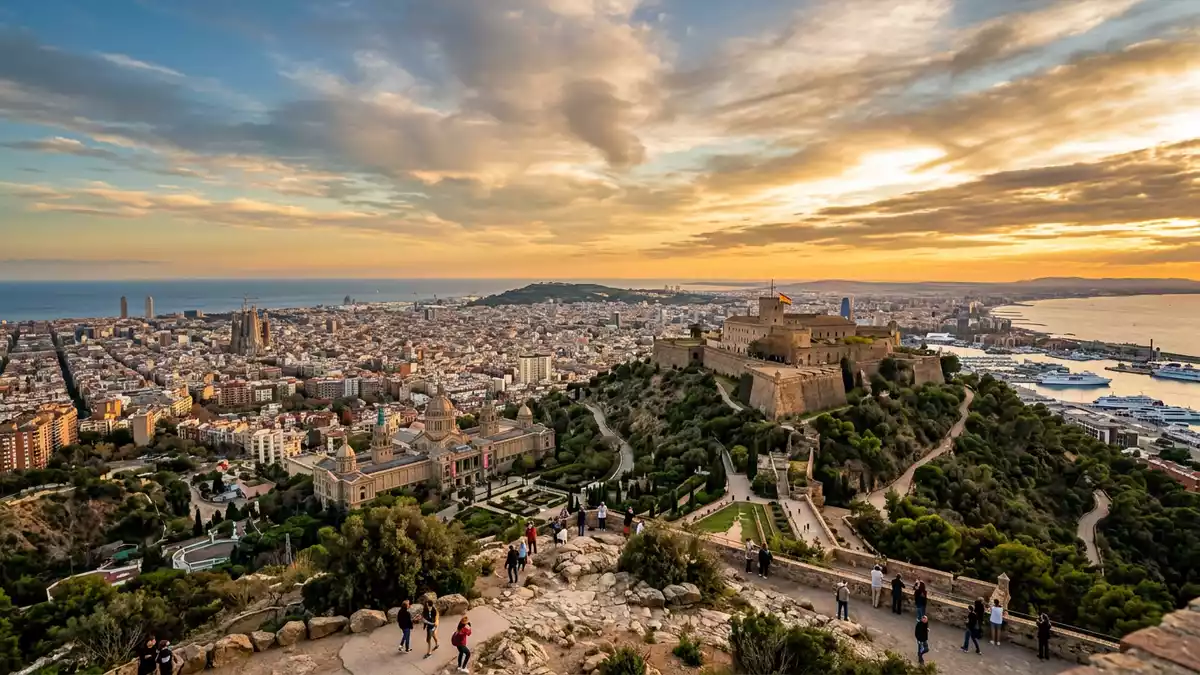
Montjuic is the broad, green hill that rises above Barcelona’s harbour, carrying gardens, museums, sports venues and a former fortress on its slopes. Its name is linked to a medieval Jewish cemetery, and its present character reflects the transformations of the twentieth century, particularly the 1929 International Exposition and the 1992 Olympic Games.Montjuic hill
A Mediterranean hill shaped by centuries
Montjuic stands close to the coastline and the mouth of the Llobregat River, giving it a strategic position above the city and the sea.Strategic location Archaeological traces link the hill to Iberian and Roman periods, when it served as a quarry for Barcelona’s stone walls.Roman quarry for the city
The name Montjuic is connected to a Jewish necropolis established on the western slope around the late eleventh century.Jewish cemetery origin In the seventeenth century the summit acquired a military fortress, later rebuilt in the eighteenth century as the Castell de Montjuic, which overlooked Barcelona and became entwined with episodes of political repression.Castell de Montjuic history
From exposition palaces to Olympic arenas
The twentieth century gave Montjuic its dense concentration of landmarks. In 1929 the hill hosted Barcelona’s International Exposition, a world fair that left behind grand structures such as the Palau Nacional, the venue that now houses the Museu Nacional d’Art de Catalunya (MNAC).Palau Nacional and MNAC The same event produced the broad ceremonial approach from Plaça d’Espanya, the Magic Fountain and exhibition buildings reused for museums.
Montjuic’s sports architecture is closely associated with the 1992 Summer Olympic Games. The Estadi Olímpic, originally linked to the 1929 Exposition, was renovated to serve as the main stadium, and the surrounding area became the Anella Olímpica, with swimming pools and indoor arenas forming a compact ring of sports facilities.Estadi Olímpic Lluís Companys The Olympic and Sports Museum Joan Antoni Samaranch completes this cluster by presenting material on sporting history within the same hilltop setting.Olympic and Sports Museum
Gardens, museums and the castle on the slopes
Much of Montjuic today forms a park landscape of lawns, paths and themed gardens. The hill includes botanical gardens and spaces such as the Mossèn Costa i Llobera Gardens, which focus on Mediterranean and semi-desert plant collections.Gardens on Montjuic Within this greenery stand cultural institutions including the Museu Nacional d’Art de Catalunya, the Museu Etnològic and the archaeological museum housed in a former exhibition palace.Museums on the hill
The Fundació Joan Miró occupies a prominent position among the museums on Montjuic. Conceived by the Catalan artist Joan Miró and architect Josep Lluís Sert, it opened to the public in 1975 and presents a large collection of Miró’s works in a building that draws on rationalist architecture.Fundació Joan Miró Above the gardens and museums, the Castell de Montjuic remains at the summit as a former military fortress, its walls and cannons recalling a period when the hill served as a place of imprisonment and execution during conflicts such as the Spanish Civil War.Fortress and political history
Visiting Montjuic: what travellers from Western Europe should know
- Montjuic rises south-west of Barcelona’s historic centre above the port area, and is reached by urban transport including the Funicular de Montjuïc from the Paral·lel metro station.Funicular de Montjuïc access
- The terrain combines paved avenues with garden paths and staircases; routes between the lower exhibition area and the summit involve noticeable gradients and, in some sections, long flights of steps.
- A cable car, the Telefèric de Montjuïc, links the funicular station with higher points on the hill, including the area near the castle, and offers elevated views over Barcelona and the sea.Cable car connection
- The hill contains a large cemetery on one flank, known as Cementiri del Sud-Oest or Montjuïc Cemetery, which includes the graves of figures such as Lluís Companys and Francesc Macià.Montjuïc Cemetery
- Spain’s official language in this region is Spanish alongside Catalan, and the national currency is the euro (EUR).
Searching for Montjuic on social platforms
These links open searches for Montjuic on each platform.
Frequently asked questions about Montjuic
Where is Montjuic in Barcelona?
Montjuic is the large hill south-west of Barcelona’s central districts, rising between the city and the Mediterranean harbour and bordered by the Llobregat River corridor inland.
What can visitors expect on Montjuic?
Visitors encounter a combination of landscaped parks, major museums such as MNAC and Fundació Joan Miró, a castle at the summit, Olympic sports facilities and wide views over Barcelona.
What makes Montjuic distinctive among Barcelona’s sights?
Montjuic is distinctive because it concentrates centuries of history, from a Jewish cemetery and a military fortress to exposition palaces and Olympic venues, across a single extensive hilltop landscape.


