
Monte Alban and the vast Zapotec city above Oaxaca
Published on 08/31/2026 at 13:59 | Editorial responsibility: Rafael Müller, Editor-in-Chief AD HOC NEWS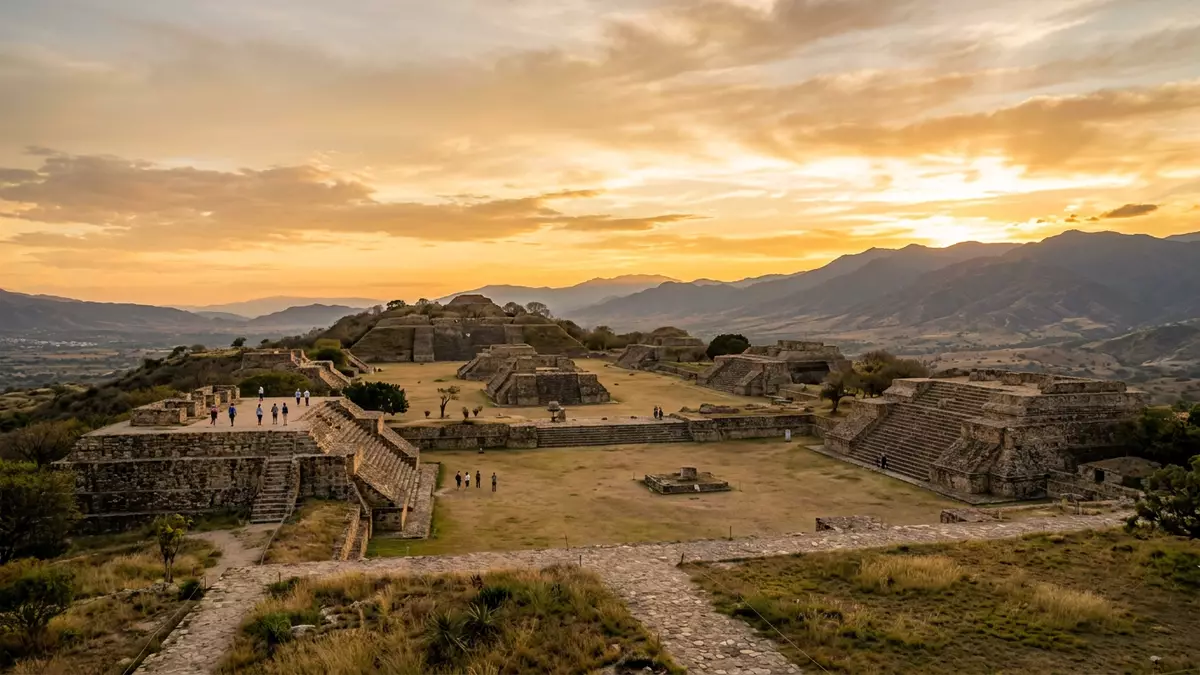
High on a flattened ridge above Oaxaca in southern Mexico, Monte Alban forms an expansive pre-Columbian city laid out along a broad ceremonial plaza rather than a compact pyramid complex. Built as the main urban centre of the Zapotec civilisation and later occupied by Mixtec groups, it presents a long urban history in stone terraces, platform mounds and plazas dating from the Middle Preclassic period into the Terminal Classic era.Monte Alban in Oaxaca
The great plaza on a levelled mountain
Monte Alban occupies the summit of a mountain in the central valleys of Oaxaca, where builders carved terraces, dams, canals, pyramids and artificial mounds directly from the ridge and surrounding slopes.terraces, pyramids and canals The centre of the site is a large rectangular plaza, edged by monumental platform mounds at the north and south and punctuated by freestanding structures within the open space. This arrangement, elevated hundreds of metres above the valley floor, creates a continuous architectural surface of cut stone and stepped platforms rather than a single focal pyramid.
The surrounding slopes carry long series of cultivation terraces that once supported the wider city and its fields, extending the built landscape far beyond the core plaza.cultivation terraces on the slopes Archaeological surveys describe an urban area covering around 6.5 km² (2.5 sq mi), with architecture and terraces descending towards the junction of three valleys, giving Monte Alban a setting where distant mountains and valley settlements remain visible from the ceremonial centre.urban area of 6.5 square kilometres
Zapotec capital, Mixtec reoccupation and long urban life
Archaeologists place the foundation of Monte Alban in the sixth century BCE, during the Middle Preclassic, when Zapotec groups established a planned city on the mountain ridge overlooking the valleys.founded in the sixth century BCE As the Zapotec capital, the city flourished between about 500 BCE and 800 CE, forming an economic, political and religious centre with plazas, truncated pyramids, palaces and residential terraces that together expressed a stable ceremonial order over many centuries.grand Zapotec capital flourished
Occupation at Monte Alban spans roughly 1,500 years, with Olmec-related influences in the earliest phases and a later period in which Mixtec groups reused parts of the site after Zapotec political power declined.inhabited for over 1,500 years Excavated tombs and carved stone panels record changing artistic styles and hieroglyphic conventions across this long sequence, while architectural details show contact with other Mesoamerican centres, including Teotihuacan, during Monte Alban’s “Golden Age” in the first six centuries CE.Golden Age between 100 and 600 CE
Temples, ball court and carved stones
The monumental core of Monte Alban contains a ball court for the Mesoamerican game known in Nahuatl as tlachtli, with sloping walls framing a narrow playing alley and associated platforms.court for playing tlachtli Around the plaza, truncated pyramids support temples and other ceremonial buildings, while a distinctive structure known as Building J stands at an oblique angle to the grid of the main plaza and carries hieroglyphic inscriptions related to place names and possible conquests.Building J with inscriptions
On one side of the plaza, a group of relief panels known as “Los Danzantes” shows human figures carved in low relief, accompanied by glyphs that are among the earliest written records in Mesoamerica.Los Danzantes and Building J Elsewhere, the site includes numerous tombs, including Tomb 7, which yielded elaborate Mixtec grave goods and has been widely discussed in the context of metalwork and ceremonial regalia.about 170 tombs including Tomb 7 Together, these elements give Monte Alban a distinctive combination of open plaza, platform architecture, ball court and carved stones that can be explored on foot among the ruins.
Visiting Monte Alban: what travellers from Western Europe should know
- Monte Alban lies in the central valleys of Oaxaca in southern Mexico, on a mountain ridge west of Oaxaca de Juárez and near communities such as Santa Cruz Xoxocotlán and Santa María Atzompa.
- The archaeological zone occupies a high plateau with stepped approaches, uneven stone surfaces and broad open areas, so visiting involves walking on sloping terrain and climbing flights of steps between platforms.
- The site stands several hundred metres above the valley floor and offers wide views over the surrounding mountains and settlements, with exposed conditions that can feel intense under direct sun.
- The official language is Spanish and the currency is the Mexican peso.
- Entry requirements depend on your nationality; UK travellers can check the FCDO travel advice at gov.uk/foreign-travel-advice, Irish travellers the Department of Foreign Affairs at ireland.ie.
Searching for Monte Alban on social platforms
These links open searches for Monte Alban on each platform.
Frequently asked questions about Monte Alban
Where is Monte Alban and what kind of place is it?
Monte Alban is a large pre-Columbian archaeological site on a mountain ridge in the state of Oaxaca in southern Mexico, overlooking the central valleys.archaeological site in Oaxaca
What can visitors expect when exploring the ruins?
Visitors encounter a broad ceremonial plaza framed by platform mounds, truncated pyramids, a ball court, carved relief panels and extensive terraces, all reached by walking across uneven stone surfaces.
What makes Monte Alban distinctive among Mesoamerican sites?
Monte Alban stands out for its long occupation as the Zapotec capital, its mountaintop setting with carved terraces, and features such as Los Danzantes, Building J and rich tombs like Tomb 7.Zapotec capital on a carved mountain


