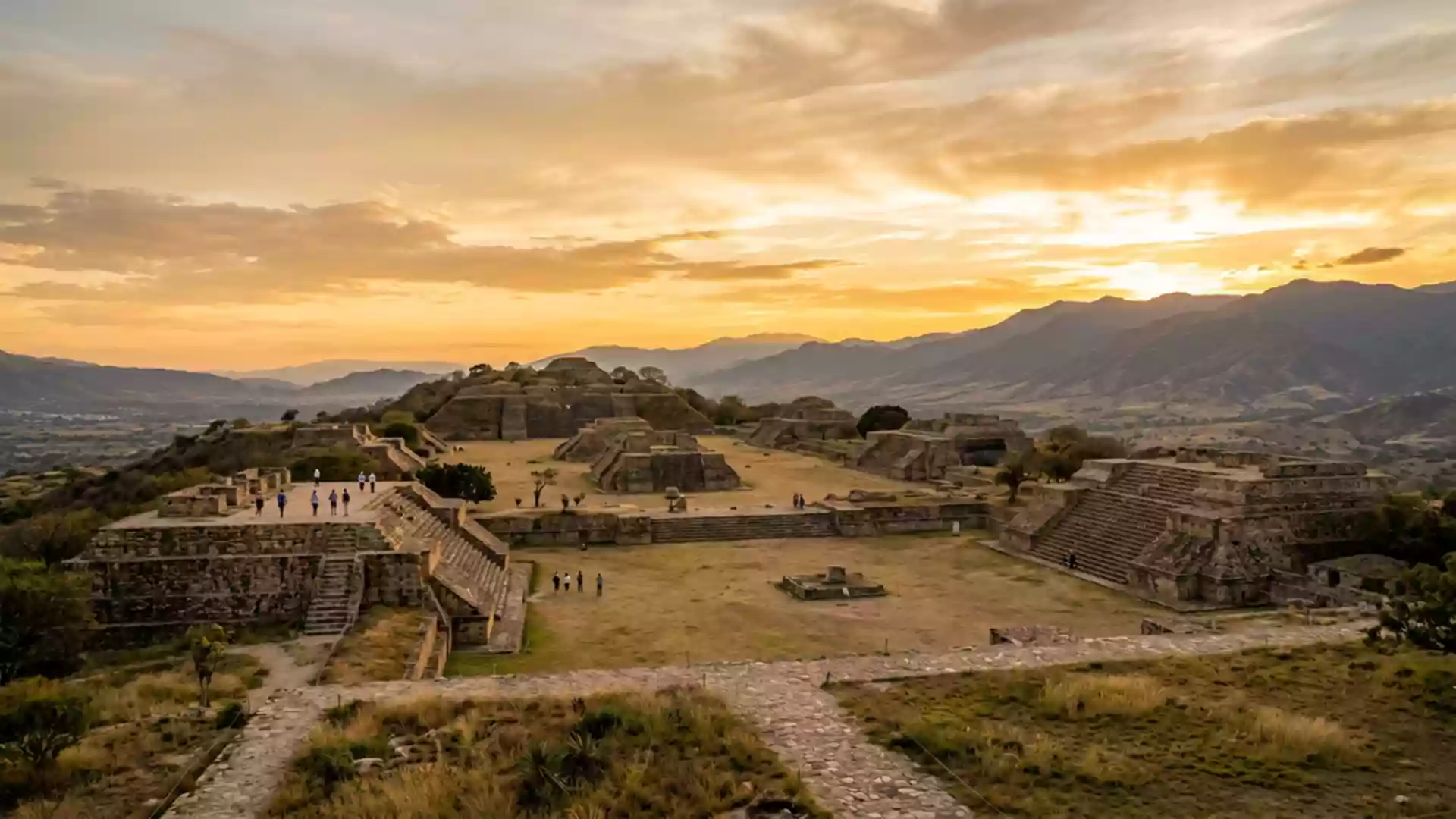
Monte Alban, a Zapotec mountain city above Oaxaca
Published on 08/26/2026 at 13:22 | Editorial responsibility: Rafael Müller, Editor-in-Chief AD HOC NEWS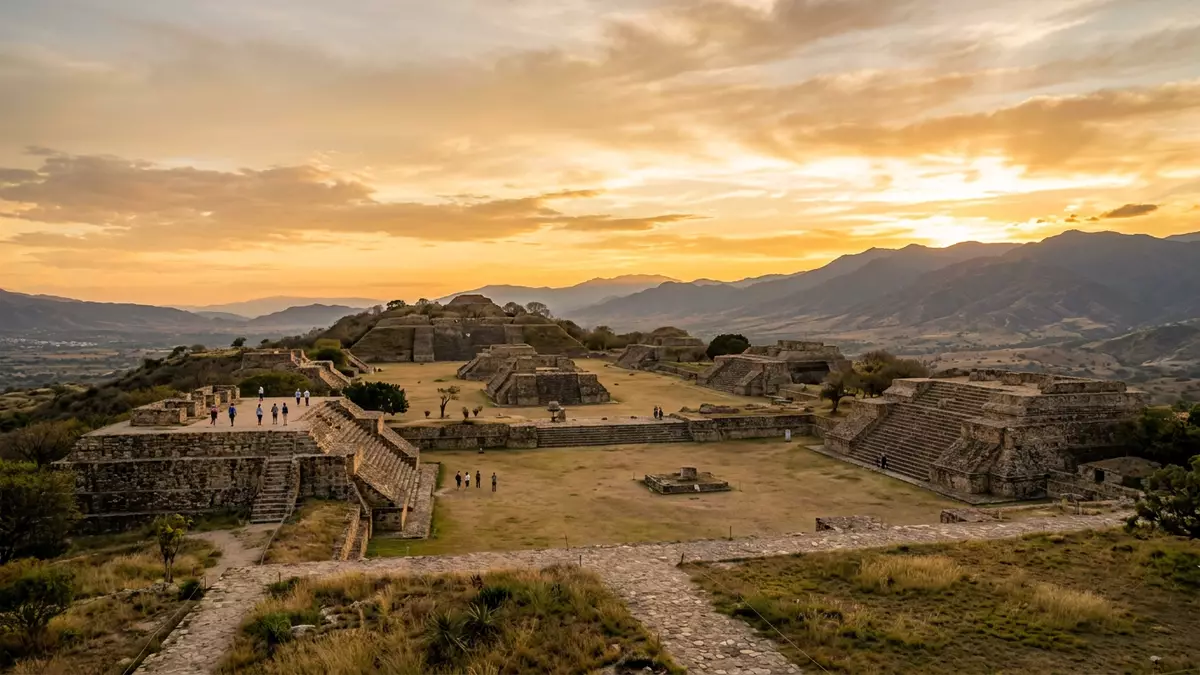
On a flattened ridge above the valleys around Oaxaca, Monte Alban unfolds as an ancient mountain city: a Zapotec urban centre carved directly into the spine of the hills. For more than a millennium it served as a political and ceremonial heart of southern Mexico, and its broad plaza, pyramids and terraces still dominate the landscape of the central valleys.
A Zapotec capital on a carved mountain
Monte Alban occupies the summit of a low mountainous range in the central section of the Valley of Oaxaca, where the valley’s northern, eastern and southern branches converge.central Valley of Oaxaca The site stands on a series of hills whose tops were levelled and reshaped into artificial platforms, creating an extensive man-made plateau ringed by steep slopes. From this height the built landscape looks out over the surrounding countryside and the distant silhouettes of the Sierra Madre ranges.
Archaeological work identifies Monte Alban as a major centre of Zapotec culture, founded in the sixth century BCE and functioning as their capital between about 500 BCE and 800 CE.Zapotec metropolis founded Over its long life the site was inhabited by successive peoples, including Olmec-related groups, Zapotec communities and later Mixtec occupants who reused many of the tombs and platforms.inhabited over 1,500 years The World Heritage listing for the “Historic Centre of Oaxaca and Archaeological Site of Monte Alban” dates to 1987, formalising its status as one of the most important archaeological zones of Mesoamerica.World Heritage inscription
The Great Plaza and the architecture of a mountain city
The core of Monte Alban is a broad open plaza, often called the Great Plaza, edged by platform mounds and pyramidal structures built in stepped forms.Great Plaza and platforms At the north and south ends of this space rise massive platforms with stairways leading to terraces and temples, forming architectural anchors to the urban plan. Around the plaza lie smaller buildings, palatial complexes and ceremonial structures that together give a clear sense of an organised city laid out on the mountain top.
Among the named features are the Ball Court for the ritual game known in Nahuatl as tlachtli, the group of carved stone slabs called Los Danzantes, and the distinctive Building J with its odd orientation in relation to the main plaza axis.ball court and carved stones Excavations have revealed underground passageways and numerous tombs, including elaborate chambered tombs reused by Mixtec elites.underground passageways and tombs Together with terraces cut into the slopes, dams and canals, these structures demonstrate that Monte Alban was not simply a ceremonial precinct but a planned urban environment spread over several square kilometres.architectural remains over wide area
Long history and cultural layers
The occupation history of Monte Alban reaches back to the Middle Preclassic period and runs through the Terminal Classic, with the principal Zapotec urban florescence centred between 500 BCE and 800 CE.Middle Preclassic to Terminal Classic In this era the city’s monumental architecture, extensive terracing and early writing systems developed, leaving a record of political authority and religious practice visible in carved monuments and sculpted reliefs.planned mountain city Later, as Zapotec power declined, parts of the site were occupied by Mixtec groups, who placed their own burials and offerings within existing tombs and buildings.Mixtec occupation
Monte Alban’s setting in the central valleys between the Sierra Madre Oriental and Sierra Madre del Sur gives context to its role as a regional centre.central valleys between ranges The site crowns Cerro del Jaguar, a hilltop around 1,500 m (4,921 ft) above sea level, with the city of Oaxaca lying below on the valley floor.Jaguar Hill elevation The wider World Heritage property links this archaeological zone with the historic centre of Oaxaca de Juárez, connecting the pre-Columbian mountain capital with the later colonial city in a single cultural landscape.combined World Heritage property
Visiting Monte Alban: what travellers from Western Europe should know
- Monte Alban lies on a mountaintop west of Oaxaca de Juárez in southern Mexico, reached from the city by mountain roads that climb towards Santa María Atzompa and the surrounding villages.roads from Oaxaca to Monte Alban
- The archaeological zone occupies a high plateau above the valley, with approaches that involve walking over uneven stone surfaces and climbing stairways on the platform mounds and pyramids.
- Monte Alban stands in Mexico; the official language is Spanish and the currency is the Mexican peso.
- Entry requirements depend on your nationality; UK travellers can check the FCDO travel advice at gov.uk/foreign-travel-advice, Irish travellers the Department of Foreign Affairs at ireland.ie.
Searching for Monte Alban on social platforms
These links open searches for Monte Alban on each platform.Frequently asked questions about Monte Alban
Where is Monte Alban and what kind of place is it?
Monte Alban is an archaeological site on a flattened mountaintop in the Valley of Oaxaca in southern Mexico, preserving the centre of an ancient Zapotec and Mixtec city.
What can visitors expect when walking around Monte Alban?
Visitors move across a broad plaza bordered by platform mounds, pyramids and terraces, with stairways, carved stones, a ball court and tomb entrances visible in the surrounding structures.
What makes Monte Alban distinctive among ancient sites in Mexico?
Monte Alban’s character lies in its planned mountain city layout, with monumental architecture and terraced slopes forming a single urban complex recognised as a UNESCO World Heritage Site.