

Mont-Saint-Michel and its abbey in granite and Gothic form
Published on 09/15/2026 at 07:33 | Editorial responsibility: Rafael Müller, Editor-in-Chief AD HOC NEWS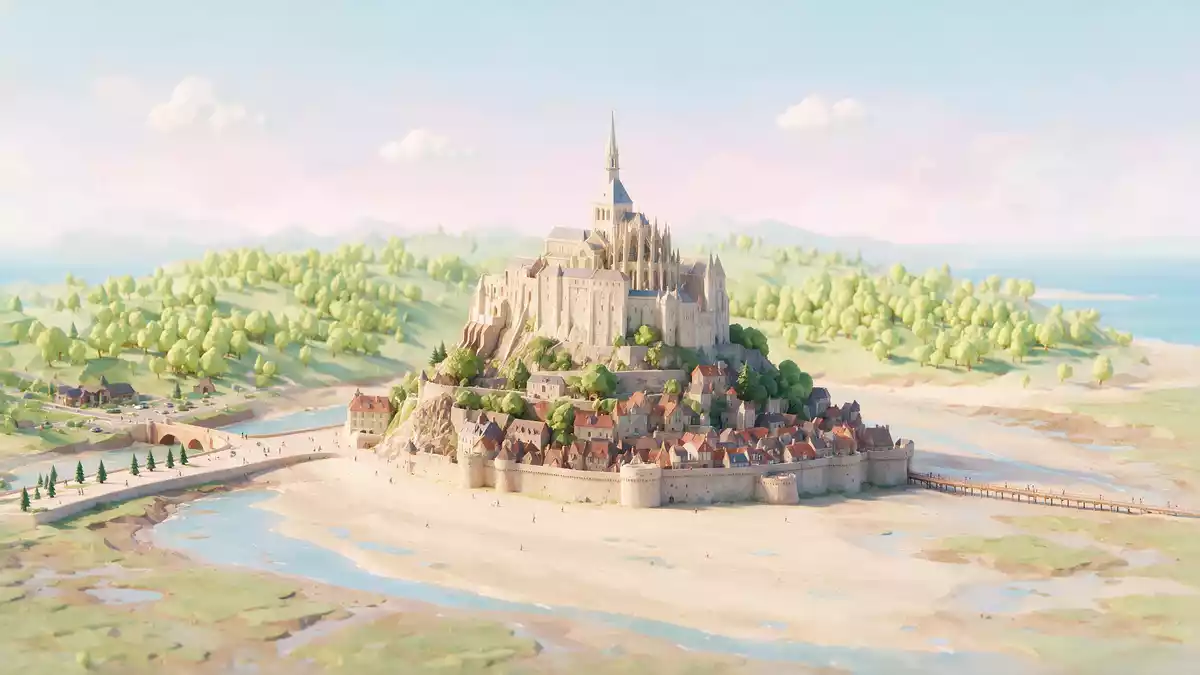
Mont-Saint-Michel rises from a rocky islet in the bay of the same name, with a Benedictine abbey and village clustered inside fortified walls. The place is UNESCO-listed, and its profile is defined by granite, vertical layers and a long medieval history.
A rocky islet shaped by abbey and village
The abbey on Mont-Saint-Michel was founded in 966, after an earlier sanctuary dedicated to the Archangel Michael had already stood here since 708. Its present form brings together Romanesque remains, Gothic height and a village that grew within the walls.
The UNESCO listing describes the site as a Gothic-style Benedictine abbey on a rocky islet between Normandy and Brittany. That combination of sacred building, settlement and exposed setting is the main reason the silhouette is so distinctive.
Romanesque masonry and Gothic height
The older parts include pre-Romanesque fabric and the Romanesque nave, where the crossing rests on the summit of the rock. Granite masonry and flat bricks appear in Notre-Dame-sous-terre, a small church from the tenth century.
Above that base, Gothic builders created the high walls, open volumes and steep masses that give the abbey its profile. The site also includes the Merveille, a later monastic complex built from 1204, and the flamboyant choir begun in 1448.
A pilgrimage site with a long medieval life
Mont-Saint-Michel was a place of pilgrimage throughout the Middle Ages, and the abbey also became a centre for manuscripts. The monastery’s history is linked to Richard I of Normandy, who installed Benedictine monks here in 966.
The site later changed function and served as a prison from 1790 until 1863. Its medieval fabric survived that period, and the abbey remains one of the clearest architectural records of layered religious building in northern France.
Visiting Mont-Saint-Michel: what travellers from Western Europe should know
- The site stands in Normandy, close to the border with Brittany, and the bay opens towards the Channel coast. Access is by road to Le Mont-Saint-Michel, with a footbridge linking the island to the mainland approach.
- The abbey rises in layers above narrow lanes, stairways and ramparts. A visit involves steps and sloping paths, rather than level ground.
- The official language is French and the currency is the euro.
- The bay is a tidal landscape, with water and sandbanks around the mount. The setting is exposed, and the island sits inside a wide maritime plain.
- Entry requirements depend on your nationality; UK travellers can check the FCDO travel advice at gov.uk/foreign-travel-advice, Irish travellers the Department of Foreign Affairs at ireland.ie.
Searching for Mont-Saint-Michel on social platforms
These links open searches for Mont-Saint-Michel on each platform.
Frequently asked questions about Mont-Saint-Michel
Where is Mont-Saint-Michel?
Mont-Saint-Michel stands in Normandy, close to Brittany, on a rocky islet in its bay. The commune is Le Mont-Saint-Michel.
What does a visit involve?
The route through the site includes the village streets, ramparts and abbey levels. Steps and sloping passages are part of the experience.
What makes Mont-Saint-Michel distinctive?
Its distinctiveness comes from the pairing of a Benedictine abbey with a fortified settlement on a tidal rock. Romanesque remains, Gothic forms and the bay setting all belong to the same ensemble.


